-
Skyzenith
- February 16, 2026
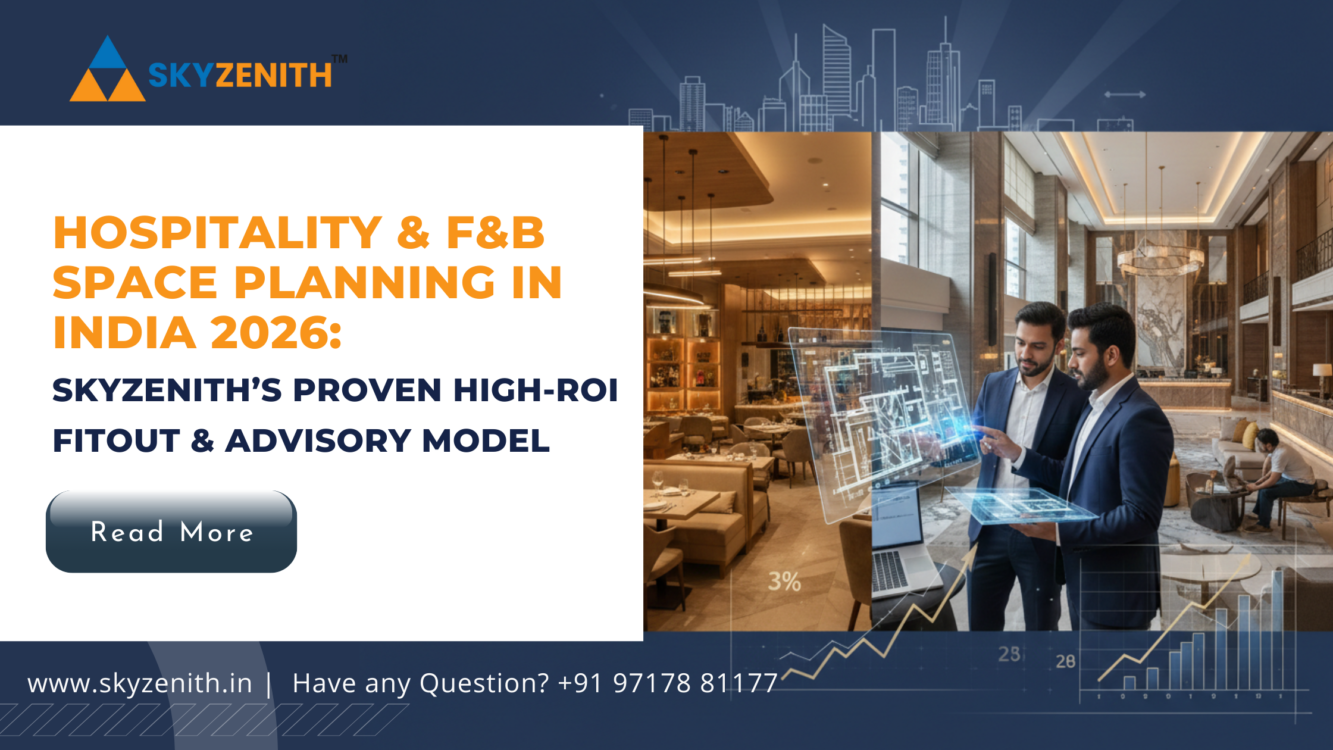
Hospitality & F&B Space Planning in India 2026: SkyZenith’s Proven High-ROI Fitout & Advisory Model.
There is a moment, just before a restaurant opens its doors for the first time, when every decision made over the preceding months converges into tangible form. The lighting temperature has been calibrated. The kitchen equipment has passed its commissioning tests. The seating layout has been walked repeatedly by managers rehearsing service sequences. And the exhaust hoods, having been verified for capture efficiency, stand ready for the first orders to fire.
What separates establishments that thrive from those that merely survive is rarely visible to the dining guest. It is not the elegance of the pendant lighting or the tactility of the tabletop surfaces. It is the spatial intelligence embedded within the floor plan the relationship between kitchen door and service station, the distance from prep line to plating pass, the circulation pathways that separate guest experience from operational necessity.
In India’s 2026 hospitality landscape, where urban real estate commands unprecedented premiums and consumer expectations have never been more sophisticated, space planning has emerged as the definitive competitive differentiator. This is the story of how strategic fitout advisory is reshaping restaurant economics, and why discerning brand owners now commission space planners before they engage architects.
The New Economics of Hospitality Real Estate
India’s food service sector has undergone profound structural transformation. The proliferation of organised retail, the maturation of dining-out culture, and the integration of global hospitality standards have elevated consumer expectations while compressing operator margins.
Consider the mathematics confronting a contemporary restaurant operator. Prime high-street locations in metropolitan centres command rents calculated on per-square-foot benchmarks that would have seemed implausible a decade ago. Pre-opening fitout expenditures, even for modest formats, regularly exceed initial capital projections. And the revenue window for achieving operational breakeven has contracted as investors demand accelerated return timelines.
In this environment, every square metre must earn its allocation. Every seat must turn with optimal frequency. Every linear metre of kitchen line must support demonstrable throughput capacity. The era of designing spaces first and adapting operations second has concluded. What remains is a discipline in which operational modelling precedes architectural expression.
Hospitality space planning in 2026 begins not with mood boards but with pro forma financial statements. Seating capacity is calibrated against projected average checks and targeted table turnover rates. Kitchen footprints are sized according to menu complexity and anticipated cover volumes. Storage allocations reflect procurement cycles and supply chain dependencies. The design emerges from the business plan, not the reverse.
The Space Planning Paradox: Density Without Diminishment
The central tension in hospitality design has always been the reconciliation of operational efficiency with guest experience. Maximum seating density supports revenue optimisation, yet excessive proximity diminishes perceived value and discourages extended dwell time. Efficient service circulation requires dedicated pathways, yet every square metre allocated to back-of-house represents revenue opportunity foregone.
Contemporary F&B space planning resolves this paradox through evidence-based configuration rather than intuitive arrangement.
Leading practitioners now deploy sophisticated analytical tools to inform spatial decisions. Digital twin modelling simulates guest arrival patterns, queue formation, and table turnover sequences under varied service scenarios. Thermal comfort mapping identifies seating zones prone to draughts or temperature stratification. Acoustic modelling predicts sound pressure level distribution across dining areas, enabling strategic placement of absorptive treatments.
The objective is not merely to maximise covers but to optimise the relationship between capacity and experience. A restaurant configured for eighty comfortable guests consistently outperforms a venue straining to accommodate one hundred patrons in compromised conditions. Repeat visitation, positive word-of-mouth, and sustainable pricing power flow from environments that respect guest comfort while achieving operator yield targets.
Kitchen Engineering: The Profit Centre Paradigm
Traditional hospitality project delivery has often marginalised kitchen planning, treating food production areas as necessary utilities rather than revenue-generating assets. This perspective has proven increasingly untenable as menu complexity expands and labour availability contracts.
Restaurant kitchen design in 2026 recognises the production space as the engine room of hospitality profitability. Every incremental reduction in preparational distance, every optimisation of pick-path efficiency, and every ergonomic refinement in work station configuration translates directly to labour productivity enhancement and service velocity improvement.
The integrated kitchen planning methodology employed by sophisticated advisory practices addresses multiple performance dimensions simultaneously:
Throughput engineering examines the relationship between equipment specification, work sequence, and production volume. A wok range positioned fifteen centimetres closer to the plating pass, repeated across five hundred daily covers, saves kilometres of chef travel annually. A cold station configured with undercounter refrigeration eliminates sixty weekly trips to the walk-in cooler.
Ventilation integration ensures that exhaust capture performance supports uninterrupted service during peak periods. Inadequate hood specification or compromised duct design forces kitchen temperature elevation, chef fatigue, and eventual service retardation. Modern planning embeds mechanical engineering within architectural programming, not appended as afterthought.
Hygiene accessibility incorporates cleanability into every design decision. Coved cove bases, sealed equipment undersides, and accessible interstitial spaces transform sanitation from labour-intensive campaign to integrated operational routine.
The Compliance Architecture: Navigating India’s Regulatory Matrix
Hospitality facility development in India requires navigation through a complex regulatory architecture spanning municipal building codes, state food safety statutes, fire service regulations, and environmental clearance requirements. Each jurisdiction maintains distinct interpretation and enforcement practices.
Commercial kitchen compliance has consequently emerged as a specialised advisory discipline. Successful project delivery demands not only technical knowledge of applicable standards but contextual understanding of regional regulatory variation.
Fire safety compliance exemplifies this complexity. National Building Code provisions establish baseline requirements for kitchen exhaust construction, fire suppression integration, and access panel provision. Yet local fire service interpretations of these requirements vary significantly across states and even municipal corporations. A duct specification approved in Gurugram may attract requisitions in Bengaluru. A suppression system configuration accepted in Hyderabad may require modification in Mumbai.
Experienced hospitality advisors maintain current intelligence on regional regulatory practices, engaging authorities early in design development rather than confronting objections during final approval stages. This proactive compliance architecture compresses project timelines, eliminates costly retrofits, and provides operators with verified certification packages satisfying insurer underwriting requirements.
Material Strategy: Durability, Maintainability, Brand Expression
The material palette specified for hospitality environments must satisfy competing imperatives. Aesthetic expression must communicate brand positioning and create atmospheric differentiation. Operational durability must withstand intensive utilisation and rigorous sanitation protocols. Lifecycle economics must balance initial capital outlay with long-term maintenance expenditure.
High-ROI fitout practice approaches material selection as strategic decision rather than aesthetic preference.
Flooring specifications illustrate this discipline. Hospitality venues subject floor finishes to extraordinary demands: constant pedestrian traffic, frequent liquid exposure, heavy equipment movement, and aggressive cleaning chemicals. The optimal flooring solution balances slip resistance, chemical durability, installation cost, and replacement interval. Porcelain tiles offer exceptional longevity but demand meticulous substrate preparation. Polished concrete delivers seamless aesthetics but requires disciplined curing protocols. Luxury vinyl provides acoustic comfort and rapid installation but presents limitations in high-heat zones.
Wall protection strategies similarly reflect operational intelligence. Corner guards, crash rails, and impact-resistant sheeting in service corridors and equipment transport pathways prevent cumulative damage that necessitates premature refurbishment. Strategic allocation of these protective elements preserves aesthetic integrity in guest-facing areas while ensuring functional durability in operational zones.
Flexibility Architecture: Designing for Menu Evolution
The contemporary hospitality operator faces unprecedented menu volatility. Culinary trends cycle at accelerating velocity. Supply chain disruptions necessitate ingredient substitutions. Delivery and takeaway channel growth has introduced packaging workflows and pick-up staging requirements unforeseen at original design conception.
Future-ready F&B environments embed adaptive capacity within their spatial DNA.
Modular furniture systems permit reconfiguration of dining room layouts in response to changing party size distributions or service format evolution. A venue configured primarily for four-top dining can readily adapt to accommodate solo guest counters or communal banquet arrangements without structural intervention.
Kitchen infrastructure designed for reconfiguration enables menu evolution without facility replacement. Modular equipment suites on castor mounting permit rearrangement of production workflows. Prefabricated utility distribution systems allow new equipment integration without wall chasing or ceiling demolition.
This adaptability preserves asset relevance and defers major capital expenditure. Venues designed for flexibility command superior valuation multiples and attract discerning operator tenants committed to sustained brand currency.
The Integrated Delivery Imperative
Hospitality project delivery has historically suffered from professional fragmentation. Architects design. Interior designers specify. Kitchen consultants engineer. Contractors construct. Facility operators inherit.
Integrated project delivery dissolves these artificial boundaries, assembling multidisciplinary teams aligned around shared performance objectives from project inception.
The integrated model transforms role definitions. Architects contribute spatial intelligence informed by operational modelling. Interior designers specify materials selected through lifecycle cost analysis. Kitchen consultants coordinate equipment integration with architectural systems. Contractors provide constructability input during design development rather than post-tender value engineering.
This collaborative methodology compresses project schedules, eliminates coordination-generated variation orders, and delivers facilities calibrated for operational performance from opening day.
The Performance Verification Mandate
Contemporary hospitality owners increasingly demand evidence-based verification of design efficacy rather than aesthetic satisfaction alone.
Post-occupancy evaluation programmes measure actual operational performance against projected benchmarks. Table turnover rates, kitchen throughput velocities, and energy consumption intensities are quantified and compared against design targets. Discrepancies trigger diagnostic investigation and remedial refinement.
This performance verification discipline transforms hospitality space planning from intuitive art to evidence-based science. Each project generates empirical intelligence informing subsequent assignments. Best practice accumulates systematically rather than residing within individual practitioner intuition.
Conclusion: The Integration of Art and Analysis
The hospitality environments that distinguish India’s 2026 dining landscape reflect an unprecedented synthesis of creative expression and analytical rigour. They are beautiful, certainly but their beauty serves a commercial purpose. They are welcoming, unquestionably yet their warmth is calibrated to optimise dwell time and spending propensity.
This integration of art and analysis defines contemporary hospitality space planning. It recognises that restaurant environments are not static installations for passive contemplation but dynamic instruments for value creation. Every design decision either enhances or compromises the venue’s capacity to generate sustainable returns.
The brands that will lead India’s hospitality sector through the remainder of this decade recognise this fundamental truth. They commission space planners before architects. They validate design concepts against operational models. They evaluate fitout proposals through lifecycle cost frameworks rather than initial capital comparison. And they select advisory partners capable of delivering not merely beautiful spaces but commercially optimised assets.
SkyZenith
SkyZenith is a distinguished commercial real estate advisory and retail strategy firm headquartered at Spaze Platinum, Sohna Road, Gurgaon. The company delivers comprehensive solutions for hospitality and F&B brand development, encompassing space planning, fitout project management, regulatory compliance advisory, and operational performance optimisation. Its unique value proposition lies in the integration of strategic financial modelling with technical design expertise, ensuring that every spatial decision serves measurable commercial objectives. SkyZenith’s advisory methodology combines evidence-based planning, lifecycle cost engineering, and rigorous project delivery discipline to produce hospitality environments that achieve superior return on investment. The firm serves national and international restaurant groups, hotel developers, and institutional food service operators seeking to establish or expand their presence across India’s dynamic hospitality landscape.
Contact SkyZenith
Address: Spaze Platinum, Sohna Road, Gurgaon
Email: Hemraj.dabur@skyzenith.in
Phone: +91 97178 81177
Website: https://skyzenith.in/