-
Skyzenith
- June 12, 2026
Smart Building Solutions in India: Building Automation, IoT Integration, Energy Management & Sustainable Smart Infrastructure for Future-Ready Commercial Buildings by SkyZenith
This transformation is not a distant future concept; it is happening now across India’s metropolitan skyline. From biometric access to AI-controlled energy systems, the country’s buildings are becoming intelligent, connected, and self-optimising. Commercial hubs are investing heavily in automation because it significantly reduces long-term operational costs. By connecting critical systems, HVAC, lighting, security, and fire safety, into a single, data-driven network, these buildings are shifting from reactive maintenance to a proactive, intelligent operating model.
This shift is underpinned by staggering market momentum. The India Building Automation & Control Systems market, valued at USD 3.46 billion in 2025, is projected to nearly double, reaching USD 7.87 billion by 2034, growing at a robust CAGR of 9.55%. Even more telling is the surge in Intelligent Building Management Systems (IBMS), with the market expected to grow at an impressive CAGR of 24.10% to reach USD 92.16 billion by 2035. This growth is fueled by rapid urbanisation, the expansion of commercial real estate, and a sharp focus on operational efficiency and occupant comfort.
The Technological Core: Building Automation, IoT, and AI Integration
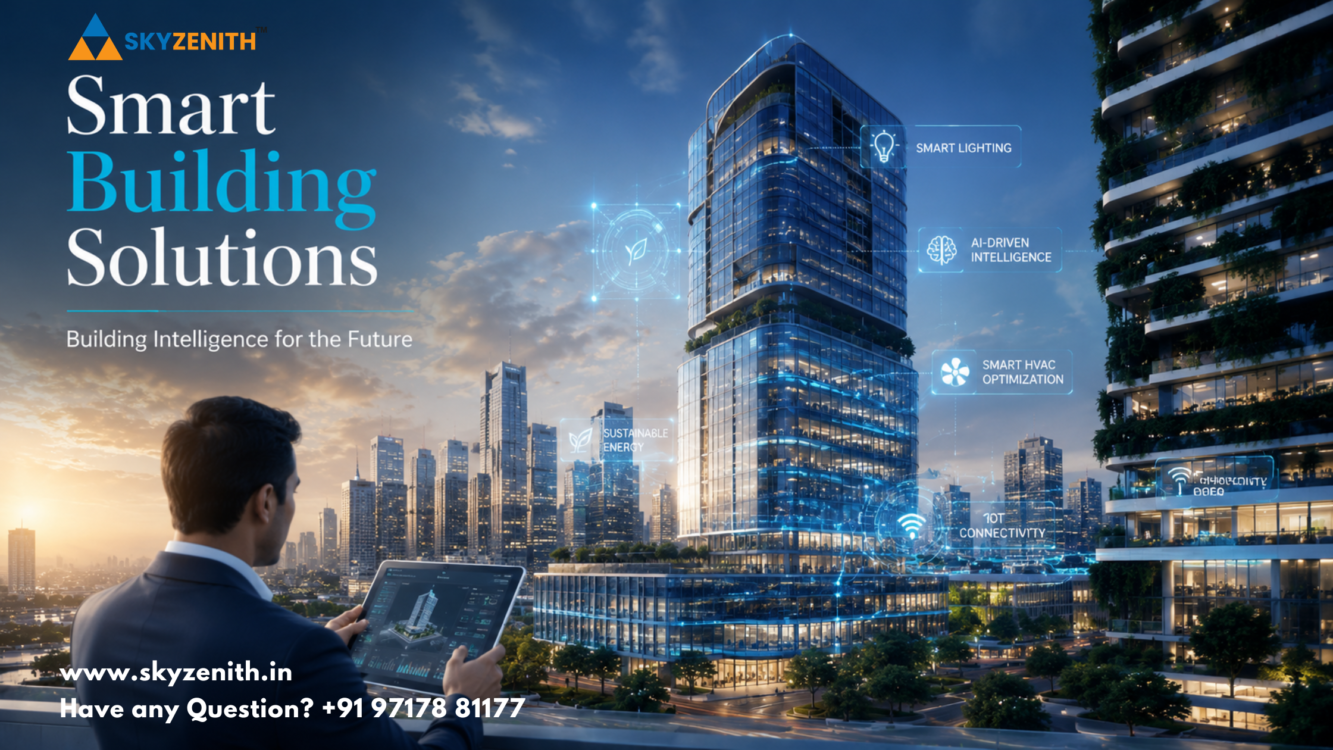
The magic of a smart building lies in its invisible nervous system, which is built on three interconnected pillars: building automation, IoT integration, and artificial intelligence. At the heart of this ecosystem is the Integrated Building Management System, a central platform that connects sub-systems like HVAC, lighting, security, and energy meters into a unified whole. This integration allows for real-time monitoring and control, transforming data into actionable insights for facilities managers.
The Internet of Things (IoT) acts as the building’s digital senses. A network of sensors monitors energy usage, occupancy, air quality, and equipment performance, feeding real-time data to the central platform. Artificial Intelligence is the brain, processing this vast amount of data to enable advanced capabilities like predictive maintenance, dynamic energy load balancing, and AI-driven control logic that continuously learns and improves efficiency. For example, AI can automatically adjust building controls based on weather forecasts, real-time occupancy, and utility prices, fine-tuning operations at the zone level for optimal performance.
Orchestrating Efficiency: Advanced Energy Management Strategies
Energy management is the primary driver of the smart building revolution, turning a major operational expense into a strategic asset. Modern strategies go far beyond static schedules, leveraging the integrated IBMS to achieve unprecedented savings.
Demand-Controlled Ventilation (DCV) is a key technique where CO2 and occupancy sensors dynamically adjust fresh air intake, ensuring optimal air quality without wasting energy on empty spaces. For lighting, intelligent systems integrate daylight harvesting with lux sensors and occupancy-based switching, dimming or turning off lights when natural light is sufficient or when a zone is vacant. Smart grids further enable sophisticated peak demand and load management, while a new wave of APIs allows legacy buildings to connect to cloud-based analytics, achieving typical energy savings of 15-25% without massive capital expenditure.
Building for Tomorrow: Sustainable and Future-Ready Infrastructure
The drive towards smart buildings is inextricably linked to India’s national push for sustainability. The government has established a robust framework, including the Energy Conservation Building Code (ECBC), which defines mandatory energy performance standards, and the National Building Code (NBC), which now mandates a 30% reduction in energy use. Furthermore, comprehensive green rating systems like GRIHA and LEED India encourage resource efficiency, which are now supported by tax rebates and low-interest green finance.
This is complemented by a commitment to building future-ready infrastructure. The Union Cabinet’s approval of 12 new smart industrial cities under the National Industrial Corridor Development Programme, backed by a ₹28,602 crore investment, is a major catalyst. These cities are designed on a plug-and-play model, mandating the integration of ICT-enabled utilities and sophisticated building management systems to support global manufacturing standards. The result is a new generation of sustainable infrastructure designed to be resilient, efficient, and adaptive.
Conclusion: The Intelligent Blueprint for India’s Future
The era of the passive building is over. As the Indian government enforces stricter building codes and sustainability mandates, developers and owners are recognising that investing in smart building solutions is a competitive necessity. By embracing integrated automation, IoT, and AI, India is not just constructing taller structures but pioneering a future where buildings are safe, efficient, and truly intelligent. The blueprint for India’s tomorrow is digital, and it is being written in the language of smart, sustainable infrastructure.
About the Company
Based in Gurgaon, SkyZenith specialises in comprehensive commercial real estate advisory and leasing services, with a deep focus on maximising property value through strategic leasing for retail, hotel, and commercial office assets. Their core services include tenant sourcing, market intelligence, feasibility studies, and innovative lease negotiation, including revenue-sharing and turnover rent models. What distinguishes SkyZenith is its deep on-ground market relationships coupled with a sophisticated data-driven approach, enabling them to transform underperforming assets into high-yield investments for developers, institutional funds, and property owners across India.
Email: Hemraj.dabur@skyzenith.in Phone : +91 97178 81177