-
Skyzenith
- March 24, 2026
Fitout Management Checklist: How to Ensure a Hassle-Free Office Transformation
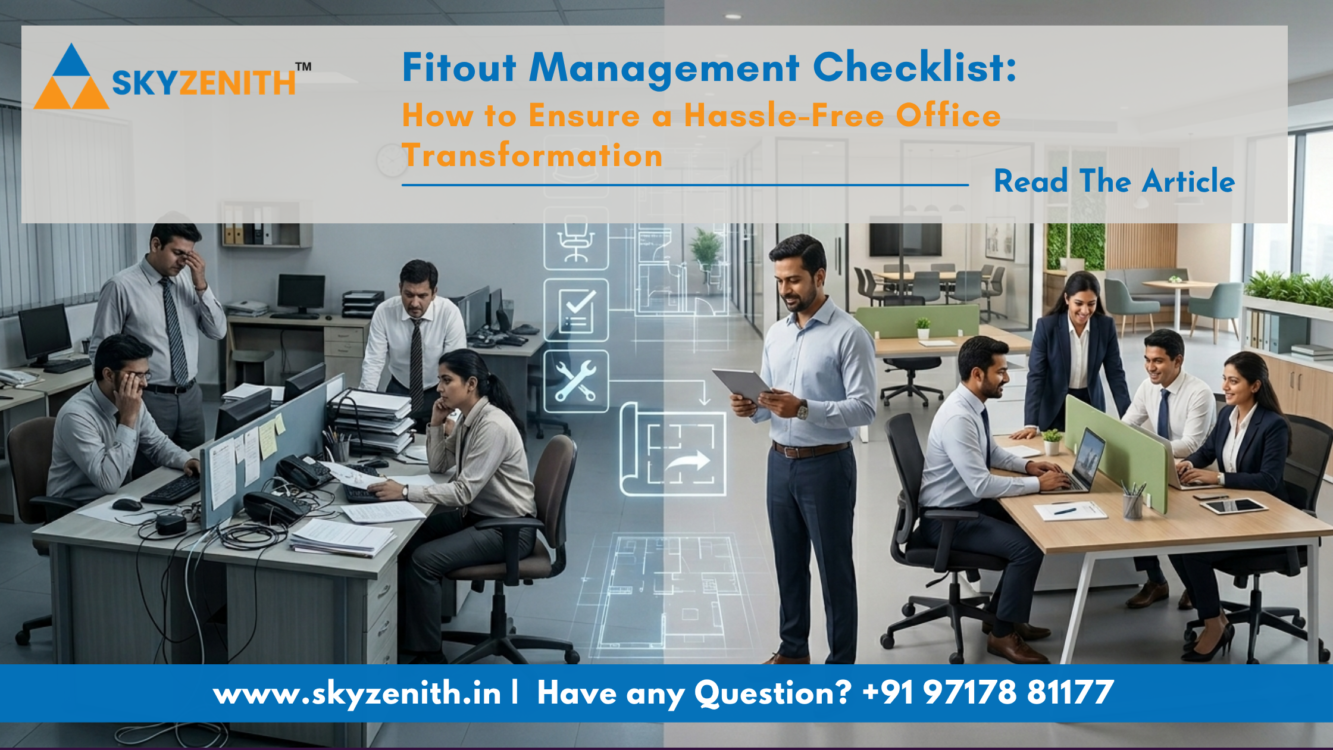
There is a moment in every growing organization when the walls begin to close in. Workstations that once felt spacious now feel cramped. Collaboration areas designed for casual conversation become overwhelmed by noise. The layout that served the company well for years no longer supports the way teams actually work. This is the moment when an office transformation moves from aspiration to necessity. Yet for many business leaders, the prospect of a fitout project evokes a familiar anxiety, disruption, delays, budget overruns, and the nagging fear that the finished space will fall short of expectations. The difference between a stressful ordeal and a seamless transformation lies not in luck but in preparation. A well-structured fitout management checklist transforms complexity into clarity, guiding organizations through every phase of the journey with confidence and precision.
Strategic Foundation: Defining Your Vision Before Breaking Ground
The most successful office transformations begin not with architectural drawings but with questions. What does your organization need this space to accomplish? How do your teams actually work? Where do collaboration, focus, and culture intersect in your daily operations?
This initial phase demands rigorous attention. Engage stakeholders across departments to understand their functional requirements, not merely their preferences. Sales teams may require acoustically private spaces for client calls. Creative teams may need writable surfaces and flexible configurations. Leadership may require spaces that accommodate both confidential conversations and visible presence.
Beyond function, consider the statement your space makes. An office is a physical manifestation of company culture. Does your current environment reflect your values? Does it support the talent you wish to attract and retain? Clarity on these strategic questions forms the foundation upon which every subsequent decision rests.
Establish a realistic timeline from the outset. A typical fitout project spans planning, design, approval, construction, and transition phases, each with its own dependencies. Understanding the full arc of the project prevents the common pitfall of underestimating the time required for critical steps such as municipal approvals and landlord coordination.
Design and Planning: Where Intentions Take Shape
With strategic clarity established, the design phase translates vision into measurable plans. This is where the expertise of experienced fitout professionals becomes indispensable. Engage a design team that understands not only aesthetics but also the technical complexities of commercial interiors, structural considerations, mechanical systems, and the intricate choreography of trades.
The design development process should yield comprehensive documentation that leaves no ambiguity. This includes detailed space plans, reflected ceiling plans, electrical layouts, millwork drawings, and material specifications. Ambiguity at this stage becomes conflict during construction. Precision in documentation protects against costly change orders later.
Material selection warrants particular attention. The choices made here affect not only appearance but also durability, maintenance requirements, indoor air quality, and project timeline. Lead times for specialized materials, custom millwork, imported finishes, specialized lighting, can extend for weeks or months. A proactive approach to procurement, initiated early in design, prevents delays that derail schedules.
Regulatory Navigation and Approvals
One of the most underestimated components of fitout management is the regulatory landscape. Commercial fitouts require a range of approvals that vary by jurisdiction, building type, and scope of work. These may include building permits, fire safety clearances, environmental health approvals, and landlord design reviews.
Each approval pathway carries its own timeline and requirements. Engaging with authorities early, submitting complete documentation, and maintaining open communication with building management prevents the delays that arise from last-minute discoveries. A knowledgeable fitout partner anticipates these requirements and builds them into the project schedule, ensuring that approvals align with construction timelines rather than becoming critical path obstacles.
Tendering and Contractor Selection
With approved plans in hand, the project moves to procurement. The selection of contractors and trades determines the quality, timeline, and budget performance of the entire project. A robust tendering process involves inviting qualified contractors to bid on clearly defined scopes of work, evaluating proposals not only on price but also on technical capability, past performance, and resource availability.
Resist the temptation to award based on lowest price alone. The contractor who submits the lowest bid may achieve that number by omitting essential scope, using lower-quality materials, or allocating insufficient resources. The true cost of a fitout includes not only the contract price but also the value of on-time delivery, quality workmanship, and responsive communication during construction.
Construction Management and Quality Control
The construction phase transforms plans into reality, and it is here that effective management separates successful projects from troubled ones. A structured approach to construction oversight includes regular progress meetings, documented quality inspections, and rigorous change management.
Establish a clear protocol for site access, working hours, and safety requirements before construction begins. Clear communication with building management and neighboring tenants prevents misunderstandings that can escalate into formal complaints or work stoppages.
Quality control requires vigilance. Inspect work at each stage, rough-in, insulation, drywall, finishes, before subsequent trades cover completed work. Deficiencies identified early can be corrected with minimal impact; those discovered after later work is complete incur significant cost and delay.
Budget Management and Contingency Planning
Even the most meticulously planned fitout encounters unexpected conditions. Behind existing walls, what appears on drawings may not match reality. Structural elements may require modifications. Supply chain disruptions may affect material availability. A realistic budget accounts for these uncertainties through a contingency reserve, typically ten to fifteen percent of construction costs, designated specifically for unforeseen conditions.
Budget management extends beyond tracking expenditures to anticipating cost implications of decisions. A change in layout may affect mechanical system requirements. A material substitution may alter installation complexity. Understanding these interdependencies allows for informed decision-making when adjustments become necessary.
Regular financial reporting provides visibility into commitments, expenditures, and remaining contingency. This transparency enables proactive management rather than reactive crisis response when budget pressures emerge.
Stakeholder Communication and Expectation Management
Throughout the fitout journey, communication with stakeholders, leadership, employees, building management, and project team members, requires intentional effort. Silence breeds speculation. Regular updates on progress, milestones achieved, and upcoming activities maintain confidence and reduce anxiety.
For employees who will occupy the space, communication serves an additional purpose: preparation. Early engagement helps teams understand what to expect, how their work may be affected during construction, and what changes await them in the new environment. This transparency builds acceptance and even enthusiasm for the transformation ahead.
Transition and Move Management
The final phase of fitout management focuses on the transition from construction to occupancy. Move management encompasses IT infrastructure installation, furniture placement, final cleaning, and the logistical choreography of relocating people and equipment.
A well-planned transition minimizes downtime. Staging the move by department or floor allows critical business functions to continue while other areas transition. Comprehensive testing of IT, audio-visual systems, and building controls before occupancy prevents the disruptions that arise from last-minute discoveries.
Post-occupancy evaluation completes the fitout process. After teams have settled into their new environment, assess whether the space performs as intended. Does it support the work patterns for which it was designed? Are there adjustments needed to optimize comfort and functionality? This feedback informs not only immediate refinements but also future projects.
Conclusion
An office transformation represents a significant investment, of capital, of time, and of organizational energy. The difference between a project that delivers lasting value and one that leaves frustration in its wake lies in the quality of preparation and management. A comprehensive fitout management checklist transforms complexity into a structured, manageable process. By attending to strategic foundation, design precision, regulatory navigation, contractor quality, construction oversight, and transition planning, organizations achieve spaces that truly serve their people and their purpose.
About SkyZenith
SkyZenith offers comprehensive fitout management and commercial real estate services designed to guide organizations through every phase of office transformation. With expertise spanning site selection, design coordination, contractor management, and move execution, SkyZenith provides the integrated support that ensures projects are delivered on time, within budget, and to the highest quality standards. Their approach combines technical expertise with a commitment to transparent communication, offering clients the confidence that comes from working with experienced professionals who understand the complexities of commercial interiors. From initial strategic consultation through final occupancy, SkyZenith delivers the clarity and control that transform office fitout from a source of anxiety into a strategic advantage.
Address: Spaze Platinum, Sohna Road, Gurgaon
Email: Hemraj.dabur@skyzenith.in
Phone: +91 97178 81177