-
Skyzenith
- May 5, 2026
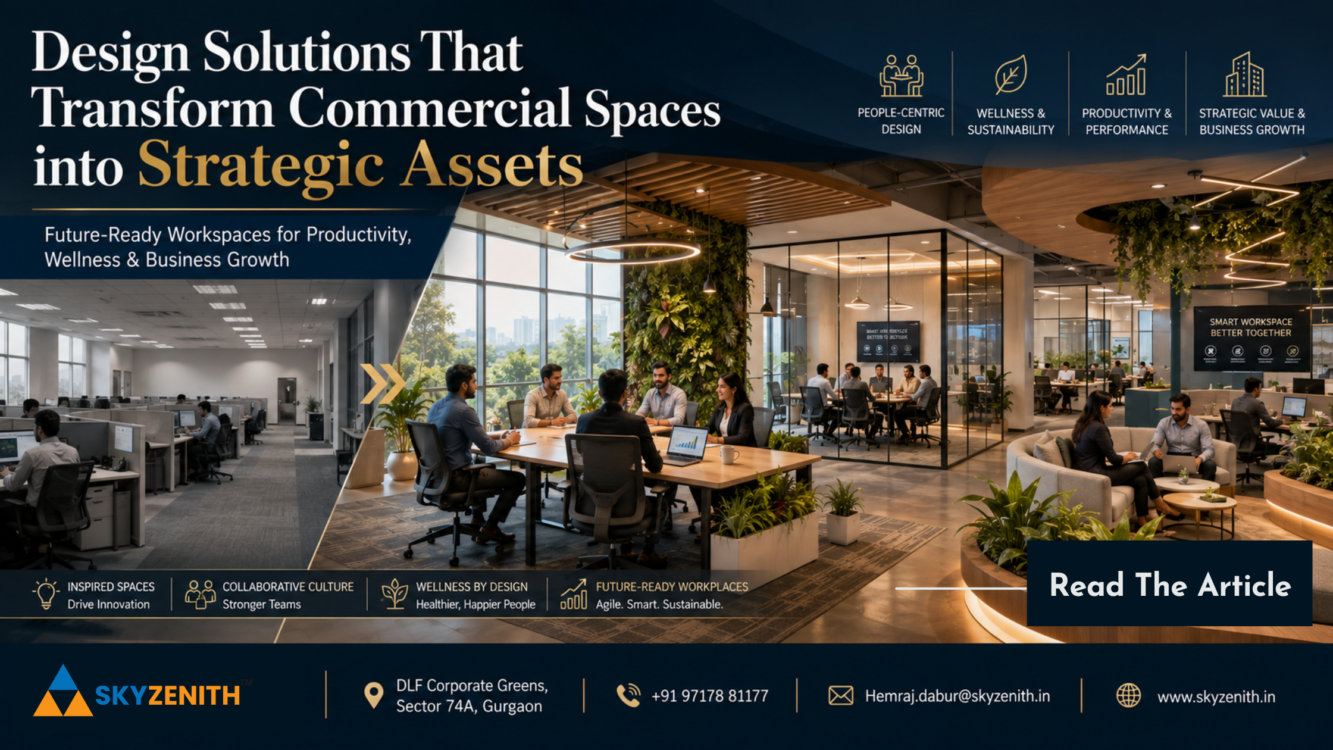
Design Solutions That Transform Commercial Spaces into Strategic Assets
The office was no longer drawing them in. Each morning, the silent, grey hallways felt more like a chore than a destination, a costly square footage of missed opportunities and disengaged talent. This is the quiet crisis unfolding across millions of square feet of commercial real estate: spaces designed for yesterday’s workforce failing to serve today’s strategic needs.
In 2026, the most valuable asset on a company’s balance sheet isn’t just its real estate, it’s how that space performs. Transforming a commercial interior from a static container into a dynamic, strategic asset is no longer an aesthetic choice; it is a fundamental business imperative demanding precision, data, and a deep understanding of human behavior.
The Return on Investment of ‘Strategic Space’
The shift from generic to strategic design is driven by hard economics. Today, financial feasibility has taken priority over pure aesthetic ambitions. Property owners and tenants are demanding tangible returns: improved employee retention, measurable productivity gains, and a space that actively builds brand equity.
This evolution has fundamentally altered the design workflow. What once allowed generous timelines for exploration has now compressed, making early decisions more consequential. Consequently, procurement strategy is now fully linked to design strategy, creating an integrated approach where every material and layout decision is validated by its contribution to the project’s viability and long-term value. The focus has shifted to designing with purpose, sequencing decisions intelligently, and measuring returns in practical use.
Flexibility: The Bedrock of Future-Proof Design
The era of the fixed cubicle and static floor plan is over. The modern workforce demands environments that adapt as fluidly as their tasks. Flexible commercial interiors for hybrid teams are the new standard, moving beyond fixed desks to a mix of activity-based zones, focus rooms, collaboration corners, and breakout cafés.
True flexibility operates on multiple levels. Furniture must be modular and easily reconfigured to support different needs throughout the day or week. More profoundly, spaces are being designed to accommodate fluctuating headcounts and evolving organizational structures. This adaptability protects the asset from obsolescence, ensuring the space remains relevant and valuable for years.
Designing for Well-Being: The Productivity Multiplier
In 2026, wellness is no longer a “nice-to-have” amenity; it is a cornerstone of design directly linked to performance. Employees now seek environments that actively support their mental and physical health. The data is conclusive: well-designed workspaces positively influence workers’ ability to accomplish tasks.
Key elements driving this wellness-first approach include biophilic design, think living walls, natural materials like wood and stone, and maximized access to daylight, which improves mood and energy levels. Equally important are quiet zones and dedicated spaces for mental recharge, a vital antidote to the overstimulation of open-plan offices. By balancing high-energy collaboration zones with low-stimulation privacy pods, designers create a humane ecosystem that reduces burnout and fosters belonging.
Technology: The Invisible Partner
Designing for the modern workforce means treating technology not as an afterthought, but as an invisible partner woven into the fabric of the space. Smart interiors now leverage sensors to regulate lighting and HVAC based on real-time occupancy, saving energy and improving comfort.
Advanced computational planning is used to simulate movement patterns, daylight access, and acoustic performance before any physical construction begins. AI-enabled kiosps can help users navigate room availability, locate colleagues, and even recall personal preferences for lighting and temperature. This frictionless integration of digital and physical experiences is a primary driver for attracting talent and earning the daily commute.
Branding Through Spatial Experience
Finally, a strategic commercial space is a living brand statement. It communicates culture, values, and vision long before a word is spoken. In 2025 and beyond, commercial interiors are about material-led storytelling, where every surface communicates brand values while improving performance.
This goes beyond placing a logo on a wall. It involves incorporating local materials, commissioning parametric furniture that reflects brand geometry, and creating journey maps that guide visitors and employees through an authentic narrative. When a space feels authentic and welcoming, often achieved through cues like regional design elements, it builds deep, lasting emotional connections.
Conclusion
The most successful organizations now view their physical space through a radically different lens: as a precision tool for achieving business goals. The transformation from ordinary container to strategic asset is the single most impactful investment a company can make in 2026.
About SkyZenith Asset Management & Advisory
SkyZenith Asset Management & Advisory is a premier partner dedicated to transforming commercial spaces into strategic, high-performance assets. Headquartered at Unit No. 908, 9th Floor, Tower 1, DLF Corporate Greens, Sector 74A, Sohna Road, Gurgaon, the firm delivers a comprehensive suite of services including Project Management, Mall Advisory, Workplace Strategy, Design Solutions, Sustainability Services, Building Audits, and Location Strategy. Their approach integrates financial discipline with environmental stewardship and human-centric design. The SkyZenith team ensures every project is built on a foundation of safety, efficiency, and responsible resource management. By bringing together industrial-grade precision, advanced technology, and a deep respect for end-user experience, they ensure every commercial asset is built to perform, endure, and inspire.
Contact SkyZenith: +91 97178 81177 | Email: Hemraj.dabur@skyzenith.in