-
Skyzenith
- June 2, 2026
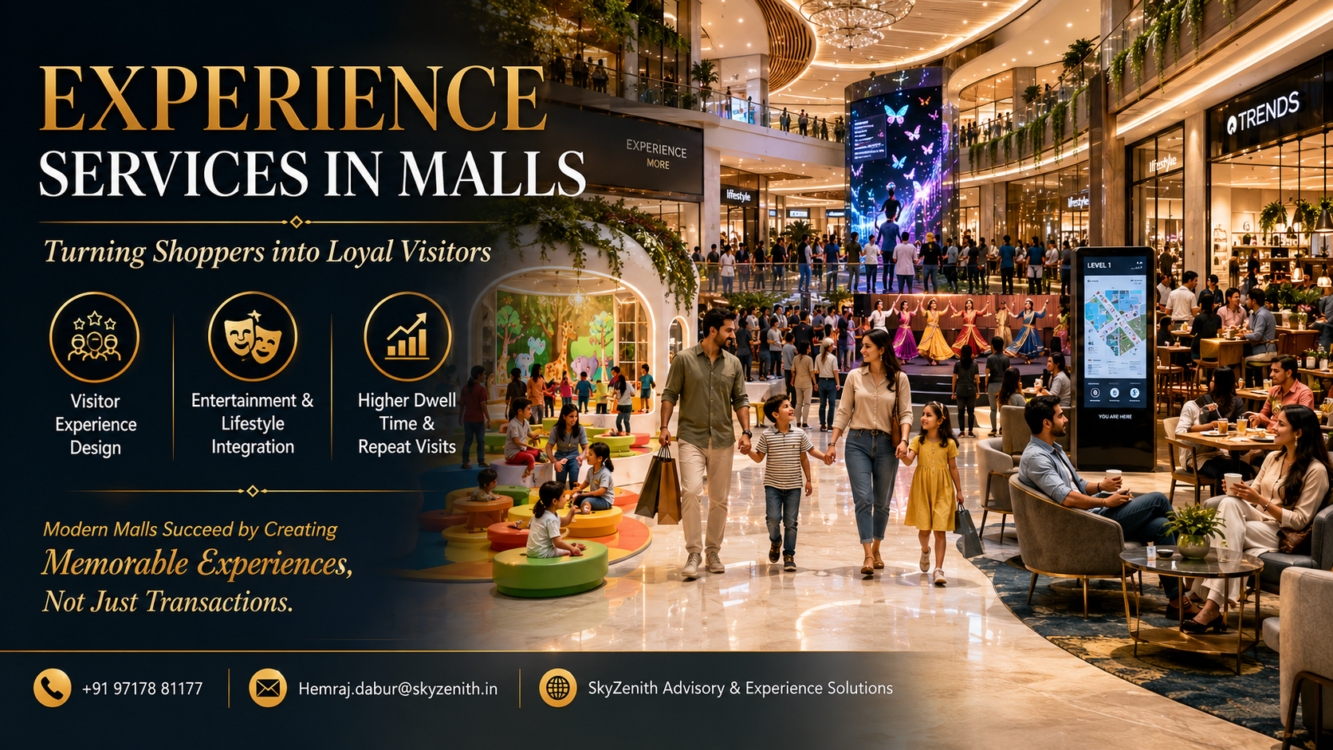
Experience Services in Malls: Turning Shoppers into Loyal Visitors
There was a time when a visit to the mall followed a predictable script: park the car, locate the required store, make a purchase, and leave. The transaction was the purpose. The mall was merely a container for shops. But somewhere in the past decade, that script began to fray. Shoppers grew restless. Online commerce offered convenience, speed, and endless variety. The physical mall needed a new reason to exist and it found one not in products, but in moments. Today, the most successful malls no longer compete on price or inventory alone. They compete on memory. This is the quiet revolution of experience services in malls, where every corridor, every lounge, every unexpected delight is deliberately designed to convert a casual visitor into a devoted, returning guest.
The Rise of the Experience Economy in Retail Real Estate
The term “experience economy” was first articulated by business strategists Pine and Gilmore, who observed that after commodities, goods, and services, the next stage of economic value lies in staging memorable experiences. For malls, this insight has become an operational mandate. A 2023 global retail study revealed that nearly 70 percent of consumers actively seek out shopping centres that offer entertainment, dining, and social spaces beyond traditional retail. In India, where the mall culture is still maturing, this shift is particularly pronounced. Modern Indian families want a destination a place where teenagers can discover new trends, parents can unwind with coffee, and children can play safely. The mall that delivers this tapestry of experiences transforms from a point of purchase into a community hub.
Beyond Browsing: Defining Experience Services in Modern Malls
Experience services encompass every non-transactional interaction a visitor has within a mall environment. These are not accidental amenities; they are curated interventions designed to engage the senses, extend dwell time, and foster emotional attachment. Consider the parent who visits a mall primarily for its climate-controlled indoor playground, then stays for lunch and browses a few stores. Consider the group of college friends who come for a new virtual reality arcade, then discover a pop-up art installation and a specialty tea shop. In each case, the anchor is the experience, and the spending follows naturally.
Leading mall operators have expanded their service portfolios to include:
- Entertainment zones – Bowling alleys, trampoline parks, multiplex cinemas with luxury seating, and immersive gaming arenas.
- Wellness and relaxation services – Spa kiosks, meditation pods, and express salon counters integrated into circulation spaces.
- Concierge-level conveniences – Hands-free shopping (where purchases are collected from a central desk), stroller rentals, prayer rooms, nursing rooms, and valet parking.
- Cultural and community programming – Weekend art markets, live music performances, seasonal festivals, and children’s workshops.
- Digital-physical hybrids – Interactive digital directories, augmented reality photo zones, and loyalty apps that reward non-purchase activities like attending an event or checking into a lounge.
Each of these services answers a fundamental question: Why should I drive twenty minutes to this mall when I can order the same product from my sofa? The answer lies in what cannot be delivered through a screen, atmosphere, human connection, and the unexpected spark of discovery.
Designing for Dwell Time: How Space Shapes Loyalty
Dwell time, the total minutes a visitor spends inside a mall, is the most reliable predictor of revenue per visitor. Experience services extend dwell time by breaking the monotony of retail corridors. Strategic placement of seating alcoves, green walls, water features, and art installations gives shoppers permission to pause. When a person stops rushing, they begin exploring. And when they explore, they encounter stores and offerings they had not planned to visit.
Retail psychology research indicates that for every additional thirty minutes of dwell time, a shopper’s likelihood of making an unplanned purchase increases by nearly 40 percent. Experience services act as gentle catalysts for this behaviour. A mother waiting for her child at a supervised play area is likely to browse nearby stores. A teenager resting on a cushioned bench beside a phone-charging station will check social media, see a friend’s post about a new store opening, and wander in. The mall that facilitates these moments of rest and recreation quietly profits from them.
Personalisation and the New Concierge Culture
Generic hospitality is no longer sufficient. Today’s shoppers expect recognition and relevance. Advanced experience services leverage data, ethically and with consent, to tailor interactions. A mall app that remembers a visitor’s favourite cuisine and alerts them when a new restaurant opens in that category. A loyalty programme that offers free parking after three visits to the cinema, acknowledging a repeated behaviour pattern. A birthday month benefit that includes a complimentary dessert at any participating café.
These personalised touches shift the relationship from anonymous to intimate. The shopper no longer feels like a wallet with feet. They feel like a guest. And guests return.
Case in Point: The Mall That Became a Destination
Consider a hypothetical but entirely realistic example from India’s National Capital Region. A suburban mall, struggling with footfall after the pandemic, decided to reinvent its experience services. It converted an underutilised basement floor into a curated food hall with live cooking stations and communal tables. It added a rooftop yoga deck accessible to loyalty members. It introduced a digital host, an interactive touchscreen directory that recommended routes based on “mood” (shopping, dining, entertaining). Within eighteen months, average dwell time doubled. Repeat visitation increased by 55 percent. The mall’s repositioning was not about changing its stores; it was about changing how visitors felt while walking through its doors.
Overcoming the Challenges of Experience Implementation
Transforming a mall into an experience destination is not without obstacles. Capital expenditure for new attractions can be substantial. Operational complexity rises with the addition of events, staff training, and maintenance of interactive installations. Furthermore, not all experience services yield immediate returns. An art gallery or a quiet reading lounge may not drive direct revenue but contributes to the mall’s brand as a sophisticated, welcoming space.
Successful mall operators adopt a portfolio approach: mix high-return, high-footfall attractions (cinemas, arcades) with lower-return, high-loyalty amenities (libraries, prayer rooms, gardens). They also partner with third-party experience providers, entertainment operators, wellness chains, cultural organisations to share investment and expertise.
The Future: Immersive and Integrated
Looking toward 2026 and beyond, experience services in malls will grow more immersive and technologically integrated. Augmented reality wayfinding that overlays promotions onto a shopper’s camera view. Sensory rooms designed for neurodivergent visitors, with adjustable lighting and sound. Subscription-based access to premium lounges and co-working spaces within malls, turning the centre into a daily lifestyle hub rather than a weekly shopping trip.
The most forward-thinking malls will blur the lines between retail, hospitality, and community service. They will become third places, after home and work, where people gather, celebrate, learn, and belong.
From Transaction to Connection
The transformation of malls through experience services is not a trend. It is an evolution of purpose. The old mall asked, “What can I sell you?” The new mall asks, “How can I make you feel welcome, entertained, and remembered?” Shoppers respond to that question with their feet, their time, and eventually, their loyalty. In an age of infinite online choice, the physical space that offers irreplaceable experience will never become obsolete. It will simply become essential.
SkyZenith
SkyZenith is a strategic advisory and facility experience firm specialising in elevating commercial spaces through curated service design, operational excellence, and experiential transformation. The organisation provides end-to-end solutions encompassing mall experience audits, visitor journey mapping, amenity programming, and technology integration for seamless service delivery. With a demonstrated track record of enhancing dwell time, repeat visitation, and brand affinity for retail properties across India, SkyZenith combines data-driven insights with creative placemaking. Their unique selling propositions include a proprietary dwell-time optimisation framework, partnerships with leading entertainment and wellness brands, and a client-centric approach that aligns experience investments with measurable business outcomes.
Contact Us
Address: Unit No. 908, 9th Floor, Tower 1 DLF Corporate Greens, Sector 74A Sohna Road, Gurgaon, Haryana 122004
Email: Hemraj.dabur@skyzenith.in
Phone: +91 97178 81177