-
Skyzenith
- July 8, 2026
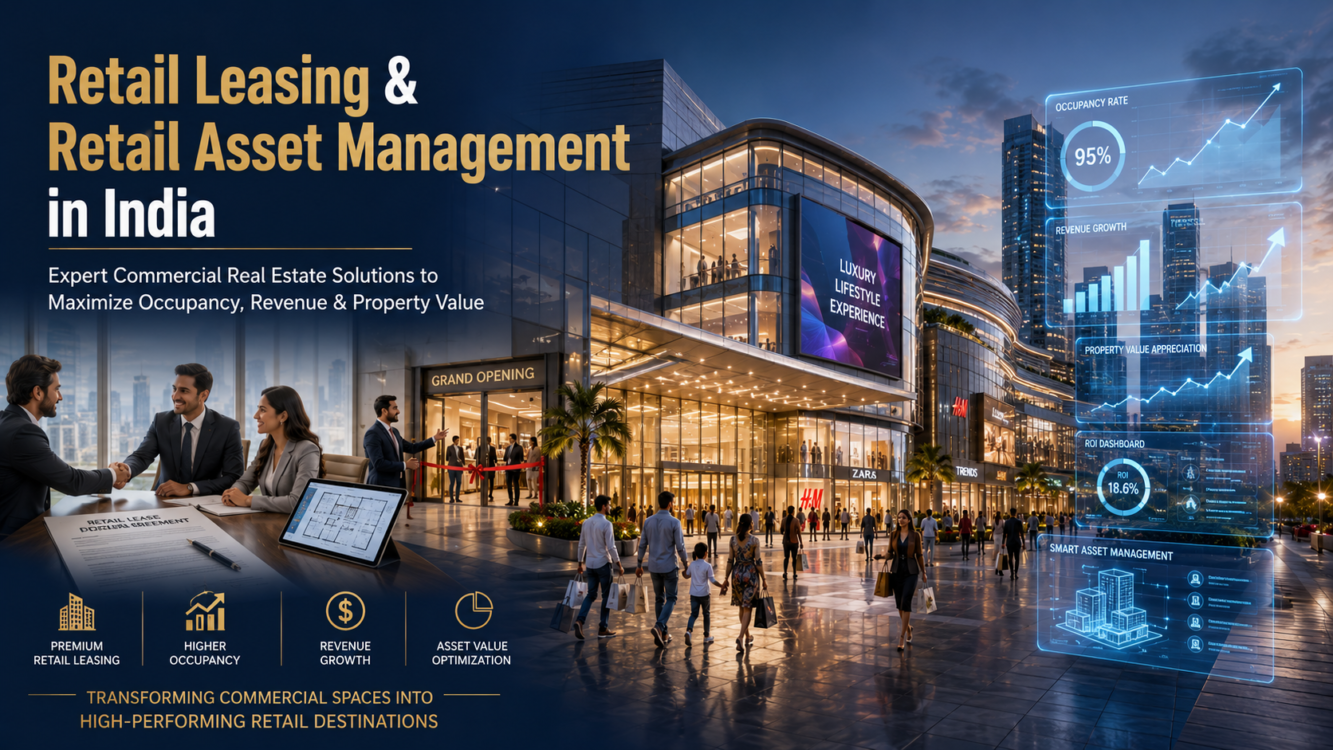
Retail Leasing & Retail Asset Management in India: Expert Commercial Real Estate Solutions to Maximize Occupancy, Revenue & Property Value
India’s retail real estate sector is undergoing a remarkable transformation. What was once a fragmented, transaction-driven market has evolved into a sophisticated, experience-led ecosystem that is capturing the attention of investors, developers, and global brands alike. The numbers tell a compelling story: retail leasing in India is poised to close 2025 with approximately 9 million square feet of absorption, the highest annual performance since the pandemic. This marks a sharp rise from around 7.8 million square feet leased in 2024, signalling a decisive recovery in mall-led leasing activity.
The momentum is not merely a post-pandemic rebound; it represents a structural shift in how India consumes, shops, and experiences physical retail. According to Cushman & Wakefield’s India Outlook 2026 report, retail leasing demand is projected to strengthen further to approximately 10–11 million square feet in 2026, supported by a robust mall pipeline of nearly 5.9 million square feet. With Grade A malls operating at a mere 5.7% vacancy and premium Grade A+ malls witnessing even tighter vacancies at just 4.28% , the market is entering a phase of meaningful capacity addition aligned with premiumisation and the evolution of malls into experience-led lifestyle destinations.
For property owners, investors, and developers, this presents an extraordinary opportunity, but also a formidable challenge. The question is no longer whether to invest in retail real estate, but how to maximise occupancy, optimise revenue, and preserve long-term property value in an increasingly competitive and discerning market. This is where strategic retail leasing and retail asset management emerge as the cornerstones of commercial real estate success.
The Evolving Landscape of Retail Leasing in India
A Market in Transition: From Transactions to Experiences
The Indian retail consumer has changed profoundly. Today’s shoppers seek more than products; they crave destinations that offer connection, discovery, and immersive experiences. This shift is reshaping the entire leasing paradigm. High streets, once viewed largely as transactional corridors, have evolved into vibrant social spines of cities, driven by strong evening and weekend footfalls, café culture, and hyper-local experiences. Destination malls, in turn, are reinventing the ‘one-stop’ model by anchoring themselves around leisure, food and beverage, wellness, and immersive experiences.
Brands are becoming increasingly discerning, favouring hybrid formats that integrate physical stores with digital touchpoints, premium design, and flexible layouts. Location quality, footfall intelligence, and the ability to deliver immersive experiences are now central to leasing decisions. Fashion and apparel brands remain dominant, accounting for 35% of leasing activity in Delhi-NCR, followed by food and beverage operators and lifestyle retailers.
The Rise of Premium Grade A Malls and the Ghost Mall Paradox
A fascinating dichotomy is emerging in India’s retail landscape. On one hand, demand for high-quality, experience-led retail spaces is surging, with premium Grade A+ malls operating at near-full capacity. On the other hand, nearly one-fifth of India’s operational shopping centres, 74 of 365 surveyed properties, have been classified as “ghost malls,” representing 15.5 million square feet of dormant retail potential.
This paradox presents a significant opportunity for strategic asset management. Industry experts estimate that reinvigorating India’s ghost shopping centres could unlock ₹357 crore in annual rentals. Tier 1 cities hold ₹236 crore of this revenue opportunity, with Tier 2 markets accounting for an additional ₹121 crore. As Shishir Baijal, CMD of Knight Frank India, observes: “India’s retail sector is entering a defining phase of growth, supported by strong consumption and a clear shift toward high-quality organised retail formats”.
Delhi-NCR: The Epicentre of Retail Leasing Activity
Delhi-NCR has emerged as the undisputed leader in retail leasing. In Q4 2025 alone, retail leasing in the region stood at 1.03 million square feet, an increase of 100% quarter-on-quarter and 4.5 times on a year-on-year basis. Gurugram led overall retail leasing during this period with a 63% share, followed by Delhi (22%) and Noida (15%). Malls secured 56% of the quarterly leasing volume, while main streets accounted for the remaining 44%.
This concentration of activity reflects the region’s status as a premier retail destination, attracting both domestic and international brands seeking high-visibility, consumption-led locations. The broader pipeline for 2026–2028 stands at 14.94 million square feet, which is likely to support leasing momentum and further drive premiumisation in the sector.
The Art and Science of Retail Asset Management
Beyond Property Management: A Strategic Imperative
Retail asset management is far more than routine property maintenance. It is the systematic and strategic stewardship of retail property portfolios to optimise financial performance, tenant satisfaction, and overall market position. Effective retail asset management encompasses leasing and tenant mix strategy, operations and maintenance, marketing and brand activation, financial management, and continuous performance monitoring.
For landlords and investors, this means shifting from passive leasing to active, strategic retail asset management that prioritises long-term asset value and operational resilience over short-term occupancy. As CBRE’s research highlights, professional retail asset management helps landlords reduce vacancy risk, improve tenant retention, and protect long-term asset value.
Maximising Net Operating Income Through Strategic Leasing
The primary objective of retail asset management is to increase net operating income (NOI) by attracting high-quality tenants and maintaining competitive rent structures. This requires a sophisticated understanding of market dynamics, tenant behaviour, and consumer preferences. Curating a balanced tenant mix is critical, with complementary brands and services, from anchor tenants that draw large crowds to niche boutiques, fostering a dynamic browsing experience.
Data-driven decision-making is at the heart of modern retail asset management. Asset managers use foot traffic analytics, demographic insights, and sales per square foot metrics to strategically position tenants, inform leasing strategies, and guide capital investments. The results speak for themselves: leading retail REITs like Nexus Select Trust have maintained 97% occupancy for multiple consecutive quarters, achieving healthy re-leasing spreads and double-digit growth in net operating income.
The Power of Ancillary Revenue Streams
Forward-thinking asset managers are increasingly unlocking value through ancillary revenue streams. Premium common-area kiosks and experiential event spaces have expanded to command up to 30% of total asset yields in some properties, driving significant footfall spikes that boost parking revenues, food and beverage consumption, and inline retail turnover.
This approach transforms retail assets from passive income generators into active, dynamic destinations that create value for tenants, shoppers, and property owners alike. As one industry expert notes, “Being scrupulous with mature income streams is another key way that asset managers can avoid complacency. For landlords and asset managers, it’s about maximising every inch of space, from underused car park areas to external zones, ensuring no opportunity is left untapped”.
Technology: The New Frontier in Asset Management
The integration of technology is revolutionising retail asset management. Digitally orchestrated malls leverage building automation systems to control HVAC, power, lighting, and all mechanical infrastructure, delivering cost reductions through zone-by-zone optimisation against actual occupancy. Technology is not eliminating jobs; it is enhancing team effectiveness, enabling data-driven decision-making, and creating operational efficiencies that directly impact the bottom line.
Developers are increasingly shifting from “build and sell” to experiential “build and operate” models, merging hospitality with real estate to create vibrant, tech-driven destinations that boost returns. This transformation is reshaping how decisions are made and experiences are delivered, positioning technology as the backbone of modern retail asset management.
Strategies for Maximising Occupancy, Revenue, and Property Value
1. Curating the Optimal Tenant Mix
The right tenant mix is the foundation of retail success. Food and beverage, once a minor category, has grown from 8% to 20–22% of mall tenant composition, reflecting changing consumer preferences for experiential consumption. Asset managers must balance fashion, F&B, entertainment, and lifestyle categories to create a compelling destination that drives repeat visits and longer dwell times. As one developer observes: “In markets like Gurugram and Faridabad, projects with the right tenant mix are seeing stronger consumer engagement, better occupancy levels, and more sustainable long-term value creation”.
2. Embracing Experience-Led Design
Modern consumers value experiences over transactions. They seek places that offer unique activities, encourage social connection, and provide opportunities for personal enrichment. Converting underutilised corners into pop-up stores, art exhibitions, or cultural zones; implementing micro-transformations like pet-friendly gardens or “Instagrammable” zones; and blending wellness, boutique fitness, and entertainment into the tenant mix are proven strategies for driving recurring footfall.
3. Implementing Data-Driven Performance Monitoring
Continuous performance monitoring using KPIs such as footfall, sales per square foot, occupancy rates, and tenant satisfaction drives informed decision-making. Asset managers who regularly assess data to inform leasing strategies, capital investments, and renovation timetables consistently outperform those who rely on intuition alone.
4. Pursuing Value-Add Opportunities Through Repositioning
Underperforming retail assets represent significant value-add opportunities. Physical and operational overhauls including facade upgrades and integrated retail are driving occupancy to over 90% and yielding rental growth of 40% to 50%. By identifying assets where occupancy levels hover between 60% and 70%, institutional investors are deploying capital to bridge the gap between current performance and institutional-grade potential.
Conclusion: The Future of Retail Real Estate in India
India’s retail real estate sector is entering a golden era. With record leasing volumes, rising institutional investment, and a development pipeline of 46.1 million square feet scheduled for delivery between 2026 and 2030 across the top seven cities, the opportunities are immense. The sector is expected to attract an estimated $3.5 billion in investments over the next three years, as global capital increasingly pivots towards India amid mounting stress in mall assets across Western markets.
However, success in this dynamic environment requires more than passive ownership. It demands strategic vision, operational excellence, and a commitment to creating destinations that resonate with today’s discerning consumers. Professional retail asset management grounded in data, driven by experience, and focused on long-term value creation is the key to unlocking the full potential of India’s retail real estate assets.
For property owners, developers, and investors, the message is clear: the time to embrace strategic retail leasing and asset management is now. Those who do will not only maximise occupancy, revenue, and property value but will also play a defining role in shaping the future of Indian retail.
About SkyZenith: Elevating Asset Management & Advisory Services
SkyZenith is a premier Asset Management & Advisory Company specialising in Retail, Hotel, and Commercial Leasing, Mall Advisory, Building Audits, and Sustainability Consulting. Headquartered at Spaze Platinum in Gurugram, the company delivers end-to-end solutions for mall developers and commercial asset owners across India.
SkyZenith’s core services include strategic leasing advisory, mall management and revamp consulting, tenant mix optimisation, asset and facility management, and retail market intelligence. The company provides comprehensive retail leasing and mall advisory solutions, including market feasibility studies, tenant mix planning, brand onboarding, mall positioning, category zoning, anchor store strategy, and complete pre-launch to post-launch advisory support.
What sets SkyZenith apart is its unmatched attention to detail, process-led execution, and data-first mindset. The company develops customised strategies to enhance mall footfall, tenant engagement, and revenue generation, implementing smart leasing models and positioning retail spaces for maximum growth. With a strong focus on market research and intelligence, SkyZenith has become a trusted strategic partner for brands seeking intelligent, data-backed expansion solutions across PAN India.
Whether it is maximising occupancy, optimising tenant mix, or repositioning underperforming assets, SkyZenith brings the expertise, innovation, and commitment needed to transform retail properties into thriving investment platforms.
Address: Unit No. 908, 9th Floor, Tower 1, DLF Corporate Greens, Sector 74A, Sohna Road, Gurgaon, Haryana 122004
Email: Hemraj.dabur@skyzenith.in
Phone: +91 97178 81177