-
Skyzenith
- April 9, 2026
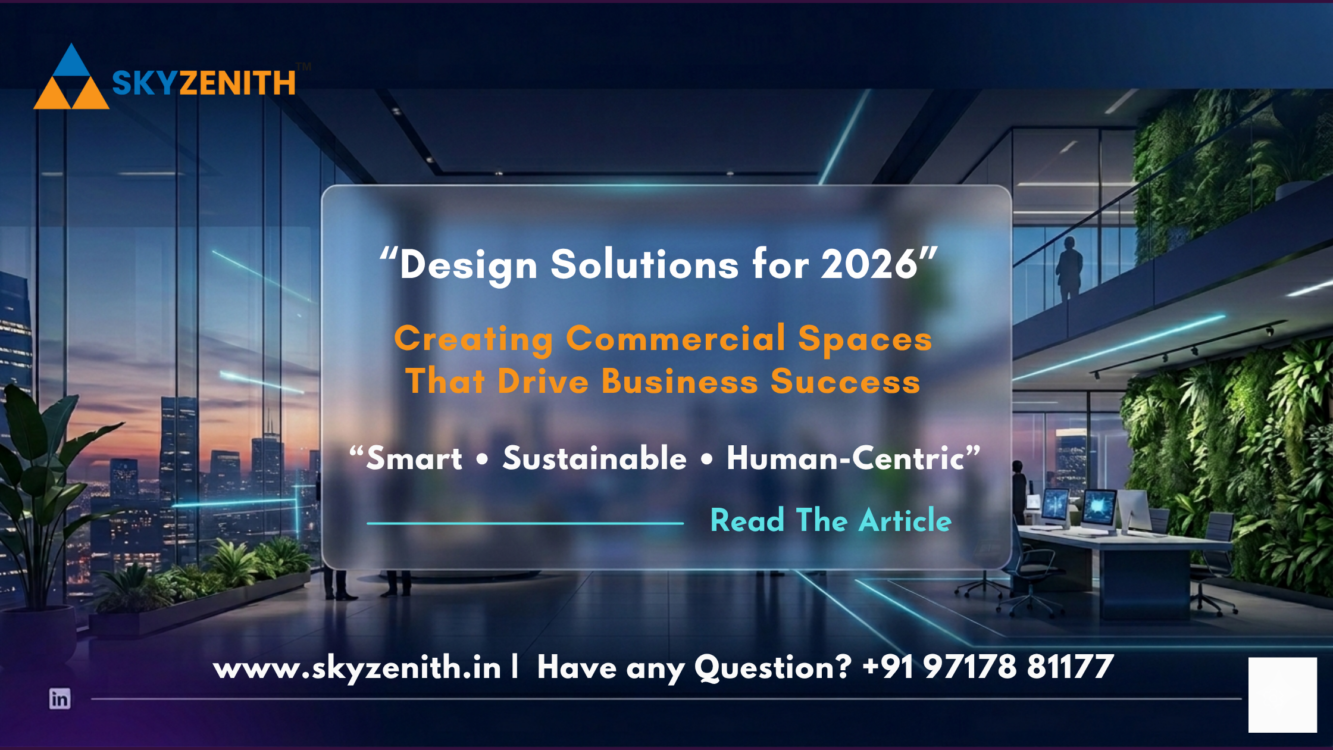
Design Solutions for 2026: Creating Commercial Spaces That Drive Business Success
The year 2026 is not a distant horizon, it is the next chapter in the evolution of work, commerce, and human interaction. As organizations recover from the tectonic shifts of remote work and hybrid models, a new truth has emerged: the physical commercial space is far from obsolete. It has been reborn. The companies that will lead their industries in 2026 are those that understand design solutions not as aesthetic choices but as strategic instruments of business performance. This article explores how forward-thinking enterprises are transforming offices, retail environments, and corporate campuses into engines of productivity, culture, and profitability.
The Commercial Space Reimagined: Why 2026 Demands a New Approach
For decades, commercial real estate followed a predictable formula: maximize square footage, minimize per-desk cost, and fill rows of identical cubicles. That era has ended. Employees now expect environments that offer choice, wellness, and technological seamlessness. Clients seek brand experiences that resonate emotionally. Investors evaluate buildings on sustainability metrics and occupancy satisfaction. In this landscape, design solutions for 2026 must answer three critical questions: Does this space improve how people work? Does it express the brand’s purpose? Does it adapt to unforeseen changes?
The commercial spaces that drive business success are no longer static containers. They are living systems, responsive, data-informed, and human-centric.
Human-Centric Design Solutions for 2026: Putting People at the Core
Biophilic Integration and Wellness as a Productivity Driver
The most powerful design solution for 2026 draws from nature. Biophilic design, incorporating natural light, living walls, water features, and organic textures, has moved from luxury amenity to business necessity. Studies consistently show that employees in biophilic environments report 15 percent higher well-being and 6 percent greater productivity. For commercial spaces, this translates to lower absenteeism, higher retention, and more creative output. In 2026, successful offices will feature circadian lighting systems that mimic daylight patterns, indoor air quality monitored in real time, and acoustic comfort zones that balance collaboration with focus.
Activity-Based Workplaces Over Fixed Desks
The rigid assigned desk is disappearing. Design solutions for 2026 prioritize activity-based working (ABW), a model where employees choose from a variety of settings based on their task. Quiet booths for deep concentration, open collaboration zones for brainstorming, lounge areas for informal catch-ups, and formal meeting rooms with seamless video integration. This approach reduces real estate footprint by 30 percent while increasing space utilization. More importantly, it respects individual work styles, a key driver of job satisfaction in the post-pandemic workforce.
Technology-Embedded Environments: Smart Commercial Spaces
IoT and Data-Driven Space Management
The commercial spaces that drive business success in 2026 will be invisible to technology—not through absence, but through seamless integration. Sensors monitor desk occupancy, meeting room usage, and foot traffic, feeding data to facility managers who optimize layouts weekly rather than yearly. Smart HVAC systems adjust temperature and ventilation based on real-time occupancy, slashing energy costs by 20 – 40 percent. Digital wayfinding guides visitors to their destinations without receptionist intervention. These are not futuristic fantasies; they are available design solutions that deliver measurable ROI.
Hybrid Meeting Infrastructure as Standard
The hybrid workplace is permanent. Therefore, every commercial space designed in 2026 must treat remote participants as equals. This means camera placements at eye level, microphone arrays that capture every voice, screens that display both local and remote colleagues in balanced proportion, and acoustic treatments that eliminate echo. Meeting rooms become “Zoom-first” by design, not by afterthought. The result: better collaboration, faster decisions, and no wasted time struggling with technology.
Sustainability as a Business Advantage
Net-Zero Design Solutions for 2026
Regulatory pressure, investor demands, and employee expectations are converging on one imperative: carbon-neutral commercial spaces. Design solutions for 2026 include solar-ready roofs, high-performance glazing that reduces heat gain, passive ventilation strategies, and rainwater harvesting systems integrated into landscaping. But sustainability also drives business success directly. Certified green buildings command higher rents, attract premium tenants, and enjoy lower vacancy rates. For owner-occupied spaces, energy savings drop straight to the bottom line. In 2026, a commercial space without a sustainability strategy is not just irresponsible, it is commercially disadvantaged.
Circular Materials and Waste-Free Construction
The next frontier is circular design: using materials that can be disassembled and reused at end of life. Modular walls, demountable partitions, and furniture leasing models prevent construction waste from entering landfills. Commercial spaces designed this way retain value over time, because they can be reconfigured for new tenants or uses without demolition. This is design thinking that aligns ecological integrity with financial prudence.
Brand Expression Through Spatial Storytelling
From Office to Brand Embassy
Every commercial space communicates something about the organization. In 2026, the most successful spaces tell a coherent brand story from the moment someone steps off the elevator. A tech company might feature interactive data walls. A creative agency might display rotating art installations. A financial firm might communicate stability through warm wood and soft lighting. Design solutions that embed brand identity into architecture, not just through logos but through materiality, color psychology, and spatial narrative, create emotional connections with employees, clients, and recruits.
Flexibility for Evolving Business Needs
The only constant in business is change. Design solutions for 2026 therefore prioritize adaptability over permanence. Movable walls, furniture on casters, plug-and-play power and data ports, and standardized partitions allow a floor plate to transform from open plan to private offices to event space within hours. This future-proofing protects the capital investment. A commercial space that cannot adapt becomes obsolete within five years; one designed for change remains valuable for decades.
Case in Point: Translating Design into Business Metrics
Consider a corporate headquarters that implemented these design solutions for 2026 ahead of schedule. They reduced square footage per employee from 200 to 140 square feet, yet employee satisfaction scores rose 22 percent. Energy consumption dropped 35 percent through smart lighting and HVAC. Meeting room utilization increased from 45 percent to 78 percent after installing occupancy analytics. The company credited the redesigned space with a 12 percent improvement in cross-departmental collaboration, measured through project completion times. This is the return on design, quantifiable, substantial, and recurring.
The Road Ahead: Making Design Solutions Work for Your Commercial Space
Creating commercial spaces that drive business success requires more than hiring an interior decorator. It demands a strategic partner who understands architecture, technology, behavioral psychology, and financial analysis. The design solutions for 2026 outlined here, biophilic wellness, activity-based working, smart sensors, hybrid meeting infrastructure, net-zero sustainability, brand storytelling, and modular flexibility, are not optional add-ons. They are the baseline for competitive advantage in a transformed business environment.
Organizations that delay this transformation will find themselves with underperforming assets, disengaged talent, and escalating operating costs. Those who act now will secure a decade of productivity gains, talent attraction, and brand strength. The commercial space is no longer a cost center. It is a strategic weapon.
At SkyZenith, we specialize in translating these design solutions into built reality for forward-looking enterprises. Our services encompass end-to-end commercial space planning, technology integration, sustainable design consulting, and project management tailored to corporate offices, retail environments, and institutional campuses. Our unique selling proposition lies in the fusion of data-driven design with human-centric execution: we do not guess what works, we measure, iterate, and deliver spaces that align with your specific business metrics. From occupancy analytics to post-occupancy evaluation, we remain partners in your success. Located strategically at Gurgaon’s commercial hub, we serve clients across India seeking to transform their commercial spaces into engines of business success.
Address
Unit No. 908, 9th Floor, Tower 1: DLF Corporate Greens, Sector 74A, Sohna Road, Gurgaon, Haryana 122004
Email: Hemraj.dabur@skyzenith.in
Phone: +91 97178 81177