-
skyzenith996@gmail.com
- April 4, 2026
Location Strategy 2026: How Data is Driving Retail and Corporate Expansion
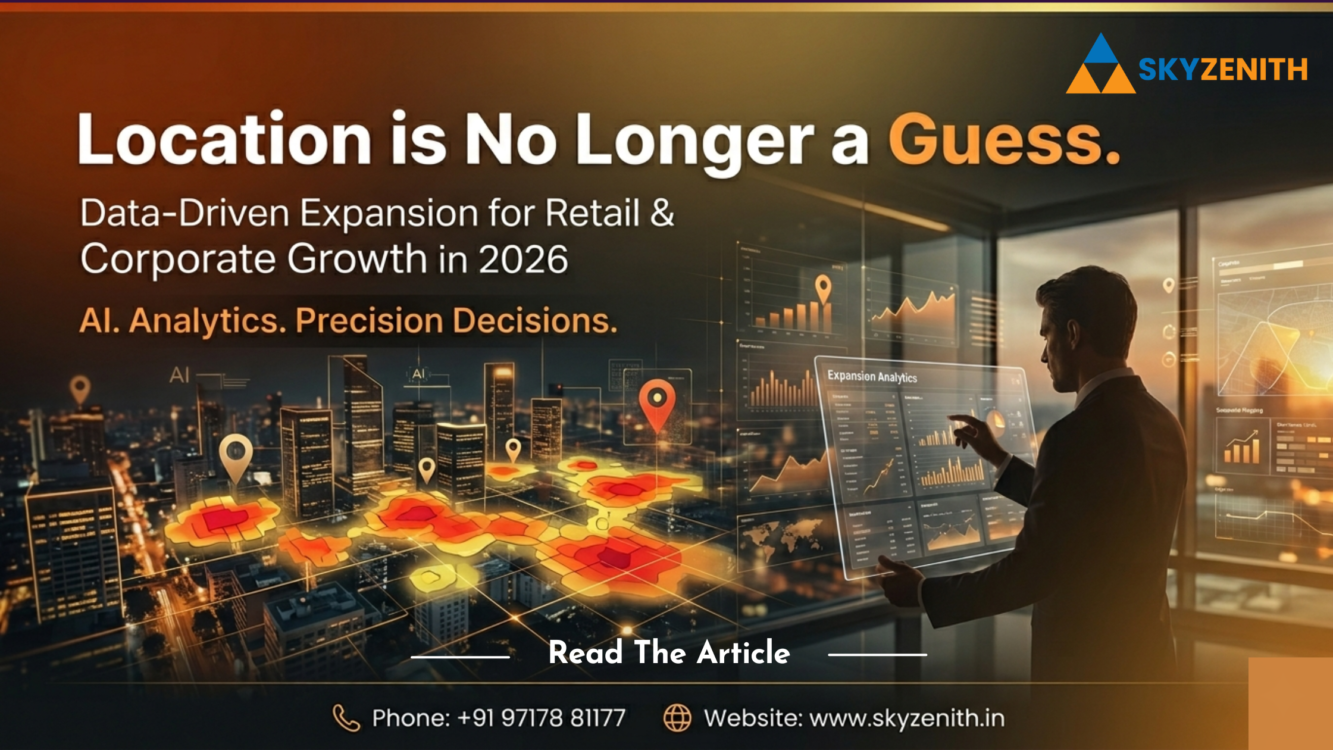
The executive’s screen illuminates not with a spreadsheet of pin codes but with a living heatmap, crimson clusters of purchasing density, amber corridors of commuter flow, and cool blue voids of untapped potential. In a single glance, she sees where her next flagship should rise, where a corporate outpost would thrive, and crucially, where a wrong move would bleed millions. This is not a scene from a distant future. This is the location strategy in 2026, where the romantic guesswork of expansion has been replaced by the cold, elegant precision of data.
For decades, expansion decisions were an art form, part intuition, part prestige, and often, part prayer. A retailer chose a high-street address because competitors were there. A corporation opened a new office in a tier-one city because that was where talent had always been. The cost of error was high, but rarely calculated. That era has ended. The stakes have risen, and so has the science.
Data-Driven Site Selection: Why Gut Instinct Lost to Algorithms
A failed retail location costs between five hundred thousand and two million dollars, a financial wound that can cripple a brand’s growth for years. Yet, until recently, many expanding businesses evaluated potential sites using little more than spreadsheets, fragmented data, and the instincts of local brokers. The shift toward data-driven site selection is not a trend; it is a survival mechanism.
Location intelligence the practice of transforming geospatial data into actionable business decisions has fundamentally altered the expansion landscape. The market’s growth reflects this urgency, with the global location intelligence sector expanding from $20.55 billion in 2025 to an estimated $23.29 billion in 2026, a compound annual growth rate of 13.4%. Retail and consumer goods represent the largest end-user vertical, claiming 24% of this market share. This is not speculative growth; it is the direct result of businesses demanding a return on every square foot they occupy.
The difference between legacy methods and modern location intelligence is the difference between a map and a prophecy. Traditional geographic information systems provided visualisation; a heatmap of foot traffic was interesting but inert. Location intelligence builds upon that foundation, overlaying demographic profiles, psychographic segments, competitor proximity, and historical performance data to generate site scores, revenue forecasts, and definitive go/no-go recommendations. The interpretation and the risk is no longer left to the expansion manager alone.
AI and Geospatial Analytics for Expansion: The New Navigators
Artificial intelligence has poured accelerant onto this transformation. By 2026, geospatial AI has moved from laboratory curiosity to boardroom necessity. Platforms now exist that can analyse, compare, and plan new locations in minutes, a process that once consumed weeks of manual labour. The elimination of custom data operations has become the most significant shift, allowing developers and retailers to access an integrated view of market economics, regulatory landscapes, and grid infrastructure from a single dashboard.
This capability is particularly critical for corporate expansion, where the variables are even more complex. According to JLL’s 2026 research, location decisions increasingly factor in power availability, infrastructure security, and AI regulatory frameworks, in addition to traditional considerations of talent, cost, and scalability. The emergence of global capability centres in emerging markets has pushed location selection strategies beyond traditional tier-one metropolitan areas, with data driving the identification of optimal geographic locations based on talent clusters, cost efficiency, and educational alliances.
Foot Traffic Data and Predictive Analytics: From Reaction to Anticipation
If 2025 forced retailers to abandon improvisation, 2026 demands something deeper: the ability to anticipate rather than react. Foot traffic data has become the clearest signal of real-world demand, often outperforming digital engagement metrics in predicting consumer intent.
Modern people counting technology has evolved from manual clickers at the door to AI-powered sensors that track foot traffic, measure conversion rates, and generate heatmaps, all while maintaining complete customer privacy. Over seventy percent of retail executives now consider customer traffic data essential for operational decisions, a dramatic increase from just thirty-five percent five years ago. This data is not merely descriptive; it is predictive. Machine learning models trained on historical footfall data can forecast traffic by hour for the next seven to fourteen days with high accuracy.
The strategic implications are profound. If foot traffic shows a slight but consistent slowdown over three consecutive weeks, that is not just historical data, it is an early warning signal. If dwell time decreases during specific hours, it may indicate friction in the in-store experience. Predictive intelligence identifies patterns before they become financial problems, allowing retailers to adjust staffing, inventory, and marketing in real time.
The battleground has also shifted. In 2025, the focus was on protecting sales. In 2026, the focus has shifted to protecting margin. Margins erode gradually through small, repeated inefficiencies: overstaffing during low-traffic hours, running promotions when organic demand is already high, under-allocating staff during peak conversion windows. A one-point increase in conversion can deliver greater impact than an expensive acquisition campaign. Operational precision has become a financial strategy.
Corporate Location Strategy: The New Geography of Talent and Infrastructure
For corporate expansion, the data revolution has rewritten the rules of geography entirely. The traditional hierarchy of tier-one, tier-two, and tier-three cities has become almost meaningless. Instead, location strategy is driven by a dynamic calculus of talent availability, connectivity, infrastructure resilience, and regulatory climate.
The shift toward hybrid work has also transformed corporate real estate requirements. Companies are no longer seeking monolithic headquarters; they are building networks of satellite offices, collaboration hubs, and flexible spaces that align with workforce distribution patterns. Location intelligence platforms now analyse commuting data, residential density, and even local amenity scores to identify optimal sites for these distributed footprints. The goal is not simply to be present in a market but to be present in the right micro-catchment within that market.
In congested urban markets, access has effectively become currency. Retail and corporate assets plugged into expressways, metro corridors, and dense residential clusters are outperforming isolated developments, reflecting the rise of micro-catchment economics. Developers study traffic flows and neighbourhood income profiles before finalising layouts. Footfall today is planned, and infrastructure is the first anchor tenant.
This principle holds true across sectors. In Gurugram, for example, Cushman and Wakefield’s Q4 2025 report noted that the city led overall retail leasing with a 63% share, driven by its strategic position along major expressways and metro corridors. The lesson is universal: location in organised commerce has evolved from a prestige-driven pin code play to a data-backed catchment strategy.
Location Strategy for Hybrid Workforce: Designing for Where People Are
The corporate sector faces a unique challenge in 2026: the office must go where the talent is, not the other way around. Location strategy for hybrid workforces relies on commuting data, residential heatmaps, and even real-time traffic analytics to determine where satellite offices, coworking partnerships, and flexible spaces should be placed. The goal is to reduce commute times, improve work-life integration, and create a distributed ecosystem that feels cohesive.
This data-driven approach extends to site selection for global capability centres and innovation hubs. Companies are no longer defaulting to established tech corridors; they are using location intelligence to identify emerging markets with the right combination of talent pipelines, cost structures, and infrastructure readiness. The result is a more decentralised, resilient, and responsive corporate footprint.
The Return on Intelligence: Why Data Wins
The evidence for data-driven location strategy is no longer anecdotal. Consider the case of Cavender’s Western Wear, which went from opening nine new stores in 2024 to twenty-seven in 2025 after adopting a location intelligence approach. TNT Fireworks began reviewing ten times more sites in committee, opening over 150 locations in under six months. These are not outliers; they are the new standard for businesses that have replaced intuition with intelligence.
The return on investment for location intelligence extends beyond store counts. Retailers using predictive footfall models align staffing levels with expected traffic, eliminating the overstaffing that erodes margin and the understaffing that damages customer experience. They tailor operating hours, commercial strategies, and inventory allocation to the unique dynamics of each location, moving away from the false assumption of consumer homogeneity. The question is no longer how much was sold, but how much of what was sold was protected.
Conclusion: The Map is No Longer the Territory
In 2026, location strategy has been demystified. It is no longer a dark art practised by veteran brokers with little black books. It is a rigorous, data-driven discipline that combines geospatial analytics, artificial intelligence, and real-time behavioural data to guide expansion with unprecedented precision. The cost of a wrong location is too high for guesswork. The opportunity of a right location, illuminated by data, has never been greater.
For businesses planning their next move whether a flagship store, a corporate headquarters, or a distributed network of hybrid workspaces the message is clear. The map is no longer the territory. The data is the compass.
About SkyZenith
SkyZenith is a premier provider of commercial real estate solutions, specialising in future-ready office spaces that integrate hybrid work models and employee wellness at their core. With a portfolio including prime addresses such as Spaze Platinum on Sohna Road, Gurgaon, the company offers end-to-end services from site selection to workplace strategy consulting. Their unique selling proposition lies in combining data-driven design, biophilic elements, and smart technology to create environments that boost productivity while nurturing mental and physical health. Unlike conventional real estate firms, SkyZenith partners with clients to deliver flexible, human-centric spaces that evolve with workforce needs, ensuring every square foot works as hard as the people within it. For inquiries regarding prime commercial spaces at Spaze Platinum Sohna Road Gurgaon, contact Hemraj.dabur@skyzenith.in or call +91 97178 81177.