-
Skyzenith
- August 21, 2026
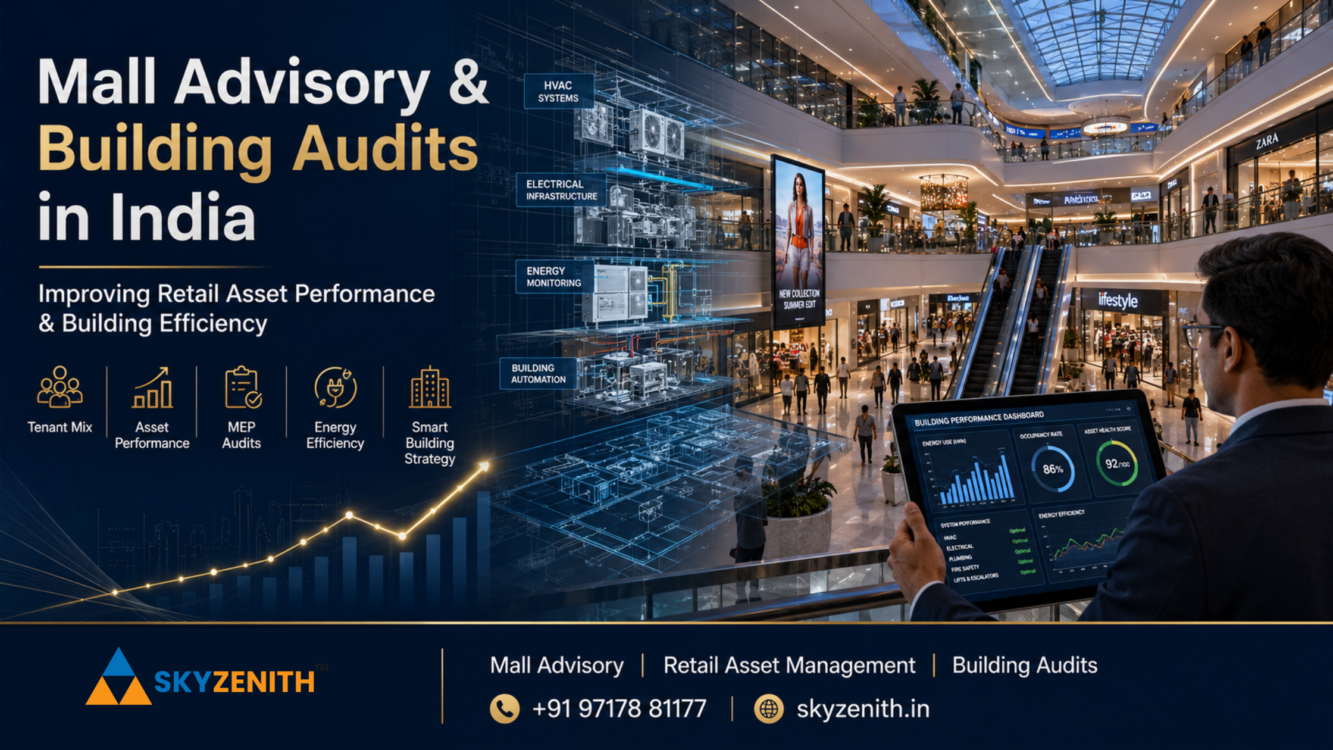
Mall Advisory and Building Audits in India: Improving Retail Asset Performance and Building Efficiency
A shopping mall can be full of customers and still underperform as an asset.
A beautifully designed atrium may attract visitors, but inefficient building systems can quietly increase operating costs. A strong retailer may generate excellent sales, yet an unsuitable tenant mix can weaken the overall customer journey. Likewise, a mall may have impressive occupancy figures while losing potential revenue through inefficient space utilisation, outdated infrastructure, weak energy management or poor operational planning.
This is why modern mall advisory and building audits in India are moving beyond conventional property management.
Today, mall owners, investors and developers need to understand not only how a property looks and operates, but how effectively every component contributes to long-term asset performance.
India’s organised retail market provides a strong reason for this strategic approach. Retail leasing reached approximately 3.9 million sq. ft. during the first half of 2026, representing 20% year-on-year growth, while retailers continued to prioritise experiential formats and high-quality retail environments.
In such a competitive environment, professional advisory and building audits can help transform a mall from a physical property into a more efficient, commercially responsive and future-ready retail asset.
What Is Mall Advisory in India?
Mall advisory services in India involve strategic evaluation and guidance across the commercial, operational and physical aspects of a shopping mall.
The objective is to understand how the asset is performing today, identify opportunities for improvement and develop practical strategies for stronger long-term results.
Mall advisory may cover areas such as:
Retail leasing strategy | Tenant mix optimisation | Catchment and market analysis | Mall positioning | Retail asset management | Revenue enhancement | Occupancy improvement | Customer experience | Operational efficiency | Marketing and activation strategy | Capex planning | Building performance | Sustainability and energy management
The most effective advisory approach connects these areas rather than examining them independently.
For example, changing the tenant mix may influence customer traffic. Customer traffic may affect parking demand and common-area operations. Increased footfall may create opportunities for food and beverage, entertainment and experiential retail. Each decision can therefore affect several parts of the asset simultaneously.
Why Mall Advisory Matters for Retail Asset Performance
The Indian retail market is becoming increasingly experience-led. CBRE reported record retail leasing of approximately 8.9 million sq. ft. across India’s top cities in 2025, with retailers increasingly focusing on experiential flagship stores, innovative formats and stronger customer engagement.
This creates both an opportunity and a challenge for mall owners.
A mall must offer retailers the right environment to grow while giving customers reasons to visit, stay longer and return.
Professional mall asset advisory can help owners examine whether the property is positioned correctly for its market.
The question is no longer simply whether shops are occupied. It is whether the right retailers are occupying the right spaces and whether the overall tenant ecosystem supports the mall’s commercial objectives.
Tenant Mix Optimisation for Shopping Malls
One of the most important elements of mall management and advisory services is tenant mix optimisation.
A successful mall needs a balanced combination of categories. Fashion, food and beverage, entertainment, beauty, lifestyle, jewellery, electronics, services and anchor tenants can each serve different customer requirements.
A weak tenant mix may create duplication between retailers, vacant pockets or insufficient reasons for customers to explore certain parts of the property.
Tenant mix analysis should therefore consider:
Catchment demographics | Consumer spending patterns | Competing malls | Existing tenant performance | Category gaps | Rental potential | Customer traffic | Store size requirements | Future retail trends
Current market activity demonstrates why this matters. Fashion and apparel remained the largest leasing category in H1 2026, accounting for around 40% of retail leasing, while food and beverage and entertainment also remained significant demand drivers.
What Is a Building Audit for Commercial Properties?
A building audit in India is a systematic assessment of a property’s physical condition, building systems, operational performance and potential areas for improvement.
For a shopping mall, the audit may examine:
HVAC systems | Electrical infrastructure | Plumbing systems | Fire and life-safety systems | Vertical transportation | Lighting | Building envelope | Common areas | Parking facilities | Water systems | Energy consumption | Maintenance practices | Asset condition | Operational risks
The objective is to establish a clearer picture of how the building is performing and where intervention may be required.
A building audit should not merely identify defects. It should help owners prioritise them according to urgency, business impact, cost and long-term asset value.
Building Efficiency Audits for Shopping Malls
A modern mall can consume substantial amounts of energy because of air-conditioning, lighting, escalators, elevators, ventilation, refrigeration, pumps and other building systems.
This makes building efficiency audits particularly relevant.
An energy or building-performance assessment can identify areas where systems may be operating inefficiently, schedules may not match occupancy patterns or equipment may require optimisation.
For example, an HVAC system operating at maximum output during low-occupancy periods can create unnecessary energy consumption. Similarly, lighting systems that operate continuously in underutilised areas may represent an avoidable operational cost.
A professional audit helps convert these observations into measurable improvement opportunities.
HVAC and MEP Audits for Mall Performance
HVAC and MEP systems form the operational backbone of a large shopping mall.
Poorly maintained or incorrectly operated systems can affect comfort, energy consumption, equipment life and tenant satisfaction.
A commercial building MEP audit may review equipment condition, maintenance records, operating parameters, control systems and performance indicators.
For HVAC, the assessment may include air-handling units, cooling systems, ventilation, ductwork, controls and air distribution.
The objective is not necessarily to replace functioning equipment. In many cases, better maintenance, balancing, controls or operational adjustments may offer a more practical solution.
How Building Audits Improve Mall Operating Costs
Cost reduction becomes more meaningful when it does not compromise customer experience.
A professional mall building audit can help identify opportunities related to:
Energy: Improving equipment operation, controls, lighting and HVAC schedules.
Maintenance: Moving from reactive repairs towards planned preventive maintenance.
Equipment lifecycle: Identifying assets approaching the end of their useful life and preparing appropriate replacement strategies.
Water: Reviewing consumption, leakage, pumping and water-management practices.
Space utilisation: Identifying inefficiently used operational areas.
Safety: Highlighting deficiencies that could create operational or compliance risks.
The goal is not simply to reduce expenditure. It is to improve the relationship between operating cost and asset performance.
Mall Advisory and Customer Experience
Modern shoppers have more choices than ever.
A successful mall therefore needs to compete not only through retailers but also through the experience it creates.
Customer experience can be influenced by wayfinding, parking, cleanliness, temperature, lighting, seating, food and beverage options, entertainment, events, accessibility and overall atmosphere.
Mall advisory can bring these elements together by evaluating the customer journey from arrival to departure.
A customer who can park easily, navigate comfortably, discover relevant retailers and enjoy multiple experiences may have more reasons to spend time within the property.
Data-Driven Mall Asset Management
The future of mall asset management in India is increasingly data-driven.
Owners can monitor leasing performance, occupancy, tenant sales where available, footfall, parking utilisation, energy consumption, maintenance costs and customer behaviour to identify patterns.
However, data is valuable only when it leads to better decisions.
For example, declining footfall in a particular zone may indicate a tenant-mix problem, weak visibility, poor circulation or insufficient activation. Similarly, unusually high energy consumption may indicate equipment inefficiency, operational scheduling issues or control problems.
Professional advisory converts these observations into actionable strategies.
Sustainability and Building Efficiency in Retail Assets
Sustainability is also becoming increasingly relevant to commercial property strategy.
For malls, sustainability is not limited to installing energy-efficient equipment. It can involve reducing energy and water consumption, improving waste management, optimising HVAC operation, using efficient lighting, monitoring building performance and planning capital improvements strategically.
A building audit can establish a baseline from which future efficiency initiatives can be measured.
This creates a more structured path towards improving operational performance without treating sustainability as a standalone exercise.
When Should a Mall Conduct a Building Audit?
A building audit for shopping malls can be particularly useful when an asset is being acquired, repositioned, renovated or prepared for refinancing.
It can also be valuable when:
- Operating costs are increasing unexpectedly
- HVAC performance is inconsistent
- Energy consumption is rising
- Maintenance costs are becoming difficult to control
- Major equipment requires replacement
- Tenant complaints are increasing
- A mall is undergoing repositioning
- The property is preparing for major capital expenditure
- Owners require an independent assessment of asset condition
Conducting an audit before problems become critical can provide management with more options and better budget control.
Integrating Mall Advisory with Building Audits
The greatest value often comes from combining mall advisory services and building audits.
Commercial performance and physical infrastructure are closely connected.
A mall may have strong leasing potential, but outdated building systems could limit tenant satisfaction. Conversely, an efficiently operated property may still underperform if its positioning and tenant strategy do not match the surrounding market.
An integrated assessment considers both sides.
It asks two important questions:
Is the mall commercially positioned to perform?
Is the physical asset capable of supporting that performance efficiently?
When both answers are addressed together, owners can make more informed investment and operational decisions.
The Future of Mall Asset Performance in India
India’s retail market is entering a period where quality is becoming increasingly important. JLL reported that retail leasing remained steady at 3.1 million sq. ft. in Q1 2026, while mall vacancy declined from 12.3% to 11.9%. Hyderabad and Delhi NCR continued to show strong mall-oriented activity.
At the same time, CBRE’s H1 2026 data indicates continued demand for high-quality retail environments, with domestic retailers accounting for more than 70% of leasing activity and D2C brands representing approximately 28% of absorption.
These trends suggest that the next generation of successful malls will need to combine strong retail strategy with efficient physical infrastructure.
Ownership alone will not create competitive advantage. Continuous optimisation will.
SkyZenith: Mall Advisory and Building Audit Services in India
SkyZenith provides mall advisory, retail asset management and building audit services designed to help property owners and stakeholders evaluate commercial performance alongside physical asset efficiency. Its approach connects market understanding, tenant and leasing considerations, operational assessment, building performance and long-term asset strategy rather than treating each requirement as an isolated service.
Its services include mall advisory, retail asset management, retail leasing, commercial leasing, fit-out management, design solutions, workplace strategy, building audits, smart building advisory and sustainability-focused solutions. The company’s USP is its integrated commercial-property approach, combining strategic advisory with practical asset-level evaluation to help owners identify performance gaps, improve operational decision-making and create stronger long-term value from retail and commercial properties.
SkyZenith’s office is located at Unit No. 908, 9th Floor, Tower 1, DLF Corporate Greens, Sector 74A, Sohna Road, Gurgaon, Haryana 122004. For business enquiries, contact Hemraj.dabur@skyzenith.in or +91 97178 81177.
Conclusion
A successful shopping mall is not simply a collection of stores inside a large building. It is a complex commercial ecosystem where leasing, tenant mix, customer experience, infrastructure, energy performance, maintenance and asset strategy influence one another.
That is why mall advisory and building audits in India are becoming increasingly valuable for owners seeking sustainable retail asset performance.
Mall advisory helps answer the commercial questions: Where should the asset compete? Which retailers should it attract? How can tenant mix and customer experience improve?
Building audits answer the operational questions: Is the infrastructure performing efficiently? Where are the risks? Which systems require attention? Where can operating performance improve?
Together, these disciplines provide a more complete view of the asset.
The strongest retail properties of the future will not simply attract customers. They will continuously measure performance, understand their markets, optimise their infrastructure and adapt before changing consumer expectations become a challenge. For mall owners and investors, that is the real opportunity: turning an existing property into a more efficient, resilient and commercially valuable retail asset.