-
Skyzenith
- July 27, 2026
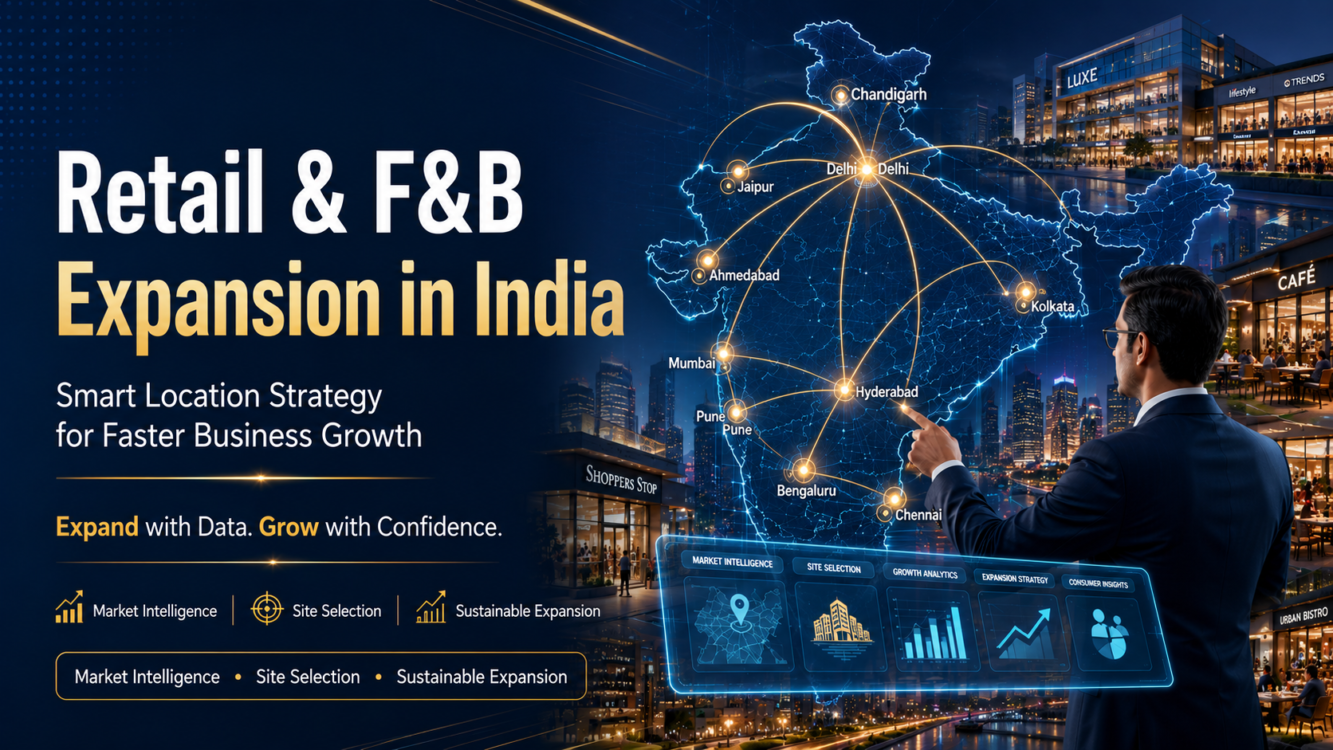
Retail & F&B Expansion in India: How Location Strategy Helps Brands Expand Across Cities & States
A successful retail store or restaurant is rarely built on a great product alone. Behind every thriving retail outlet, bustling café, quick-service restaurant, luxury boutique, or lifestyle brand lies one critical decision that determines long-term success, choosing the right location.
India’s retail and food & beverage (F&B) sectors are experiencing unprecedented growth. Rising disposable incomes, rapid urbanisation, expanding shopping centres, and evolving consumer preferences have created enormous opportunities for brands looking to scale across multiple cities and states. However, expansion without a well-defined location strategy often leads to underperforming outlets, operational inefficiencies, and significant financial losses.
Every city has its own demographic profile, purchasing behaviour, infrastructure, competitive landscape, and consumer expectations. What succeeds in Bengaluru may not generate similar results in Jaipur, Chandigarh, Indore, or Guwahati. Understanding these regional differences has become essential for brands aiming to achieve sustainable expansion across India.
This is where Retail & F&B Expansion Services play a strategic role. Rather than relying on intuition or available real estate alone, businesses can make informed decisions through market intelligence, location analytics, feasibility studies, and data-driven site selection.
India’s Retail Expansion Story Is Growing Faster Than Ever
India has become one of the world’s fastest-growing consumer markets. Organised retail continues to expand beyond metropolitan cities into Tier II and Tier III markets, where increasing purchasing power and changing lifestyles are driving new demand.
Similarly, the food and beverage industry has witnessed remarkable growth across quick-service restaurants, fine dining, cafés, cloud kitchens, bakeries, premium dessert brands, and international food chains. Consumers today actively seek convenience, experience, quality, and accessibility, making location more important than ever before.
As businesses pursue expansion opportunities, selecting the right market at the right time becomes a competitive advantage rather than a routine real estate decision.
Why Location Strategy Matters More Than Ever
Expansion is not simply about opening more stores; it is about opening stores that perform consistently.
A strategically selected location improves customer accessibility, enhances brand visibility, supports operational efficiency, and creates long-term profitability. Conversely, even an excellent product or popular brand may struggle if the chosen location lacks sufficient demand, appropriate demographics, or convenient accessibility.
Modern Location Strategy Services combine market research, geographic intelligence, consumer insights, traffic analysis, and commercial feasibility to evaluate each potential site before investment decisions are made.
This scientific approach significantly reduces uncertainty while increasing the likelihood of commercial success.
Understanding Location Strategy Beyond Real Estate
Many businesses mistakenly assume that location strategy only involves finding vacant retail space. In reality, it is a multidisciplinary process involving business planning, consumer behaviour analysis, competitive benchmarking, demographic evaluation, infrastructure assessment, and financial forecasting.
A comprehensive location strategy considers multiple variables simultaneously, including population density, household income, spending patterns, age distribution, educational profile, lifestyle preferences, accessibility, parking availability, public transport connectivity, nearby residential developments, commercial activity, and future urban growth.
These insights enable businesses to identify locations capable of supporting sustainable customer demand rather than short-term occupancy.
The Role of Market Research in Retail Expansion
Every successful expansion begins with understanding the market before entering it.
Professional market research evaluates customer demand, purchasing behaviour, local competition, consumer preferences, seasonal trends, and category-specific opportunities. Instead of relying solely on assumptions, brands gain measurable insights that guide investment decisions.
For example, a premium coffee chain may perform exceptionally well near corporate offices and educational institutions, while a family dining restaurant may achieve stronger performance within residential communities and mixed-use developments.
Similarly, luxury fashion retailers, supermarkets, pharmacies, electronics stores, fitness centres, salons, and specialty retail formats each require unique location criteria based on their target audience.
Market intelligence transforms expansion from guesswork into strategic planning.
Why Demographic Analysis Influences Business Success
People buy differently depending on where they live, work, travel, and socialise.
Demographic analysis helps brands understand the characteristics of local populations before selecting a new market. Factors such as income levels, family size, age groups, education, occupation, cultural preferences, and consumer lifestyle significantly influence purchasing decisions.
For instance, younger urban populations may generate higher demand for cafés, co-working spaces, fitness centres, and premium quick-service restaurants, whereas family-oriented residential neighbourhoods may support supermarkets, healthcare services, children’s entertainment, and casual dining outlets.
Understanding these demographic patterns allows brands to align their business model with local demand.
Competitive Analysis Helps Reduce Expansion Risk
Opening a new outlet without understanding the competitive landscape can expose businesses to unnecessary financial risk.
Competitive analysis identifies existing market players, pricing strategies, customer preferences, market saturation, tenant mix, service gaps, and emerging opportunities.
Rather than avoiding competition entirely, strategic analysis helps determine whether sufficient market demand exists to support another entrant while identifying opportunities for differentiation.
This information enables businesses to position themselves more effectively within the marketplace.
Catchment Analysis: Understanding Your True Customer Base
One of the most valuable components of location strategy is catchment analysis.
Catchment analysis evaluates the geographical area from which customers are likely to visit a store or restaurant. It considers travel time, road connectivity, traffic flow, residential density, workplace concentration, public transportation, accessibility, and surrounding commercial activity.
By understanding where customers originate and how they travel, businesses can accurately estimate potential footfall and sales opportunities before opening a new location.
Site Selection Is Both an Art and a Science
Selecting a retail location requires balancing commercial potential with operational practicality.
Factors such as frontage visibility, pedestrian movement, vehicle access, parking availability, loading facilities, lease structure, neighbouring brands, anchor tenants, future infrastructure projects, and local regulations all influence site performance.
Professional Retail Site Selection Services evaluate these factors systematically, enabling brands to choose locations that support both customer convenience and long-term business objectives.
A strategic site is not always the most expensive or the busiest—it is the one that best matches the brand’s target audience and operational model.
Expansion Across Multiple Cities Requires Consistency
Expanding from one city into several states presents additional challenges.
Consumer preferences vary considerably across regions, requiring brands to adapt their location strategy without compromising brand identity. Local regulations, commercial rental trends, supply chain logistics, labour availability, infrastructure quality, and competitive environments also differ from one market to another.
A structured expansion framework enables businesses to evaluate every new city using consistent criteria while accommodating regional variations.
This disciplined approach supports sustainable growth across diverse markets.
Technology Has Transformed Location Intelligence
Modern expansion planning increasingly relies on data-driven technologies.
Geographic Information Systems (GIS), demographic mapping, mobility analytics, satellite imagery, consumer behaviour data, traffic intelligence, and predictive market analytics now allow businesses to evaluate locations with greater accuracy than ever before.
Rather than depending solely on manual site visits, decision-makers can analyse hundreds of potential locations using objective performance indicators before conducting physical inspections.
Technology enhances confidence while reducing expansion risks.
The Financial Benefits of Strategic Expansion Planning
Thoughtful location strategy extends far beyond real estate acquisition.
By selecting high-potential markets, businesses can reduce operating costs, optimise marketing investments, improve inventory planning, enhance workforce productivity, strengthen customer acquisition, and maximise return on investment.
Well-planned expansion also supports stronger brand positioning, faster break-even periods, improved franchise performance, and long-term business sustainability.
Every successful location represents not only a physical address but also a strategic business asset.
Building a Scalable Growth Strategy for the Future
As India’s retail landscape continues to evolve, businesses must think beyond individual store openings and focus on building scalable expansion models.
Whether launching flagship stores, entering new states, expanding franchise networks, introducing food courts, developing shopping centre concepts, or establishing national retail footprints, success depends upon careful planning supported by reliable market intelligence.
Brands that invest in comprehensive location strategy today are better positioned to adapt to changing consumer expectations, emerging markets, and future growth opportunities.
Expansion should never be driven solely by available space, it should be guided by data, strategy, and long-term vision.
Conclusion
Retail and F&B expansion is one of the most significant investments a business can undertake. Choosing the right city, neighbourhood, shopping destination, or commercial property requires far more than intuition or convenience. It demands a deep understanding of markets, demographics, consumer behaviour, competitive dynamics, infrastructure, and long-term commercial viability.
A structured location strategy empowers brands to minimise investment risks while maximising growth potential across India’s rapidly evolving retail ecosystem. By combining market research, demographic intelligence, site evaluation, and data-driven decision-making, businesses can expand with greater confidence, operational efficiency, and long-term profitability.
In an increasingly competitive marketplace, successful expansion is no longer defined by the number of outlets opened, it is defined by opening the right outlets in the right locations at the right time.
Strategic Retail & Expansion Advisory by SkyZenith
SkyZenith provides comprehensive Retail Expansion Services, Location Strategy Consulting, Site Selection Advisory, Market Research, Catchment Analysis, Retail Leasing Support, Asset Management, Commercial Due Diligence, Mall Management, Feasibility Studies, and F&B Expansion Planning for retailers, restaurant brands, shopping centres, developers, investors, and commercial real estate stakeholders across India.
Combining deep market expertise with data-driven analytics, on-ground research, demographic intelligence, and strategic commercial insights, SkyZenith helps businesses identify high-potential growth opportunities while reducing investment risk. Every assignment is approached with a focus on long-term value creation, operational efficiency, and sustainable expansion, enabling brands to make informed decisions that support profitable growth across cities and states.
Contact Us
SkyZenith
Address: Unit No. 908, 9th Floor, Tower 1, DLF Corporate Greens, Sector 74A, Sohna Road, Gurgaon, Haryana – 122004
Phone: +91 97178 81177
Email: Hemraj.dabur@skyzenith.in
Website: https://skyzenith.in