-
Skyzenith
- September 15, 2026
Franchise Expansion in Chandigarh & Delhi NCR: How Brands Can Build a Pan-India Retail Presence
A successful retail brand is rarely built by opening stores everywhere at once. It grows by entering the right markets, understanding the right customers and choosing locations that can support both immediate sales and long-term brand value. For ambitious businesses in India, franchise expansion in Chandigarh and Delhi NCR can provide a strategic starting point for developing a wider national retail network.
The opportunity is particularly relevant for brands that have already established a product-market fit through online sales, existing outlets, distribution or franchise operations and are now looking to create a stronger physical presence.
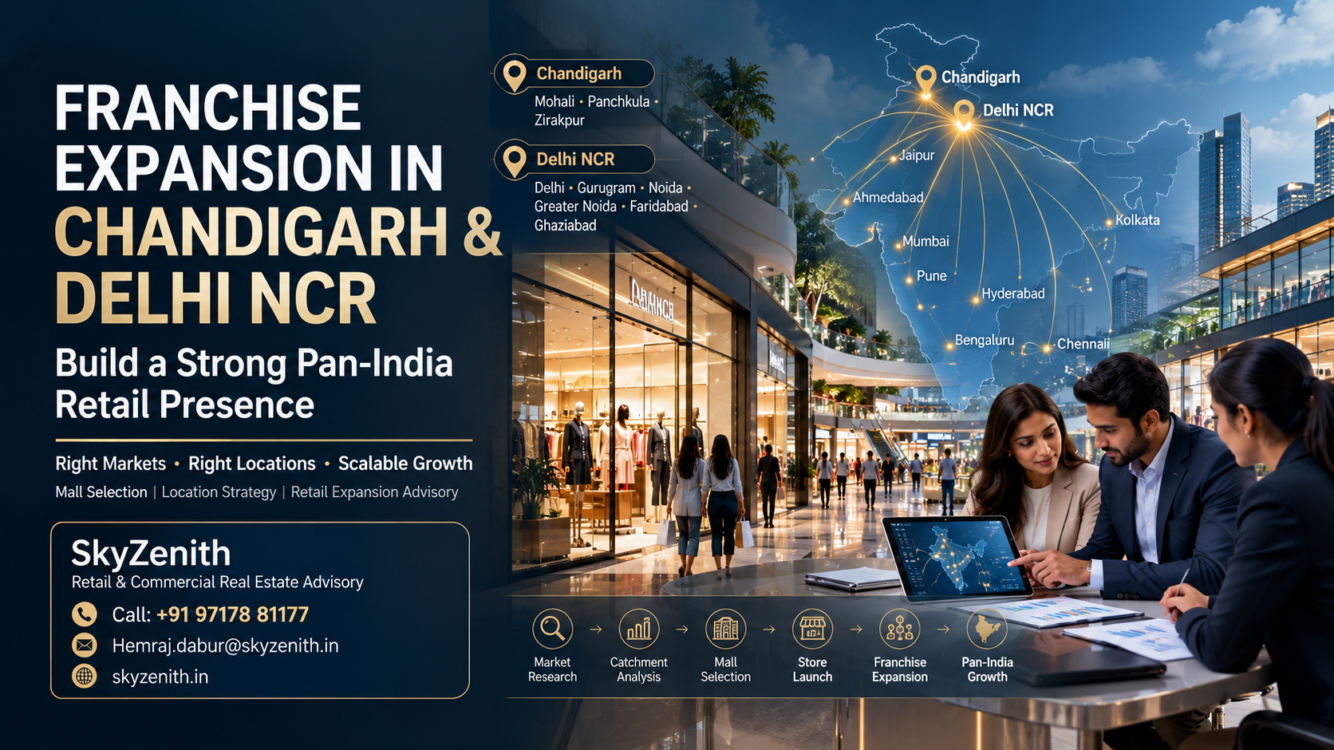
Chandigarh offers access to the wider Tricity and North Indian market, while Delhi NCR provides one of India’s most diverse and commercially active retail ecosystems. Together, these markets can become important stages in a carefully planned Pan-India retail expansion strategy.
Why Chandigarh Is Important for Franchise Expansion
Chandigarh is more than a city-level retail market. Its commercial influence extends into Mohali, Panchkula, Zirakpur and surrounding areas of Punjab and Haryana.
This wider catchment makes Chandigarh mall space for franchise brands particularly interesting for businesses looking to establish a North Indian presence.
The market already supports a broad mix of national and international fashion, lifestyle, footwear, food and beverage and entertainment brands. Chandigarh’s organised retail ecosystem also benefits from its proximity to several affluent and rapidly developing surrounding markets. Industry analysis has identified Chandigarh and the wider Tricity as an important Tier-II retail destination, with established retail clusters and continued development potential.
For a growing brand, entering Chandigarh can therefore serve two purposes: generate local revenue and establish a recognisable retail presence across a wider regional catchment.
Recent brand activity illustrates this potential. Krispy Kreme entered Chandigarh through CP67 Mall in 2026 as part of its broader North India expansion, extending its presence beyond Delhi NCR.
Delhi NCR Retail Expansion: A Gateway to National Growth
While Chandigarh can provide a strong regional entry point, Delhi NCR retail expansion offers access to a much larger and more diverse consumer base.
Delhi, Gurugram, Noida, Greater Noida, Ghaziabad and Faridabad function as interconnected but distinct commercial markets. Each has different consumer demographics, retail formats, residential catchments, corporate districts and spending patterns.
This creates opportunities for brands across multiple categories.
A premium fashion brand may target destination malls in South Delhi or Gurugram. A QSR or café may prefer a high-footfall commercial zone or a corporate catchment. A family lifestyle brand may require a mall with strong weekend traffic and entertainment offerings.
The latest market indicators reinforce the strength of the region. Delhi-NCR retail leasing increased sharply during the first half of 2026, with fashion, food and beverage and department stores among the key demand drivers. Mall leasing also recorded strong growth during the period.
For brands, this means the opportunity is significant but competition for suitable retail locations is also becoming more intense.
Choosing the Right Mall for Franchise Expansion
A common mistake in retail expansion is assuming that the most famous mall is automatically the best location.
The right mall is the one where the brand’s target customer, positioning and store economics align with the property’s characteristics.
Before selecting a location, brands should evaluate:
Retail Catchment and Customer Profile
Who lives, works and shops around the property? A high footfall number has limited value if the visitors do not match the brand’s target audience.
Mall Footfall and Quality of Traffic
Brands should consider not only total visitors but also weekday versus weekend patterns, dwell time, customer demographics and the areas of the mall generating the strongest movement.
Tenant Mix and Brand Compatibility
Complementary brands can increase customer attraction, while direct competitors may provide useful evidence of category demand. A carefully selected tenant mix can strengthen the positioning of a new outlet.
Store Visibility and Positioning
Ground-floor frontage, atrium visibility, anchor proximity, entrance positioning and escalator or elevator movement can influence customer discovery.
Commercial Terms
Rent, revenue share, common-area maintenance charges, security deposits, fit-out periods and other commercial obligations should be evaluated against realistic sales projections.
Future Development
Upcoming residential projects, office districts, infrastructure improvements and transport connectivity can materially influence a location’s long-term potential.
This is why mall selection for franchise expansion should be treated as a strategic exercise rather than simply a property search.
Chandigarh and Delhi NCR as a Two-Stage Expansion Strategy
For some brands, entering Chandigarh and Delhi NCR can work particularly well as a two-stage North India strategy.
The brand can establish itself in Chandigarh and the Tricity, understand regional customer behaviour and strengthen its franchise operating model. Delhi NCR can then provide a larger platform for premium positioning, greater visibility and wider market recognition.
The reverse strategy can also work.
A brand with an established Delhi NCR presence may use Chandigarh as its next regional expansion market, particularly when the business has already developed the operational infrastructure required for multiple locations.
The correct sequence depends on the category, investment capacity, franchise model and customer profile.
From Chandigarh and Delhi NCR to Pan-India Retail Expansion
A national retail network should not be created simply by adding cities to a list.
A stronger approach is to build an expansion hierarchy.
Phase One: Establish the North India Base
The brand identifies suitable opportunities in Chandigarh and Delhi NCR and develops a repeatable store model.
Phase Two: Enter Major Metropolitan Markets
Once the model is validated, the business can evaluate markets such as Mumbai, Bengaluru, Hyderabad, Pune, Chennai and Ahmedabad.
Phase Three: Expand Into High-Potential Regional Cities
The brand can then identify cities such as Jaipur, Lucknow, Indore, Chandigarh, Ludhiana, Amritsar, Surat, Nagpur, Kochi and other markets according to its customer profile and category demand.
Phase Four: Develop a Wider Franchise Network
After establishing operational consistency, the brand can use franchise partnerships to reach additional Tier-II and Tier-III markets where direct company-operated expansion may require greater capital.
The exact city sequence should always be based on market research rather than assumptions.
Franchise Expansion Strategy for Growing Brands
A strong franchise expansion strategy in India begins with understanding the economics of the individual store.
Before approaching franchise partners, brands should have clarity on:
- Store size and format
- Initial investment
- Expected sales range
- Gross margins
- Operating costs
- Break-even expectations
- Franchise fee, where applicable
- Royalty structure
- Marketing contribution
- Inventory model
- Staff requirements
- Territory policy
- Store-level performance metrics
A franchise opportunity becomes more attractive when the business model is transparent and repeatable.
For the brand itself, this preparation is equally important because every franchise outlet represents the company’s reputation.
The Importance of Location Strategy in Retail
Retail success often depends on details that are invisible in a simple property listing.
Two stores in the same city can have dramatically different performance because of differences in catchment, visibility, access, competition and customer movement.
This is why retail location strategy in India should combine real estate evaluation with consumer analysis.
For Delhi NCR, a brand should assess individual micro-markets rather than treating the entire region as one location. Gurugram’s corporate districts, Noida’s mixed residential-commercial zones, South Delhi’s established retail corridors and other NCR markets have different commercial characteristics.
The same principle applies to Chandigarh and the Tricity.
Building a Consistent Brand Experience Across India
Pan-India expansion creates another challenge: maintaining consistency.
Customers should recognise the brand whether they encounter it in Chandigarh, Delhi, Mumbai or Bengaluru.
This requires clear standards for:
Store design: consistent visual identity and customer flow.
Product quality: standardised quality-control procedures.
Customer service: common service principles and staff training.
Technology: integrated billing, inventory and customer-data systems.
Marketing: central brand guidelines with room for local campaigns.
Operations: clearly documented franchise procedures.
At the same time, successful brands understand that India is not a single consumer market. Product assortment, promotions, store communication and local marketing may need to adapt to regional preferences.
The goal is national consistency with local intelligence.
Mall Leasing and Retail Advisory for Expanding Brands
As competition for high-quality retail space increases, brands need more than a list of available properties.
They need to understand which locations genuinely fit their expansion objectives.
A professional retail advisory process can help businesses identify markets, evaluate catchments, compare malls and high streets, assess commercial structures and develop a location pipeline aligned with the brand’s growth plan.
This becomes particularly valuable when a brand is simultaneously evaluating Chandigarh, Delhi NCR and other cities.
The objective is not simply to secure a store. It is to create a portfolio of strategically positioned retail locations.
Avoiding Common Franchise Expansion Mistakes
Fast growth can be tempting, but uncontrolled expansion can damage a promising brand.
Common mistakes include choosing locations solely because of high footfall, underestimating rental and operating costs, opening multiple stores before validating the business model, selecting franchise partners without adequate evaluation and failing to maintain consistent operating standards.
Another frequent mistake is treating real estate and franchise strategy as separate decisions.
They are closely connected.
A franchise model must work within the economics of the selected location, while the location must support the brand’s customer proposition and store format.
The Future of Retail Expansion in India
India’s retail environment is becoming increasingly sophisticated. Digital-first brands are moving into physical stores, established retailers are expanding into new cities and consumers are increasingly seeking experiences that combine convenience, discovery and physical interaction.
Recent industry data indicates that organised retail leasing remains strong, while Delhi NCR continues to attract substantial demand from expanding brands.
At the same time, premium retail locations are becoming more competitive, making early and informed location planning increasingly important.
For brands, this creates an opportunity but also raises the importance of making disciplined expansion decisions.
Turning Regional Presence Into a Pan-India Brand
The journey from a successful local outlet to a national retail brand is not achieved through store count alone.
It is built through strategic location selection, strong franchise economics, disciplined operations, consistent brand experience and intelligent market expansion.
Chandigarh can provide an influential North Indian platform. Delhi NCR can provide scale, visibility and access to a diverse consumer ecosystem. Together, they can form a powerful foundation for brands planning a broader Pan-India retail presence.
The most successful brands will be those that treat every new store not simply as another outlet, but as another carefully planned chapter in the brand’s national growth story.
About SkyZenith
SkyZenith is a professional real estate advisory firm focused on helping brands, retailers, investors and businesses make informed commercial property and expansion decisions across India. Its services include mall management and advisory, retail asset management and leasing, commercial leasing and sales, hotel leasing, location strategy, smart-building advisory, sustainability and building audits, workplace and occupancy planning, fit-out and design advisory, and experience and club management. The company’s key USP is its advisory-led approach to retail and commercial real estate, combining market understanding, location strategy, property evaluation and business objectives rather than approaching expansion simply as a property transaction. This enables brands to assess opportunities across established metros, emerging cities and regional markets while developing a structured and scalable retail expansion strategy.
Contact SkyZenith
Address: Unit No. 908, 9th Floor, Tower 1, DLF Corporate Greens, Sector 74A, Sohna Road, Gurgaon, Haryana 122004
Email: Hemraj.dabur@skyzenith.in
Phone: +91 97178 81177
Website: skyzenith.in