-
Skyzenith
- April 29, 2026
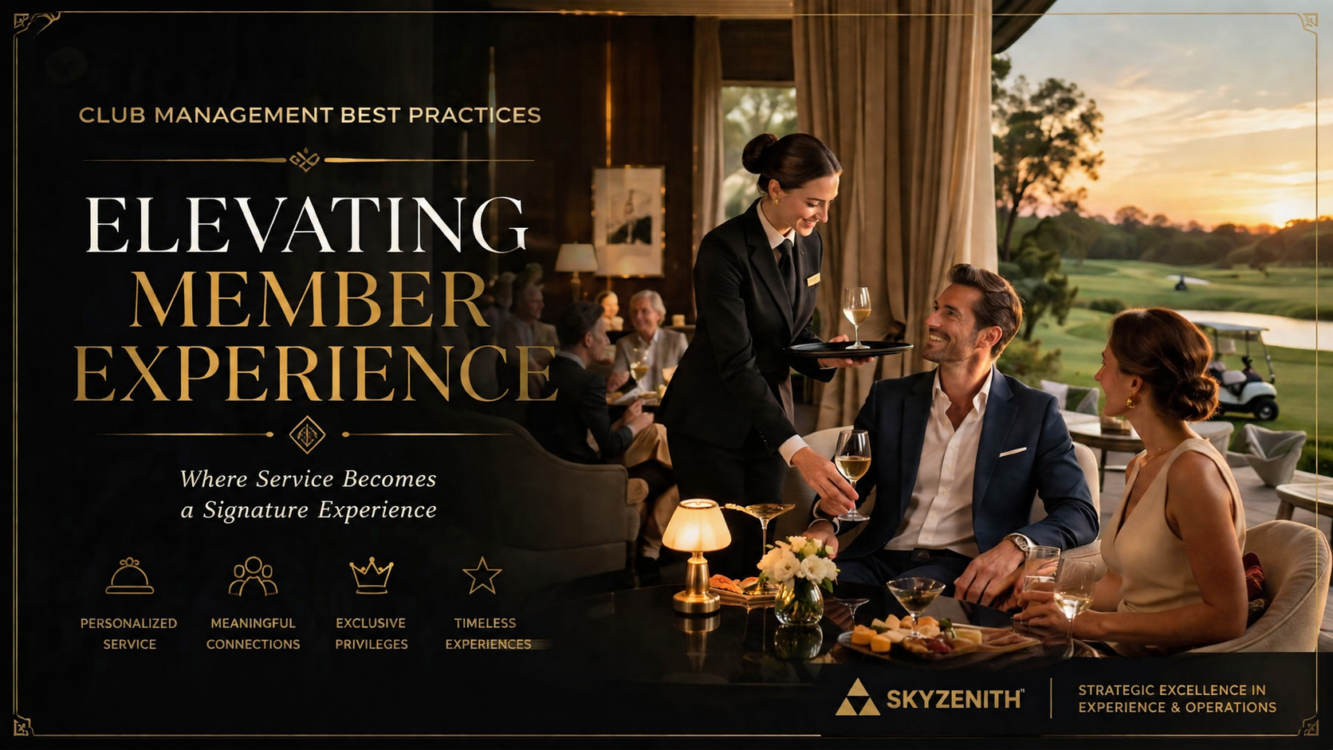
Club Management Best Practices: Elevating the Member Experience
A private club is not merely a building with amenities. It is a curated community where every interaction, every service, and every silent detail contributes to a sense of belonging. In an era where digital connections often overshadow physical ones, the most successful clubs are those that transform transactions into relationships and facilities into sanctuaries. For club managers, board members, and hospitality professionals, the question is no longer how to retain members but how to create experiences so compelling that leaving becomes unthinkable. This article explores the best practices that define exceptional club management, focusing on the art and science of elevating member experience.
The New Paradigm: From Amenity to Experience
Historically, clubs competed on facilities: the finest golf course, the most elegant dining room, the most exclusive spa. Today, these are table stakes. Members expect seamless integration of luxury, convenience, and personal recognition. A 2023 survey of private club members revealed that 78 percent valued personalised service over any single amenity. The club that remembers a member’s preferred table, their child’s name, or their aversion to crowded spaces builds loyalty that no new chandelier can match.
The shift demands a holistic management approach. Every department from front desk to groundskeeping, must operate as a single organism with a shared mission: making each member feel seen, valued, and anticipated.
Member Journey Mapping: Understanding Every Touchpoint
The first step in elevating experience is understanding exactly how members interact with your club. Journey mapping involves documenting every point of contact, from the moment a potential member inquires about joining to the farewell after an evening event.
Key touchpoints to analyse:
- Initial inquiry and tour experience
- Onboarding and welcome process
- Daily visits (parking, reception, locker rooms)
- Dining and event reservations
- Use of sports facilities, pool, or golf course
- Billing and administrative interactions
- Departure (end of visit or membership offboarding)
For each touchpoint, ask: Is this frictionless? Does it delight? Does it communicate respect for the member’s time? Clubs that excel conduct quarterly journey audits, identifying bottlenecks and eliminating unnecessary steps. A simple change, moving the check-in desk or introducing mobile key access, can transform a frustrating arrival into a gracious welcome.
Staff Empowerment: The Frontline of Member Experience
No policy manual can replace a well-trained, empowered employee. The most memorable club experiences often arise from a staff member who solved a problem without escalation, offered an unexpected courtesy, or remembered a personal preference.
Best practices for staff development include:
- Recognition programmes that celebrate employees who receive member compliments
- Cross-departmental training so that a pool attendant can answer a question about dinner reservations
- Discretionary authority allowing front-line staff to resolve minor issues (e.g., comping a drink or sending flowers) without manager approval
- Regular service culture meetings where team members share “member delight” stories
When staff feel valued and trusted, they extend that respect to members. The result is a virtuous cycle of positive interactions.
Personalisation at Scale: Using Data Without Intrusion
Members expect clubs to know their preferences but not to feel surveilled. The solution lies in intelligent, consent-based data use.
Modern club management software can track:
- Preferred dining times and seating areas
- Food allergies or dietary restrictions
- Significant dates (birthdays, anniversaries)
- Frequently used facilities or classes
- Guest history and accompanying family members
This information, when used discreetly, enables gestures that feel magical. A favourite wine waiting at the usual table. A complimentary round of golf for a member’s birthday. A quiet note welcoming a member back after an absence. These small acts communicate that the club pays attention, not intrusively, but caringly.
However, data handling must comply with privacy regulations and member expectations. Opt-in consent, transparent policies, and the ability to update preferences are non-negotiable.
Operational Excellence: The Unseen Foundation
Member experience is built on reliability. A club that consistently fails on basics,dirty locker rooms, cold food, broken equipment, cannot rescue itself with friendliness. Operational excellence requires:
- Predictive maintenance schedules for HVAC, pool filtration, and kitchen equipment
- Real-time reporting systems for housekeeping and grounds teams
- Inventory management ensuring popular items are never out of stock
- Emergency protocols for medical incidents, weather events, or security concerns
Clubs that invest in back-of-house technology, such as integrated facility management software, free their staff to focus on front-of-house hospitality. Members never see the boiler room, but they immediately notice when the hot water fails.
Programming That Creates Community
Beyond facilities and service, members join clubs for connection. The most successful clubs curate programmes that foster genuine relationships across generations and interests.
High-impact programming ideas:
- Family-focused events (parents’ night out, children’s holiday parties)
- Interest-based groups (book clubs, investment circles, gardening societies)
- Wellness series (nutrition workshops, mindfulness retreats)
- Cultural evenings (guest speakers, art exhibitions, live music)
- Competitive but friendly tournaments (golf, tennis, bridge)
The key is variety and rhythm. Members should always have something to look forward to, without feeling overwhelmed. A well-designed calendar balances recurring favourites with novel experiences.
Feedback Loops: Listening as a Strategic Asset
Even the best-managed club cannot read minds. Formal and informal feedback mechanisms are essential. Best practices include:
- Quarterly satisfaction surveys with anonymised responses
- Suggestion boxes in physical and digital formats
- Member advisory committees representing different demographics
- Exit interviews for departing members (the most honest feedback)
More importantly, clubs must act on feedback visibly. When a suggestion is implemented, acknowledge it. When an issue cannot be resolved, explain why. Silence erodes trust; transparency builds it.
The Financial Dimension: Balancing Investment and Value
Elevating member experience costs money. Successful clubs approach this not as expense but as investment. Capital improvements, technology upgrades, and staff training all require budget allocation. The discipline lies in prioritising projects that member surveys identify as most desired.
Transparent financial communication also matters. Members tolerate fee increases when they understand the value received. Regular town hall meetings, detailed annual reports, and open budget sessions demystify club finances and build collective ownership.
Crisis Readiness: Protecting the Experience When Things Go Wrong
No club is immune to disruptions, from natural disasters to reputational incidents. Best practice requires a crisis communication plan that prioritises member safety and transparency. Designate a crisis team, establish clear messaging channels, and rehearse scenarios annually. Members remember how you responded in difficulty as much as how you performed in normal times.
Measuring Success: Beyond Retention Rates
While member retention is the ultimate metric, leading indicators matter more. Track:
- Net Promoter Score (how likely members are to recommend the club)
- Average visit frequency per member
- Utilisation rates of different facilities
- Member referral rates
- Staff turnover (high turnover destroys experience consistency)
A dashboard of these metrics, reviewed monthly by management, enables proactive adjustments before small issues become membership cancellations.
Conclusion: The Art of Invisible Excellence
Exceptional club management resembles a well-orchestrated symphony. The audience hears the music but never sees the countless rehearsals, the tuned instruments, or the conductor’s silent cues. Similarly, members should feel effortlessly cared for, warm greetings, seamless logistics, thoughtful surprises, without ever perceiving the systems and staff that make it possible. That invisible excellence is the ultimate best practice. And it begins with a deliberate choice: to see club management not as administration but as the creation of lasting human connection.
About SkyZenith
SkyZenith is a professional asset management and investment advisory firm that also provides strategic consulting for businesses seeking operational excellence and sustainable growth. The company offers services including portfolio construction, risk management, asset allocation, and financial planning across equities, fixed income, real assets, and alternative investments. SkyZenith’s unique selling proposition lies in its forward-looking, data-driven approach that combines macroeconomic analysis with behavioural finance to deliver customised solutions. For organisations in the hospitality, club management, and service industries, SkyZenith provides advisory on financial structuring, operational efficiency, and long-term value creation. The firm emphasises transparency, regular performance reviews, and alignment of interests with its clients. For inquiries or to explore how strategic financial and operational insights can elevate your organisation, contact SkyZenith at Unit No. 908, 9th Floor, Tower 1 DLF Corporate Greens, Sector 74A Sohna Road, Gurgaon, Haryana 122004. Email: Hemraj.dabur@skyzenith.in. Phone: +91 97178 81177. Visit the official website: www.skyzenith.in