-
Skyzenith
- April 21, 2026
Hotel Leasing in 2026: What Property Owners Need to Know About Operator Demand ?
Consider two hotel owners. One sits back, confident that a property with four walls and a reception desk is enough to attract a top-tier operator. The other, watching the rapid changes in the Indian hospitality landscape, asks a more difficult question: what do the brands actually want today?
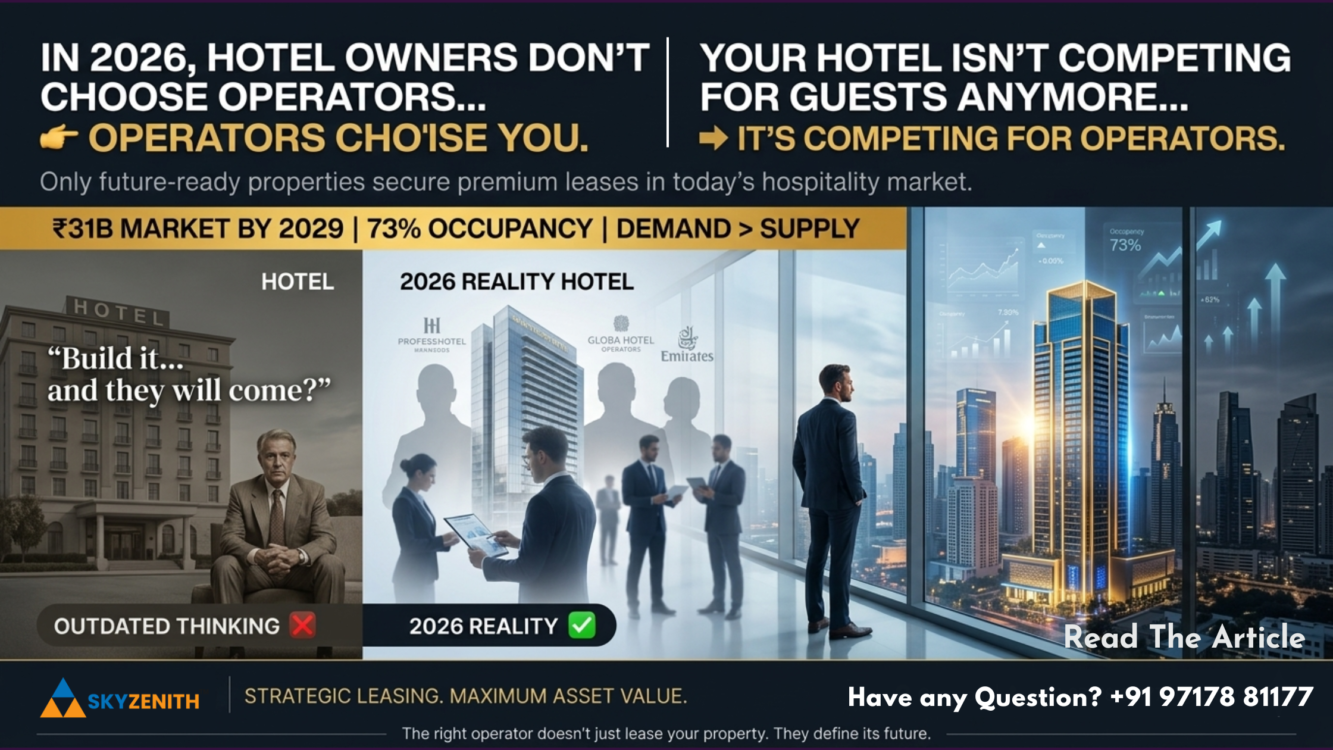
In 2026, the answer to that question has shifted fundamentally. Hotel leasing is no longer a passive transaction. It has become a strategic competition, one where operators hold the upper hand, and only properties that align with their evolving priorities will secure premium leasing terms.
A Market That Has Fundamentally Changed
The Indian hospitality sector has entered a phase of structural maturity. Between 2024 and 2029, the market size is projected to rise from approximately USD 24.6 billion to nearly USD 31 billion, driven largely by an extraordinary surge in domestic tourism that recorded 4.1 billion visits in 2025 alone. This growth is not a temporary bounce. Demand is expected to outpace supply consistently, growing at 10.5 per cent annually against just 8 per cent on the supply side, pushing occupancy rates toward 73 per cent by the end of the current fiscal year.
For property owners, these numbers translate into a singular reality: operators are expanding aggressively, but they are doing so on their own terms.
The Quiet Revolution in Operating Models
The traditional lease, where a hotel brand simply paid fixed rent to occupy a property, is steadily losing relevance. According to a 2026 Global Investor Outlook, there is a pronounced shift away from conventional lease structures toward more hands-on, risk-based agreements, with franchise and management contracts increasingly replacing fixed leases. The reason is simple: operators want greater control and the ability to participate directly in performance upside, while investors seek stronger returns.
India mirrors this global trend. The asset-light model has become the dominant framework for expansion. A developer constructs the hotel; the brand operates it, earning management fees linked to revenue or profit. In 2025 alone, Indian and global hotel chains signed pacts to manage at least 550 new hotels across the country. Major players such as Marriott signed 99 contracts in 2025 and added another 13 in the first quarter of 2026, while Radisson has already added nine new hotels this year.
For property owners, this evolution carries a critical implication. The days of simply handing over the keys to a brand and collecting a cheque are fading. Today, operators evaluate every property through a far more demanding lens.
What Hotel Operators Are Demanding in 2026
Understanding what drives operator demand is essential for any property owner seeking to secure a favourable leasing arrangement.
Location Beyond the Metros
The conventional wisdom that only gateway cities matter has been overturned. Investor interest is expanding beyond traditional metro markets to include leisure destinations, pilgrimage centres, and emerging commercial cities with constrained supply of branded inventory. Western India leads with a 69.5 per cent occupancy rate, while destinations such as Rishikesh, Udaipur, and Varanasi are emerging as high-yield markets. Operators are actively seeking properties in tier-two and tier-three cities, supported by improving connectivity and expanding tourism infrastructure.
The Premiumisation Imperative
Consumer behaviour has tilted decisively towards premium and luxury hospitality products. Five-star deluxe hotels achieved the highest occupancy rate of 69.2 per cent, and their average daily rate has grown at the fastest pace of 10 per cent among all categories. This preference is not temporary; it reflects a sustained shift in consumer willingness to pay for superior quality in amenities, services, and experiences. Operators, consequently, are prioritising properties that can support upscale or upper-midscale positioning. The supply pipeline in 2025 shifted decisively toward premiumisation, with upper midscale, upscale, and upper upscale categories accounting for nearly 60 per cent of new openings.
Sustainability as a Non-Negotiable
What was once considered a niche preference has become a core expectation. Three-quarters of travellers now say that sustainability credentials influence their hotel choice, and many are willing to pay an average premium of nearly 12 per cent for a night at a hotel with stronger environmental practices. For operators, this translates into a clear requirement: properties must demonstrate genuine commitment to eco-conscious operations. Green architecture, rainwater harvesting, water-saving technologies, and local sourcing are no longer differentiators, they are baseline expectations.
Flexibility and Modernisation
The modern traveller seeks experiences that engage the senses and foster connection, not merely accommodation. Hotels are increasingly curating interactive activities such as cultural workshops and themed social gatherings. Storytelling-led design and sensory cues are transforming the guest journey. At the same time, the integration of artificial intelligence is accelerating, with hotels planning significant investment in revenue intelligence, forecasting, and automation. For property owners, this means that a rigid, outdated asset is unlikely to attract serious operator interest. Properties that can accommodate flexible layouts, technology integration, and modern design elements will command premium attention.
Preparing Your Property for the New Leasing Landscape
For property owners, the question is no longer whether to lease, but how to position their asset to win in a competitive environment.
First, understand your property’s true profile. Is it suited for upscale positioning, or would it perform better as a select-service asset? The answer determines which operator segments to approach. Second, assess your property’s readiness for modern guest expectations. Does the design allow for wellness-oriented spaces? Can the infrastructure support sustainability certifications? Third, recognise that leasing terms have evolved. Fixed-rent structures are giving way to performance-linked agreements. Owners must be prepared for transparent negotiations that align incentives between both parties.
The Indian hospitality market is entering its most dynamic phase in decades. For property owners who understand the new rules of engagement, the opportunity is substantial. For those who cling to outdated assumptions, the risk of being left behind is equally real.
About SkyZenith
SkyZenith is a specialised real estate advisory firm focused on creating long-term value through strategic leasing solutions. The company offers comprehensive services including retail leasing, tenant mix planning, market research and analysis, lease negotiation and execution, and post-leasing support. For hotel properties specifically, SkyZenith provides expertise in operator selection, hospitality brand alignment, lease structuring, and property optimisation. With a philosophy that leasing is not merely about filling space but about creating enduring asset value, SkyZenith serves as a trusted partner for property owners seeking to maximise return on investment in an increasingly sophisticated hospitality market.
Address
Unit No. 908, 9th Floor, Tower 1
DLF Corporate Greens, Sector 74A
Sohna Road, Gurgaon, Haryana 122004
Contact
📧 Hemraj.dabur@skyzenith.in
📞 +91 97178 81177