-
Skyzenith
- April 17, 2026
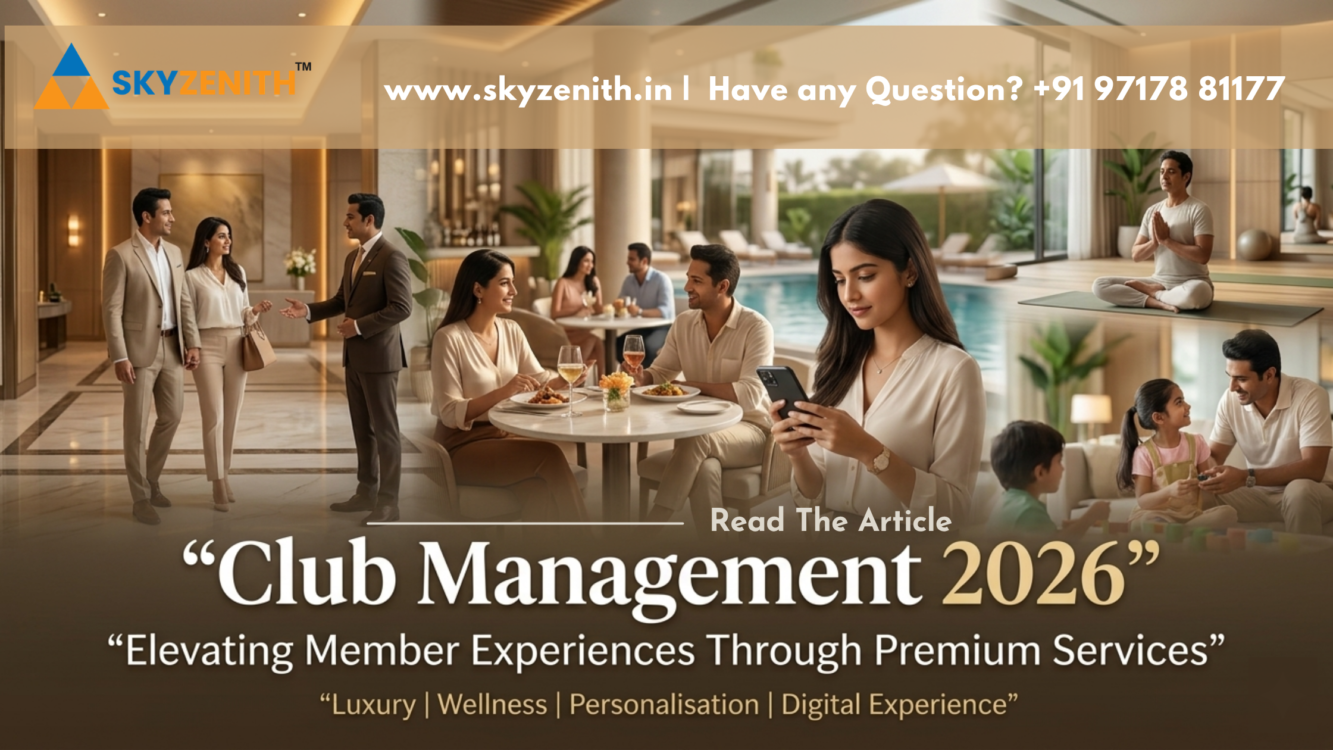
Club Management in 2026: Elevating Member Experiences Through Premium Services
The New Dawn of Private Club Culture
The year 2026 marks a defining moment for private clubs across India’s metropolitan landscape. Gone are the days when a swimming pool, a restaurant, and a banquet hall sufficed to retain members. Today’s discerning clientele, urban professionals, affluent families, and corporate executives, demand something far more sophisticated. They seek seamless experiences, anticipatory service, and environments that blend luxury with efficiency. Club management has evolved from operational administration to experience orchestration, and those who fail to adapt risk obsolescence.
Imagine walking into a club where the concierge knows your preferred table, the temperature adjusts to your comfort before you arrive, and the calendar offers curated wellness retreats alongside business networking events. This is not a distant vision. This is the baseline expectation for premium clubs in 2026. The question for club owners and general managers is no longer if they should transform, but how, and how quickly.
Why 2026 is the Pivot Year for Indian Club Management
The Post-Pandemic Shift in Member Priorities
The COVID-19 pandemic fundamentally rewired what people seek from leisure and social spaces. Health, hygiene, and personalisation have taken centre stage. Members now evaluate clubs not merely by their facilities but by their responsiveness, transparency, and ability to deliver safe, contactless experiences. A 2025 industry survey revealed that 78% of club members in major Indian cities consider digital integration, mobile apps for bookings, payments, and feedback, as non-negotiable.
Furthermore, the rise of hybrid work models means clubs have become extensions of the home and office. Members expect quiet co-working lounges, high-speed connectivity, and private meeting pods alongside traditional recreational amenities. Club management in 2026 must therefore straddle three domains: hospitality, workplace design, and wellness.
The Premiumisation Trend: From Access to Exclusivity
Premium services no longer mean simply higher fees. They mean curated exclusivity, limited guest lists for events, personalised training programmes, farm-to-table dining with traceable ingredients, and partnerships with luxury brands. Members pay a premium not just for access but for a sense of belonging to a community that reflects their aspirations. Club managers who understand this psychological shift can transform their properties into coveted lifestyle destinations rather than mere facilities.
Core Pillars of Premium Club Management in 2026
1. Personalisation Through Data Intelligence
The most successful clubs in 2026 are those that treat personalisation as a science. By integrating club management software with customer relationship management systems, clubs can track member preferences, from favourite beverages to preferred tennis court timings, and act on that data proactively. Imagine a member receiving a notification that their preferred spa therapist has a cancellation next Tuesday, or that the wine they ordered last month is back in stock.
Data intelligence also enables dynamic pricing for peak hours, targeted promotions for underutilised services, and predictive maintenance of equipment. However, club managers must balance personalisation with privacy, ensuring transparent data policies and opt-in consent.
2. Seamless Digital Ecosystems: The Mobile-First Member Journey
A premium club experience in 2026 is incomplete without a robust mobile application. Members expect to book a squash court, register for a pilates class, order a post-workout smoothie, and settle their monthly bill, all from their smartphone. Digital wallets, biometric entry systems, and QR-code-based locker access reduce friction and enhance security.
Moreover, the app serves as a communication channel for real-time updates: class cancellations, weather-related pool closures, or last-minute chef’s table openings. Clubs that invest in intuitive, visually appealing digital platforms see higher engagement and lower administrative overhead.
3. Wellness as an Integrated Lifestyle Offering
Wellness has expanded far beyond gym equipment. Premium clubs now offer cryotherapy chambers, IV vitamin therapy, mindfulness zones, and sleep pods. Group classes range from aerial yoga to high-intensity interval training with heart rate monitoring. Nutritionists conduct body composition analyses, and personal trainers design long-term fitness roadmaps.
Crucially, wellness is no longer siloed. A member’s gym attendance might trigger a tailored menu recommendation from the restaurant, or a spa visit might lead to a discounted physiotherapy session. Club management must foster cross-departmental collaboration to deliver holistic wellness journeys.
4. Culinary Excellence with Local & Sustainable Sourcing
The club restaurant has transformed into a destination in its own right. Members expect menus that rotate seasonally, feature organic produce from local farms, and accommodate dietary preferences, keto, vegan, gluten-free, and more. Open kitchens, chef’s tables, and interactive dining experiences elevate mealtime into entertainment.
Wine cellars with sommelier-led tastings, mixology bars with signature cocktails, and private dining rooms for family celebrations all contribute to a premium food and beverage programme. In 2026, a club’s culinary reputation directly influences member retention and word-of-mouth referrals.
5. Family-Centric Programming & Multi-Generational Appeal
Modern clubs must cater to every generation. While parents use the gym and spa, children need supervised activity zones with educational play. Teenagers want gaming lounges and social events. Grandparents seek gentle yoga, card rooms, and book clubs. Successful club management designs programmes that allow families to spend time together, poolside barbecues, movie nights, holiday workshops, while also providing age-appropriate separate spaces.
Child-minding services with qualified staff, school holiday camps, and intergenerational events like “cooking with grandma” build deep emotional loyalty. When a club becomes woven into a family’s weekly rhythm, membership churn plummets.
6. Sustainability as a Service Differentiator
Environmentally conscious members increasingly choose clubs that align with their values. Solar-heated pools, rainwater harvesting, LED lighting, and waste segregation are now baseline. Premium clubs go further: they eliminate single-use plastics, install electric vehicle charging stations, and publish annual sustainability reports. Some clubs even involve members in tree-planting drives or community clean-up events, turning sustainability into a shared mission.
Operational Excellence: The Unsung Hero of Premium Experiences
Staff Training & Emotional Intelligence
Technology alone cannot deliver premium experiences. Well-trained, emotionally intelligent staff who remember names, anticipate needs, and handle complaints with grace are the true differentiators. Club managers must invest in continuous training, not just in service protocols but in communication, conflict resolution, and cultural sensitivity. Recognition programmes that reward staff for member compliments create a motivated, member-first culture.
Preventive Maintenance & Asset Longevity
A broken treadmill or a malfunctioning sauna erodes member trust instantly. Premium clubs adopt predictive maintenance schedules using IoT sensors that alert engineering teams before equipment fails. Regular deep-cleaning of HVAC systems, pool filtration checks, and kitchen exhaust duct cleaning (as highlighted in industrial facility management) ensure that behind-the-scenes operations never disrupt the member experience.
Feedback Loops & Continuous Improvement
The most agile clubs in 2026 operate on real-time feedback. Digital kiosks, in-app surveys, and quarterly member councils provide actionable insights. Club managers who treat complaints as gifts, and close the loop publicly by communicating changes made, build a culture of transparency and co-creation.
The Future-Ready Club: A Blueprint for 2026 and Beyond
As we look ahead, club management will continue to converge with hospitality technology, wellness science, and community psychology. Artificial intelligence will enable hyper-personalised recommendations, suggesting a recovery session after a member’s long run, or inviting them to a wine and cheese evening based on their past purchases. Virtual reality might allow members to preview club renovations or attend remote classes. Blockchain could revolutionise membership transfers and loyalty points.
Yet amidst all this technology, the human element remains irreplaceable. A genuine smile, a thoughtful gesture, a sense of belonging, these timeless truths will always define a great club. The clubs that thrive in 2026 will be those that harness innovation not for its own sake, but to deepen authentic human connections.
About SkyZenith
SkyZenith is a premier integrated facility and club management consultancy based in Gurgaon, serving clients across the National Capital Region. The company specialises in elevating member experiences through data-driven personalisation, digital transformation, wellness programming, and operational excellence. SkyZenith’s unique selling proposition lies in its holistic approach—bridging luxury hospitality standards with operational efficiency to deliver measurable improvements in member satisfaction, retention, and revenue per member. From conceptualising premium service blueprints to implementing smart club management software and training frontline teams, SkyZenith partners with club owners to transform properties into thriving lifestyle communities. With a proven track record across corporate clubs, residential complexes, and private membership organisations, SkyZenith stands as a trusted advisor for those seeking to future-proof their club assets in 2026 and beyond.
Address:
Unit No. 908, 9th Floor, Tower 1 DLF Corporate Greens, Sector 74A Sohna Road, Gurgaon, Haryana 122004
Email: Hemraj.dabur@skyzenith.in
Phone: +91 97178 81177