-
Skyzenith
- April 19, 2026
Commercial Leasing 2026: Trends Shaping Office and Retail Spaces
The landscape of commercial real estate has never been static, but the forces reshaping it in 2026 are unlike anything seen in the previous decade. The traditional office, once a non‑negotiable anchor of corporate identity, is being reimagined. The retail store, long threatened by the rise of e‑commerce, is finding new life as an experiential hub. For businesses, investors and property owners, understanding the currents of commercial leasing in 2026 is not merely an advantage it is a necessity for survival.
This article takes you inside the shifting dynamics of office and retail leasing, weaving together the stories of how spaces are being redefined, why tenants are demanding more than square footage, and what the future holds for India’s commercial corridors.
The Great Uncoupling: Why 2026 Is Different
Imagine a corporate headquarters in Gurgaon’s bustling business district. Five years ago, its long hallways were filled with rows of identical desks, each assigned to an employee who commuted daily. Today, those same hallways tell a different story. Meeting rooms are booked by the hour, collaboration zones hum with hybrid teams, and a third of the desks are gone, replaced by phone booths and wellness rooms. This is not a story of downsizing; it is a story of re‑engineering.
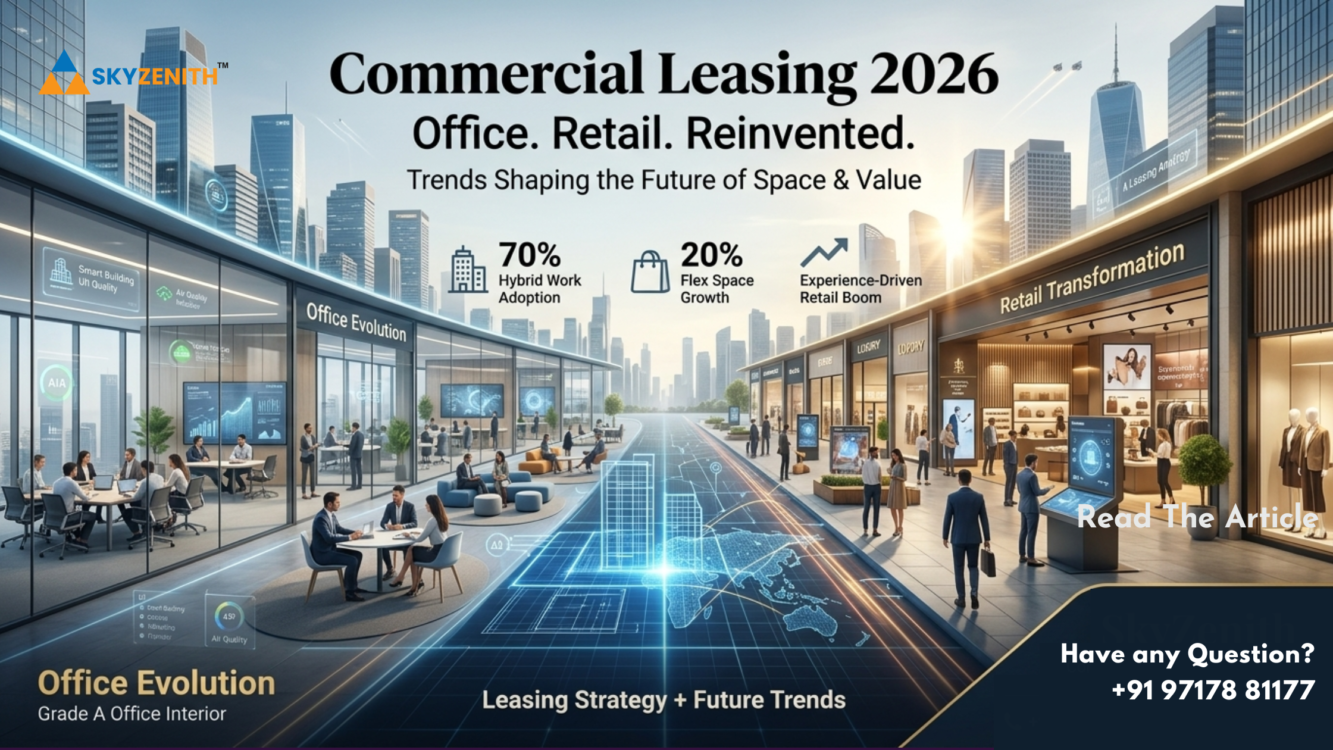
The pandemic untethered work from the workplace, but 2026 is the year businesses finally accept that the old model will never return. According to recent industry surveys, more than 70 per cent of Indian organisations now operate some form of hybrid model, and the average office space per employee has shrunk from 150 square feet to around 100 square feet. Yet total leasing volumes have not collapsed they have simply shifted. Companies are trading quantity for quality, and location is no longer the sole king. Amenities, air quality, flexibility and sustainability now sit beside it on the throne.
Office Leasing Trends in 2026: From Desks to Destinations
The Flight to Grade A and Flex Spaces
One of the most defining trends of commercial leasing in 2026 is the relentless flight to quality. Tenants are abandoning older, poorly maintained buildings in favour of Grade A office spaces that offer superior infrastructure, reliable power backup, high-speed elevators and, crucially, healthy indoor environments. The pandemic educated everyone: the air you breathe indoors matters. As a result, buildings with advanced HVAC systems, MERV 13 filtration and real-time air quality monitoring command significant rental premiums.
Simultaneously, flexible workspace providers once seen as a niche for startups have gone mainstream. Large corporations are now leasing entire floors from managed office operators, effectively outsourcing facility management, IT infrastructure and even cafeteria services. This model allows companies to scale up or down without the burden of long-term capital expenditure. In 2026, flex spaces account for nearly 20 per cent of total office leasing in major Indian cities, a figure that continues to climb.
The Hybrid-Responsive Floor Plan
Walk into any newly leased office in 2026, and you will notice a deliberate absence of assigned seating. The hybrid-responsive floor plan is now standard. Activity-based working zones replace individual desks: quiet areas for deep focus, collaborative zones for team discussions, social hubs for informal catch-ups, and wellness rooms for meditation or nursing mothers. Landlords who refuse to allow tenants to modify interiors or who impose rigid fit-out restrictions find their spaces empty for months.
Sustainability as a Lease Condition
Green building certifications are no longer just badges of honour; they are lease conditions. Large corporate tenants, especially those with net-zero commitments, actively seek spaces with LEED, WELL or GRIHA certifications. They demand energy-efficient lighting, water recycling systems, electric vehicle charging stations in parking lots, and waste management protocols. In 2026, a building without a credible sustainability roadmap is essentially un-leasable to any Fortune 500 company or even mid-sized progressive Indian firms.
Retail Leasing Trends in 2026: The Experience Economy Takes Over
If offices have become destinations for collaboration, retail spaces have become destinations for experience. The days of the simple transactional store walk in, buy, leave are fading. In 2026, successful retail leasing is about creating moments that cannot be replicated online.
Experiential Retail: More Than Just Shopping
Consider a high-street location in South Delhi. A global sportswear brand does not just sell shoes there; it offers a free running analysis, a shoe customization bar and a weekly community run that starts from the store. A cosmetics brand provides skin consultations, mini-makeover stations and a loyalty programme that includes free beauty workshops. These are not gimmicks; they are survival strategies. E‑commerce offers convenience and price comparison. Physical retail offers touch, taste, trial and human connection but only if the space is designed for it.
Leasing agreements in 2026 increasingly include clauses that allow tenants to reconfigure interiors frequently, to host events, and even to sublet portions of their space to complementary pop-ups. Landlords who understand the experience economy are partnering with tenants to co-create destinations, not just renting out square meters.
The Rise of Omnichannel Fulfilment Centres
Another surprising retail leasing trend is the conversion of traditional storefronts into hybrid fulfilment hubs. A clothing retailer may lease a 2,000-square-foot space where customers can try on items, but the back room is a mini‑warehouse for online orders, with staff packing shipments for same-day delivery within a five-kilometre radius. This model, often called dark store or omnichannel fulfilment, blurs the line between retail and logistics. In 2026, landlords are adapting by providing higher floor load capacities, dedicated service elevators and last-mile delivery parking spaces.
Community-Centric and Hyperlocal Retail
The pandemic taught consumers to value their neighbourhoods. In 2026, retail leasing is seeing a resurgence of community-centric spaces: local grocery stores with artisanal products, bookshops that host reading circles, cafes with co-working corners, and pharmacies that double as health consultation kiosks. Global chains are also adopting hyperlocal strategies, tailoring their merchandise and store design to the specific demographics of each neighbourhood. For landlords, this means curating tenant mixes that serve the daily needs of surrounding residents, not just attracting the highest bidders.
The Convergence of Office and Retail: Mixed-Use Developments
One of the most exciting stories of 2026 is the convergence of office and retail within mixed-use developments. Imagine a tower where the lower three floors house a curated selection of cafes, fitness studios, a medical clinic and a daycare centre. Above them, floors four to fifteen contain flexible office spaces. And the top floor? A members-only club with a terrace garden and a restaurant. Workers never need to leave the building for lunch, a workout, or a doctor’s appointment. Retailers benefit from a captive weekday audience of professionals. Landlords achieve higher occupancy and rental yields.
In cities like Gurgaon, Bengaluru and Mumbai, mixed-use developments are the fastest-growing segment of commercial leasing. Tenants pay a premium for the convenience, and investors see them as lower-risk assets because they diversify income across office and retail tenants.
What Tenants Are Demanding in 2026 Leases
The balance of power in commercial leasing has shifted. In 2026, tenants especially high-quality ones have negotiating leverage. Key demands include:
- Shorter lease terms with renewal options: Three to five years instead of nine, with pre‑negotiated rent caps.
- Fit-out flexibility: Permission to modify interiors without excessive approval delays or reversion obligations at lease end.
- Performance-based rent: Percentage rent models where base rent is lower but landlords share in tenant revenue above a threshold, aligning incentives.
- Health and safety clauses: Guarantees on indoor air quality standards, cleaning protocols, and access to outdoor or naturally ventilated spaces.
- Technology infrastructure: Pre‑wired high-speed internet, IoT sensors for occupancy and energy management, and app-based visitor management systems.
Landlords who dismiss these demands find their properties languishing. Those who embrace them sign leases faster and retain tenants longer.
The 2026 Outlook for India’s Commercial Real Estate
India’s commercial leasing market in 2026 is marked by polarisation. Grade A offices in prime micro-markets Gurgaon’s Golf Course Extension Road, Bengaluru’s Outer Ring Road, Mumbai’s Bandra Kurla Complex command rents that approach pre‑pandemic peaks. Vacancy rates in these buildings are below 10 per cent. Meanwhile, Grade B and C properties in less connected areas struggle with 30 to 40 per cent vacancy, as tenants consolidate into better spaces.
Retail, too, shows a K‑shaped recovery. High-street locations in affluent neighbourhoods and large, well-managed malls are thriving. But standalone shops in secondary locations, especially those with poor footfall or inadequate parking, are being returned to landlords. The message is clear: mediocrity is no longer acceptable. Only spaces that actively contribute to tenant success will succeed.
A Story of Two Leases
Let us follow two imaginary leasing journeys in 2026. First, a mid-sized tech company in Noida. Its old office had constant complaints about stale air, unreliable Wi-Fi and a cramped cafeteria. Employees dreaded coming in. The company’s new lease is in a WELL-certified building with a gym, a rooftop garden and an air quality dashboard in the lobby. Within three months, in‑office attendance rises by 40 per cent, and employee satisfaction scores double. The slightly higher rent pays for itself through reduced attrition and increased productivity.
Second, a family-run jewellery business in Jaipur. Its traditional shop on a busy street was losing customers to online competitors. The owner leases a larger space nearby, but instead of filling it with display cases, she creates a small museum of heritage jewellery, a live craftsmanship demonstration area, and a private lounge for VIP clients. Footfall increases, and average transaction value triples because customers feel they have experienced something special. Her lease includes a revenue-share agreement with the landlord, who actively promotes the store through joint marketing.
These stories are not fiction. They are happening across India in 2026. And they share a common thread: the understanding that commercial space is no longer just a container for activities. It is a strategic asset that shapes brand perception, employee well-being and customer loyalty.
Conclusion
Commercial leasing in 2026 is not about square footage. It is about square footage that works harder, breathes cleaner, adapts faster and connects deeper. For office spaces, the winning formula is hybrid-ready layouts, premium indoor environmental quality and sustainability credentials. For retail spaces, it is experiential design, omnichannel integration and community relevance. For both, flexibility is not a luxury it is the price of entry.
The organisations that recognise this shift and act decisively will secure the best locations, attract the best talent and retain the most loyal customers. Those that cling to the old ways of long-term, rigid, commoditised leases will find themselves watching from the sidelines as the market moves on. The choice, as always, belongs to the visionary.
SkyZenith
SkyZenith is a distinguished commercial real estate advisory and leasing solutions provider, specialising in office and retail space transactions across India’s primary urban markets. With deep expertise in market intelligence, lease negotiation, fit‑out planning and ongoing asset management, SkyZenith helps businesses secure spaces that align with their operational needs, employee expectations and long-term growth strategies. The company’s unique selling proposition lies in its data‑driven approach to matchmaking tenants with landlords, its unwavering focus on post‑lease support, and its ability to navigate the complexities of hybrid work models and experiential retail trends. SkyZenith acts not merely as a broker but as a strategic partner, ensuring that every commercial lease signed in 2026 delivers measurable value beyond the four walls of the property.
Address: Unit No. 908, 9th Floor, Tower 1 DLF Corporate Greens, Sector 74A Sohna Road, Gurgaon, Haryana 122004
Email: Hemraj.dabur@skyzenith.in
Phone: +91 97178 81177