-
Skyzenith
- April 15, 2026
Smart Buildings in 2026: A Guide to Sustainability, Automation, and Cost Savings
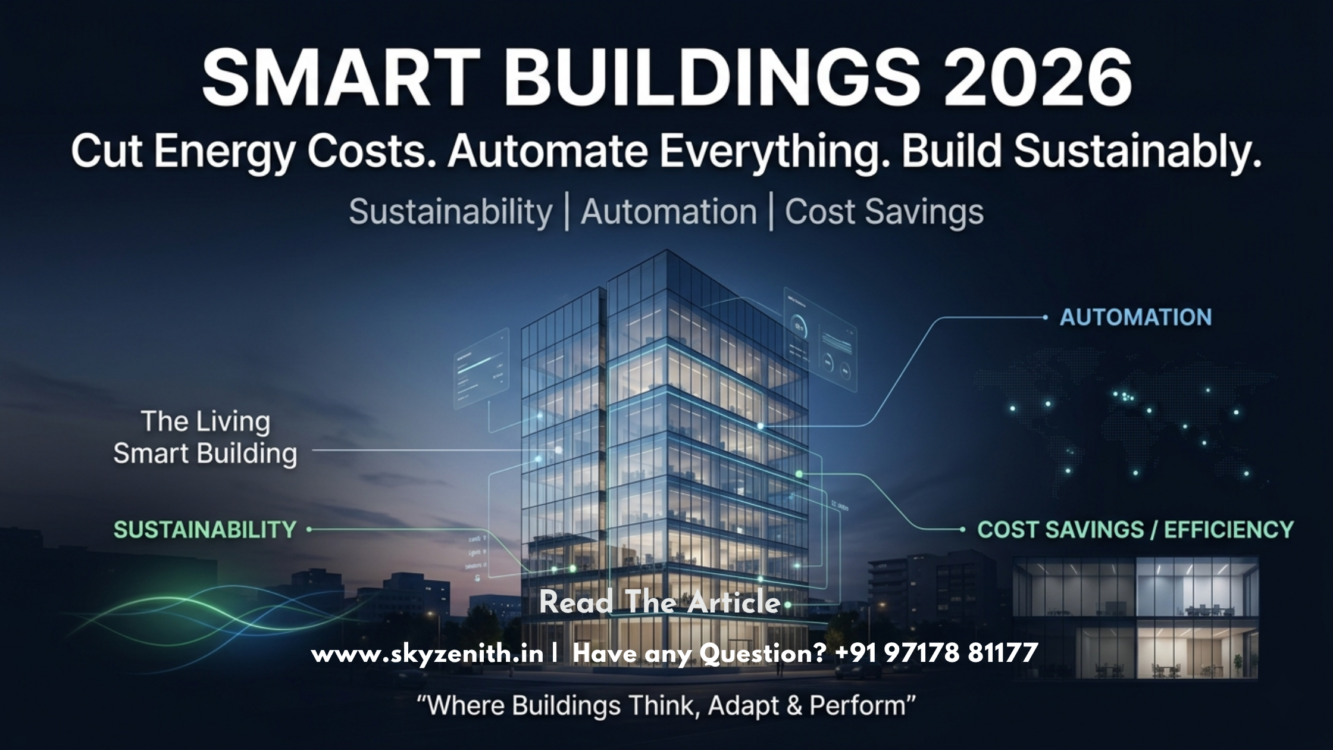
The year 2026 marks a pivotal moment in the evolution of urban infrastructure. No longer a distant concept reserved for futuristic campuses, smart buildings have become the operational standard for forward-thinking commercial and residential properties across India and the globe. These are not merely structures with internet-connected devices; they are living, breathing ecosystems that learn, adapt, and respond to their occupants and environment. As energy costs rise and regulatory pressures intensify, understanding the triad of sustainability, automation, and cost savings is no longer optional, it is essential for asset longevity and occupant well-being.
The Evolution of Built Environments: From Static Structures to Living Ecosystems
Imagine walking into an office tower in Gurgaon’s DLF Corporate Greens. The lobby adjusts its lighting based on the natural daylight streaming through the glass facade. Elevators anticipate peak traffic hours by learning usage patterns. Ventilation systems silently modulate fresh air intake based on real-time occupancy sensors. This is not science fiction; this is the daily reality of smart buildings in 2026.
The transformation has been gradual yet relentless. A decade ago, building management systems were siloed, HVAC operated independently of lighting, which had no communication with security protocols. Today, converged IP networks and edge computing have unified these functions. Sensors embedded in ceilings, walls, and even furniture collect granular data on temperature, humidity, CO₂ levels, motion, and acoustic signatures. Artificial intelligence processes this data in milliseconds, triggering automated responses that optimize performance without human intervention. The building, in essence, has become a proactive partner in its own operation.
Sustainability at the Core: How Smart Buildings Slash Carbon Footprints
Sustainability in 2026 transcends recycling bins and solar panels. For smart buildings, it is a data-driven discipline that directly influences energy procurement, water conservation, and waste management. The most impactful lever remains energy efficiency, buildings account for nearly 40 percent of global carbon emissions, and smart technologies offer a direct path to reduction.
Predictive HVAC control stands as a prime example. Traditional thermostats react to temperature setpoints; smart systems anticipate demand. By integrating weather forecasts, occupancy schedules, and thermal inertia models, a smart building can pre-cool or pre-heat zones just before occupants arrive, then scale back during unoccupied hours. This dynamic approach reduces heating and cooling energy by 20 to 30 percent annually. Similarly, intelligent lighting with daylight harvesting and presence detection ensures that no kilowatt is wasted illuminating empty corridors or over-lit workstations.
Water management has also matured. Leak detection sensors embedded in plumbing networks identify anomalies in flow rate, alerting facility managers before a minor drip becomes a major flood. Landscape irrigation systems now reference hyperlocal weather data to skip cycles when rain is imminent. For buildings aiming for net-zero status, smart grids enable bidirectional energy trading, selling excess solar power back to the utility during peak production and drawing stored energy from batteries during expensive tariff periods.
Automation Unleashed: The Invisible Hand of Intelligent Operations
Automation in a 2026 smart building is subtle yet pervasive. It does not announce itself with flashing lights or robotic voices; instead, it works quietly in the background, eliminating friction and reducing operational overhead. Consider the journey of a facility manager who once spent hours manually adjusting schedules, responding to tenant complaints, and coordinating maintenance. Today, that manager receives a single dashboard showing real-time performance of every asset, from chillers to elevators, with predictive alerts that flag potential failures before they disrupt operations.
The backbone of this automation is a robust Building Management System (BMS) integrated with Internet of Things (IoT) sensors and cloud analytics. When a conference room remains unoccupied for thirty minutes, the BMS automatically adjusts lighting and temperature to standby mode. When a cleaning crew enters a zone, the system logs their presence and updates maintenance records. When air quality deteriorates beyond WHO guidelines, fresh air dampers open wider without any manual override. These automated sequences not only save energy but also extend equipment life by reducing unnecessary runtime and stress.
Perhaps the most transformative automation lies in fault detection and diagnostics (FDD). Rather than waiting for a chiller to break down, smart algorithms continuously compare actual performance against expected baselines. A gradual decrease in cooling efficiency triggers an automatic service ticket, and the system even suggests the most likely root cause—a clogged filter, a refrigerant leak, or a failing valve. This shift from reactive to predictive maintenance reduces downtime by up to 50 percent and slashes emergency repair costs.
Quantifying Cost Savings: Where Efficiency Meets the Bottom Line
For building owners and tenants alike, the ultimate question remains: does smart technology pay for itself? Evidence from 2026 points to a clear affirmative. The upfront investment in sensors, controllers, and software platforms typically recoups within two to five years through operational savings alone. Energy reductions of 15 to 30 percent translate directly to lower utility bills. Water savings add another layer. And predictive maintenance extends the lifespan of expensive equipment like chillers, boilers, and air handlers by years.
Beyond direct utility savings, smart buildings generate value through enhanced leasing potential. Tenants increasingly demand healthy, efficient, and technologically capable spaces. A building certified under green rating systems such as LEED or IGBC commands premium rents and enjoys lower vacancy rates. Insurance underwriters have also taken notice; buildings with comprehensive smart safety and monitoring systems often qualify for reduced premiums, recognizing the lower risk of fire, flood, or equipment failure.
Labour efficiency represents an often-overlooked saving. Automated reporting and remote diagnostics reduce the need for on-site personnel. A single facility manager can oversee multiple buildings from a central command center, intervening only when exceptions arise. Janitorial services become more targeted, cleaning high-traffic zones more frequently and low-traffic zones less often, optimizing labour hours. Over a multi-year horizon, these operational efficiencies accumulate into substantial financial advantages.
The Human Experience: Wellness, Productivity, and Adaptive Spaces
Cost savings and sustainability, while critical, do not tell the full story. Smart buildings of 2026 prioritize human experience with equal fervour. Research consistently demonstrates that indoor environmental quality directly impacts cognitive function, mood, and physical health. A building that maintains optimal thermal comfort, circadian-friendly lighting, and pristine air quality becomes a competitive asset in attracting and retaining talent.
Personalized comfort zones are now feasible. Using mobile apps or desk-mounted interfaces, occupants can set their preferred temperature and lighting for their specific workstation. The system remembers these preferences across days and even adapts as seasons change. For shared spaces like meeting rooms, occupancy sensors combined with machine learning predict how many people will attend a scheduled gathering and precondition the room accordingly—cooler for a large presentation, warmer for an intimate brainstorming session.
Acoustic comfort has also gained attention. Smart buildings deploy sound masking systems that adjust white noise levels based on ambient chatter, preserving speech privacy without creating a sterile environment. Vibration sensors on mechanical equipment alert technicians to developing imbalances before they generate disruptive noise. These subtle interventions create spaces where people feel healthier, think clearer, and collaborate more effectively.
Future-Proofing Your Asset: Integration, Cybersecurity, and Scalability
As smart building technologies advance, the risk of obsolescence looms. A 2026 guide would be incomplete without addressing how to ensure longevity. The solution lies in open protocols and modular design. Buildings locked into proprietary systems from a single vendor face expensive upgrades and limited flexibility. Conversely, those built on open standards such as BACnet, Modbus, or MQTT can integrate best-of-breed components from multiple suppliers, swapping out sensors or controllers as technology evolves.
Cybersecurity has risen to the forefront of smart building concerns. An automated building is a connected building, and every connected device represents a potential entry point for malicious actors. Modern implementations deploy network segmentation, encrypting all control traffic and isolating building systems from guest Wi-Fi networks. Regular penetration testing and firmware updates are non-negotiable. Responsible providers treat cybersecurity not as an afterthought but as a foundational design principle.
Scalability ensures that a smart building can grow with its occupants. A system designed for a single floor must expand seamlessly to an entire tower. Cloud-based architectures with edge gateways offer this flexibility, processing data locally for real-time control while synchronizing analytics to the cloud for long-term optimization. As artificial intelligence models improve, these systems automatically upgrade without hardware replacements, a silent evolution that keeps buildings at the cutting edge.
Conclusion: The Imperative for Intelligent Action
The smart building movement of 2026 is not a luxury reserved for trophy projects; it is a pragmatic response to rising energy costs, stricter environmental regulations, and evolving occupant expectations. Building owners who delay adoption face a widening competitive gap, saddled with higher operating expenses and diminished asset values. Those who embrace sustainability, automation, and cost savings as integrated goals will enjoy lower risk, higher returns, and spaces that truly serve their inhabitants.
About the Company
SkyZenith is a premier provider of intelligent building solutions, specializing in the design, integration, and maintenance of advanced automation systems that drive sustainability and operational excellence. Their comprehensive service portfolio includes smart HVAC controls, energy management platforms, IoT sensor networks, predictive analytics for fault detection, and end-to-end cybersecurity for connected buildings. With deep expertise in open-protocol integration and cloud-based building management, SkyZenith delivers tailored solutions that reduce energy consumption by up to 30 percent, extend equipment lifespan, and enhance occupant comfort. The company’s unique selling proposition lies in its vendor-agnostic approach, seamlessly integrating best-in-class components from multiple manufacturers, combined with a relentless focus on measurable ROI and long-term scalability. Every project, from retrofitting existing structures to equipping new constructions, is executed with meticulous attention to data security, future-proofing, and user-centric design, ensuring that clients receive not just a smart building, but an intelligent partner for decades to come.
Contact Information
Address: Unit No. 908, 9th Floor, Tower 1, DLF Corporate Greens, Sector 74A, Sohna Road, Gurgaon, Haryana 122004
Email: Hemraj.dabur@skyzenith.in
Phone: +91 97178 81177
Website: skyzenith.in