-
Skyzenith
- October 28, 2026
Location Strategy for Retail Businesses: How to Choose the Right Market
A retail business can have the right product, strong branding and an effective marketing strategy, yet still struggle if it operates from the wrong location.
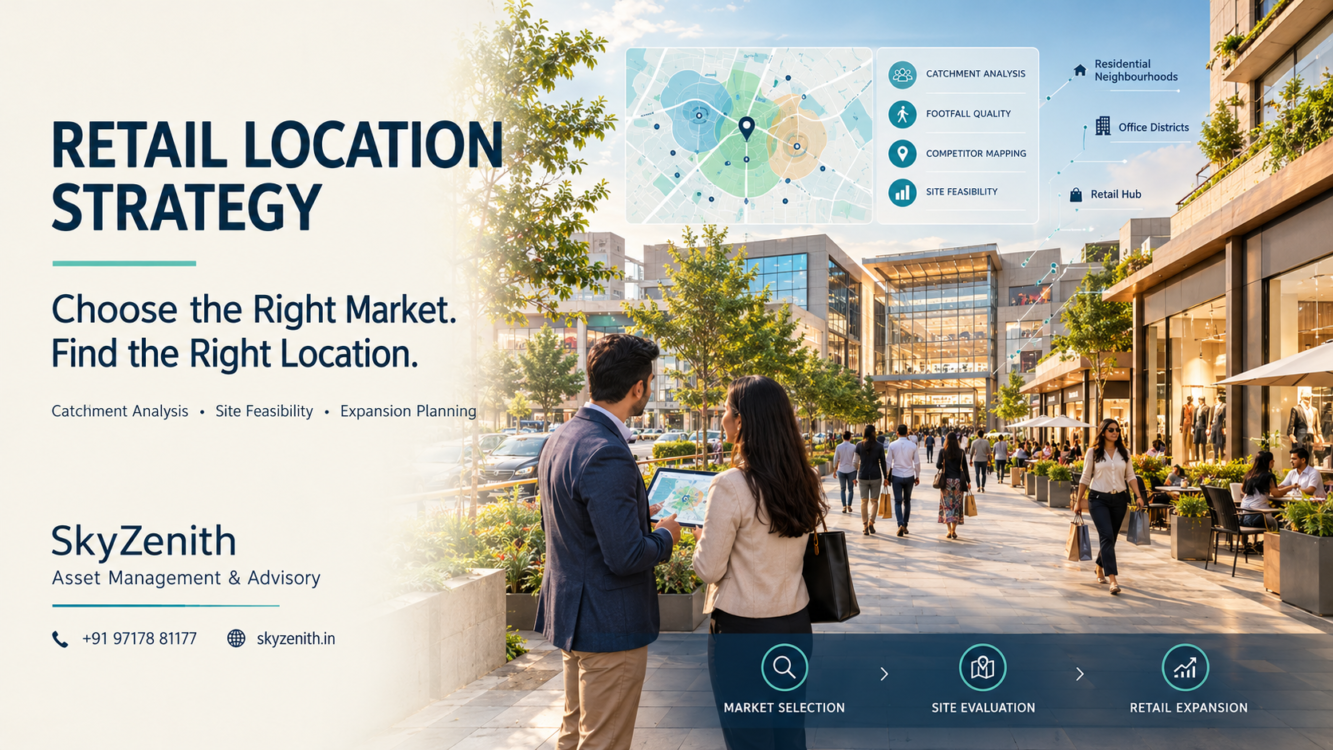
In physical retail, location influences who sees the store, who can reach it, how often customers visit and how much revenue the business can realistically generate. This is why location strategy for retail businesses has become an important part of expansion planning.
Choosing a location is no longer simply about finding an available shop in a busy market. Modern retailers need to understand customer demographics, catchment areas, accessibility, competition, footfall quality, rental costs and future development before making a long-term commitment.
What Is Location Strategy for Retail Businesses?
Retail location strategy is the structured process of identifying, evaluating and selecting markets and individual sites that have the strongest potential for a retail brand.
The process connects several factors | customer profile | market demand | catchment potential | competition | accessibility | visibility | property cost | store economics | future growth.
The objective is to identify a location where the brand’s target customers are most likely to visit and purchase, while ensuring that the economics of the site support sustainable business performance.
A location should therefore be evaluated not only for what it looks like today, but also for how the surrounding market is likely to evolve.
Why Is Retail Location Strategy Important?
Location is one of the decisions that can be difficult and expensive to reverse.
Once a business signs a long-term lease and invests in interiors, equipment, staffing and marketing, changing the location can involve significant financial and operational costs.
A busy road does not automatically mean a successful retail site. The important question is whether the people passing through the area are relevant to the business.
A premium fashion brand, a grocery store, a restaurant and a healthcare business can require completely different location strategies.
This is why retail site selection in India should begin with the business model and target customer rather than with available properties.
Understanding the Retail Catchment Area
The catchment area is the geographical zone from which a retail store is expected to attract its customers.
However, a catchment is not always a simple circle around the property. Roads, travel time, public transport, residential clusters, offices, competing destinations and physical barriers can influence how customers actually reach a store.
A strong catchment area analysis therefore considers demographics, income levels, lifestyle, customer behaviour, accessibility and existing retail infrastructure.
For example, a location surrounded by residential communities may be ideal for daily-needs retail, while an office-heavy catchment may be more suitable for food, convenience or service-oriented businesses.
The quality of the customer base is often more important than the absolute number of people nearby.
Footfall Quality vs Footfall Quantity
High footfall is attractive, but it does not guarantee high sales.
A location may have thousands of pedestrians every day, yet generate limited business if those visitors do not match the brand’s target audience.
Retailers should therefore examine footfall quality | who is visiting | when they visit | where they come from | what they are likely to purchase | how frequently they return.
Modern location analysis can combine footfall patterns with demographic and competitive information to provide a more complete picture of potential store performance.
Competition and Market Gaps
Competition should not automatically be viewed as a negative factor.
A strong cluster of relevant retailers can sometimes indicate that customers already recognise the area as a destination for a particular category.
At the same time, excessive competition can make customer acquisition more difficult and increase pressure on pricing.
This is why retail competitor analysis should examine both competitive intensity and market gaps.
The important questions are | Which competitors are present? | How strong are they? | What customer segments do they serve? | Are there underserved areas? | Is there enough demand for another store?
Identifying these gaps can help brands discover attractive expansion opportunities.
High Street or Shopping Mall?
The choice between a high street and a mall depends on the brand.
High-street retail can provide direct visibility, street frontage and access to established local markets. Shopping malls can offer organised customer traffic, parking, complementary brands, entertainment and a controlled retail environment.
Neither format is universally better.
The decision should be based on customer profile, product category, store format, brand positioning, expected footfall and occupancy cost.
For many retailers, the right answer may also involve a combination of formats across different cities.
Accessibility, Visibility and Parking
A location can have excellent demographics and still underperform if customers cannot reach it easily.
Accessibility includes road connectivity, public transport, pedestrian movement, parking, entry and exit points and the overall convenience of reaching the store.
Visibility also matters. A store that is difficult to see from the main road may require significantly more marketing investment to achieve the same level of awareness.
These factors should therefore be evaluated alongside catchment and footfall rather than treated as separate considerations.
Rental Cost and Store Economics
One of the most common mistakes in retail expansion is choosing a location based mainly on rental affordability.
A cheaper location is not necessarily more profitable.
Retailers should compare rent with expected revenue, customer potential, store size, operating expenses and investment required for interiors and setup.
A financially attractive location is one where the expected commercial return justifies the total occupancy and operating cost.
This makes location feasibility analysis an essential part of the retail expansion process.
Location Strategy for Retail Expansion in India
For brands expanding across India, location strategy becomes even more important.
A successful expansion plan should identify priority cities and then evaluate the most suitable micro-markets within those cities.
Market selection can consider | population and income | customer demand | competition | retail supply | infrastructure | accessibility | real estate costs | future development.
India’s retail landscape is also becoming more diversified, with organized retail and experience-led destinations developing across different urban markets. This makes market selection increasingly important for brands planning their next phase of expansion.
Data-Driven Retail Site Selection
Modern retail location analysis can combine multiple information layers to support better decisions.
Demographic data, income patterns, competitor locations, road networks, accessibility, footfall, real estate information and future infrastructure can be evaluated together.
The benefit is not simply finding a location.
It is being able to compare multiple locations using the same criteria and understand why one site may offer stronger commercial potential than another.
This reduces dependence on intuition alone and creates a more structured expansion process.
How to Choose a Retail Location Strategy Partner
A location strategy partner should understand both real estate and retail.
Important capabilities include market research, catchment analysis, competitor mapping, location feasibility, retail leasing, tenant mix, commercial evaluation and expansion planning.
The strongest approach connects location strategy | retail leasing | asset management | customer understanding | commercial feasibility.
This creates a more complete view of what a location can contribute to the business.
SkyZenith: Location Strategy and Retail Advisory
SkyZenith Asset Management & Advisory works with developers, property owners, investors, brands and businesses across India.
Its capabilities include location strategy, retail leasing, commercial leasing, retail asset management, mall advisory, mall management, occupancy and space planning, fit-out management, design solutions, project management, smart buildings and sustainability services.
Its advisory-led approach connects market understanding with commercial real estate strategy. Instead of evaluating a location only as a property opportunity, the focus is on understanding its relationship with customer demand, retail positioning, leasing potential, space requirements and long-term business objectives.
This integrated perspective can help businesses make more informed decisions when entering new markets, expanding their store network or evaluating potential retail locations.
Contact SkyZenith
SkyZenith Asset Management & Advisory
Unit No. 908, 9th Floor, Tower 1, DLF Corporate Greens, Sector 74A, Sohna Road, Gurgaon, Haryana 122004
Email: Hemraj.dabur@skyzenith.in
Phone: +91 97178 81177
Website: skyzenith.in
Conclusion
The right retail location does more than provide a physical address. It creates access to customers, supports brand visibility, influences operating economics and can shape the long-term success of a store.
That is why location strategy for retail businesses should be treated as a strategic investment decision.
By combining catchment analysis, customer understanding, competition, accessibility, property economics and future market potential, retailers can move beyond choosing locations based on instinct and build a more disciplined approach to sustainable expansion.