-
Skyzenith
- October 26, 2026
Workplace Strategy and Space Planning: How Businesses Can Optimize Office Space
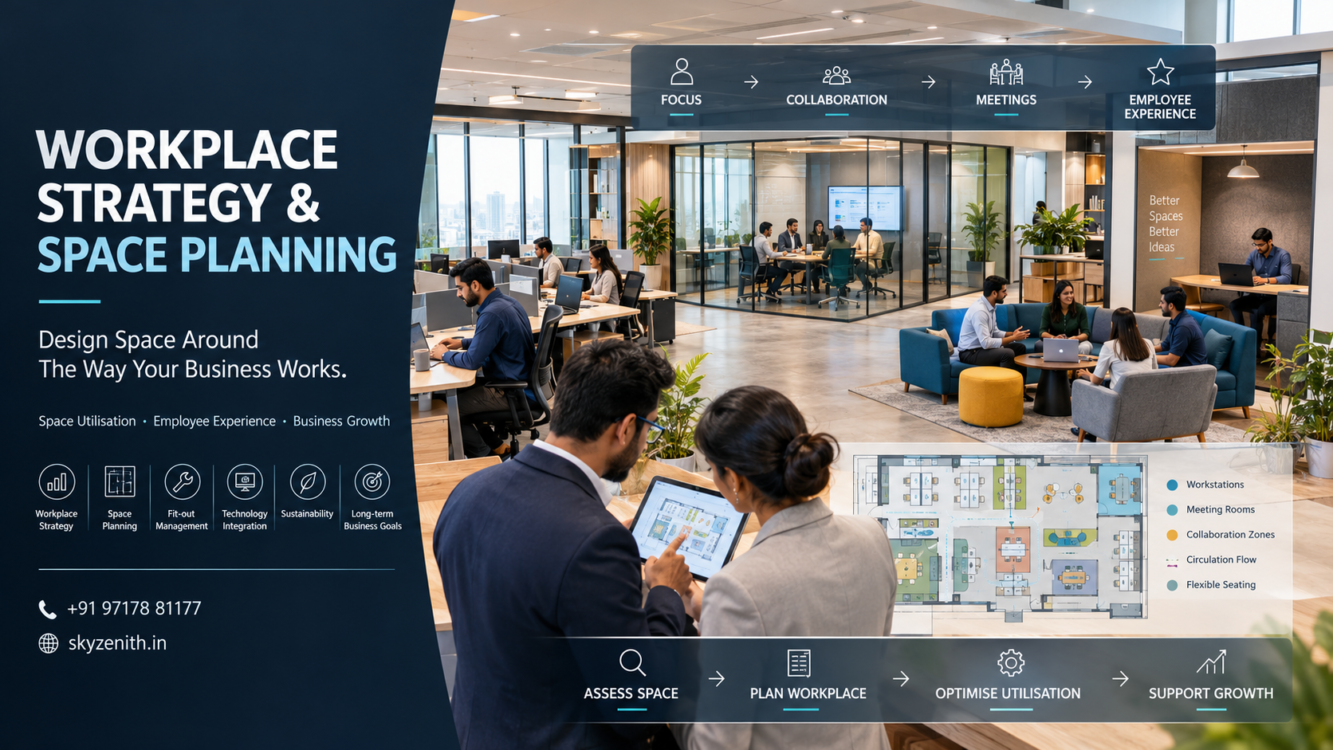
An office is more than a collection of desks, cabins and meeting rooms. The way people use a workplace can influence productivity, collaboration, employee experience, operating costs and even how a company presents its brand. As businesses evolve, traditional approaches to office planning are increasingly being replaced by more strategic methods of understanding how space should support the organisation.
This is where workplace strategy and space planning become important. Instead of asking simply, “How much office space do we need?”, businesses need to consider how their teams work, how space is actually being used, what the organisation may need in the future and how the workplace can support long-term business objectives.
What Is Workplace Strategy?
Workplace strategy is the process of aligning an organisation’s physical workplace with its business goals, workforce requirements and operating model.
It considers factors such as employee numbers, work patterns, collaboration requirements, technology, company culture, location, growth plans and real estate costs. The objective is to create a workplace that supports the way the organisation actually works rather than simply replicating a conventional office layout.
A good workplace strategy connects business planning with real estate decisions | people | space | technology | experience | cost | growth.
What Is Space Planning?
Space planning focuses on how the available physical area should be organised and allocated.
It can involve workstation planning, meeting rooms, collaboration areas, leadership spaces, breakout zones, reception areas, support spaces, circulation, storage and other workplace requirements.
Effective office space planning aims to make the best use of the available footprint while maintaining functionality, comfort and flexibility. The objective is not necessarily to fit the maximum number of employees into the smallest possible area. Instead, the right balance must be created between density, employee experience and business requirements.
Why Is Workplace Strategy Important for Businesses?
Real estate is a significant cost for many organisations. Poor workplace planning can result in unused areas, overcrowded spaces, inefficient layouts or unnecessary expansion.
A strategic approach helps businesses understand whether their existing office is being used effectively and whether the current footprint supports future requirements.
Workplace strategy can also help organisations prepare for changing workforce patterns. Businesses may require a combination of individual work areas, meeting rooms, collaboration spaces, flexible work zones and employee amenities rather than a traditional desk-based layout.
Office Space Utilisation and Occupancy Planning
One of the most important elements of modern space planning is understanding actual utilisation.
An office may have hundreds of workstations, but that does not necessarily mean all of them are being used consistently. Meeting rooms may be constantly occupied while other areas remain underused.
Occupancy and utilisation analysis can provide valuable information about how different parts of the workplace are functioning. This can support better decisions around workstation ratios, meeting room requirements, collaboration areas and future expansion.
The objective is to plan based on evidence rather than assumptions.
Workplace Strategy for Hybrid and Flexible Work
Flexible working has changed the way many organisations think about office space. Businesses may need workplaces that support both individual concentration and high-quality collaboration.
This does not mean every organisation needs the same hybrid workplace model. The appropriate strategy depends on the nature of the business, employee roles, management approach and operational requirements.
A flexible workplace may include | collaborative zones | meeting spaces | focus areas | touchdown areas | flexible workstations | employee experience spaces.
The important factor is that each element should have a clear purpose.
Space Planning and Employee Experience
A workplace can be technically efficient but still fail if employees find it uncomfortable, difficult to navigate or unsuitable for their daily activities.
Workplace strategy therefore needs to consider employee experience alongside space efficiency. Natural movement through the office, accessibility, acoustics, lighting, privacy, collaboration and shared amenities can all influence how people experience the workplace.
The workplace should support the company’s culture rather than simply reflect an architectural trend.
Workplace Strategy and Cost Optimisation
Effective space planning can also support better real estate cost management.
Businesses can identify underutilised areas, improve space allocation, evaluate consolidation opportunities and plan future requirements more accurately. In some cases, better utilisation of existing space may reduce the need for additional real estate.
Cost optimisation, however, should not mean simply reducing the area. A smaller workplace that performs poorly can create new problems. The stronger approach is to optimise the relationship between space, people, business requirements and employee experience.
Planning for Business Growth
Workplace strategy should consider where the organisation is today as well as where it expects to be in the future.
A company planning rapid recruitment may need additional capacity. Another organisation may require more meeting and collaboration space rather than more individual workstations. A growing business may also need flexibility to expand within the same building or location.
This makes scenario planning an important part of workplace strategy. Businesses can evaluate different growth assumptions before committing to major real estate or fit-out decisions.
Workplace Strategy and Sustainability
Space planning can also contribute to sustainability objectives.
Efficient use of office space can reduce unnecessary real estate requirements, while better planning of lighting, HVAC, technology and occupancy can support more efficient building operations.
Sustainable workplace planning should therefore consider both the physical design and the way the workplace operates over time.
How to Choose a Workplace Strategy and Space Planning Partner
The right advisory partner should look beyond interior design. Workplace strategy requires an understanding of business objectives, real estate, occupancy, employee requirements, space utilisation and future growth.
A strong approach should combine data analysis, workplace assessment, space planning, design guidance and implementation planning. This allows decisions to be made before major leasing, construction or fit-out commitments are finalised.
SkyZenith: Workplace Strategy and Space Planning Advisory
SkyZenith Asset Management & Advisory provides workplace strategy, occupancy and space planning, design solutions, project management, fit-out management, smart building and sustainability capabilities as part of its integrated real estate advisory approach.
Its USP lies in connecting workplace decisions with wider property and business considerations. Instead of viewing space planning as an isolated design exercise, SkyZenith can approach it through the broader lens of location, occupancy, workplace requirements, asset performance, operational efficiency and long-term business objectives.
This integrated perspective can help businesses make more informed decisions about office space while creating workplaces that are practical, adaptable and aligned with future growth.
Contact SkyZenith
SkyZenith Asset Management & Advisory
Unit No. 908, 9th Floor, Tower 1, DLF Corporate Greens, Sector 74A, Sohna Road, Gurgaon, Haryana 122004
Email: Hemraj.dabur@skyzenith.in
Phone: +91 97178 81177
Website: skyzenith.in
Conclusion
The best office is not necessarily the largest or the most visually impressive. It is the one that supports the organisation’s people, operations and future direction.
Professional workplace strategy and space planning helps businesses understand how their workplace should function, how much space they actually need and how the environment can evolve with changing business requirements.
When workplace planning is connected with occupancy data, employee experience, technology, sustainability and real estate strategy, office space becomes more than a cost centre. It becomes an important part of how a business operates, grows and creates value.