-
Skyzenith
- October 16, 2026
Sustainable Buildings in India: Energy, Efficiency and Long-Term Asset Value
A commercial building is designed to serve its occupants for years, but the way it is designed, operated and maintained can have a significant impact on energy consumption, operating costs, resource use and long-term property value. As businesses and property owners become more conscious of efficiency and environmental performance, sustainability is becoming an important part of commercial real estate strategy.
This is driving greater interest in sustainable buildings in India, where developers, investors, occupiers and property managers are increasingly looking beyond construction quality to understand how efficiently a building performs throughout its lifecycle.
What Is a Sustainable Building?
A sustainable building is designed and operated to use resources efficiently while creating a healthier, more functional and environmentally responsible environment for its occupants.
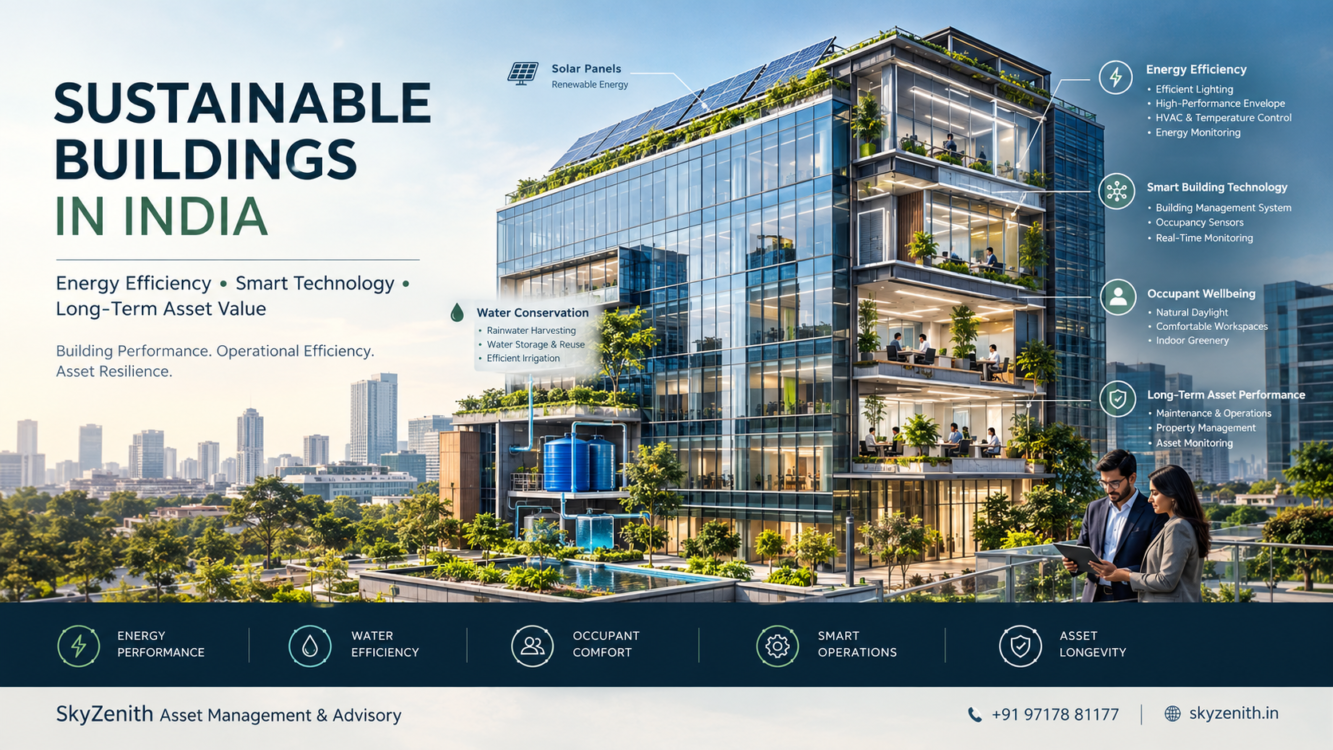
Sustainability can involve several interconnected areas | energy efficiency | water conservation | waste management | responsible material selection | indoor environmental quality | renewable energy | smart building systems | efficient operations.
The objective is not simply to add individual green features. A genuinely sustainable building takes a more integrated approach in which design, technology, operations and maintenance work together.
Why Are Sustainable Buildings Important in India?
Commercial buildings consume significant amounts of energy and water through HVAC systems, lighting, lifts, pumps, electrical equipment and daily operations.
Improving building efficiency can therefore have both environmental and commercial benefits. Better resource management can help control operating costs, while efficient systems and well-planned maintenance can contribute to better building performance.
For property owners and investors, sustainability can also become part of a wider asset strategy. A building that performs efficiently and responds to changing environmental and occupier expectations can be better positioned for long-term relevance.
Energy Efficiency in Sustainable Buildings
Energy efficiency is one of the most important components of sustainable building strategy.
HVAC systems, lighting, electrical equipment and other building services should be evaluated not only for their initial installation but also for their long-term operating performance.
Building audits, energy monitoring, smart controls and efficient equipment can help identify opportunities for improvement. HVAC optimisation, occupancy-based controls, efficient lighting and better operating schedules can all contribute to more effective energy management.
The key is to understand where energy is being consumed and how building systems can operate more intelligently.
Water Conservation and Sustainable Building Management
Water efficiency is another important consideration for commercial properties.
Large buildings may consume water through washrooms, landscaping, cooling systems, kitchens and other operations. Sustainable planning can therefore include water-efficient fixtures, monitoring systems, rainwater management, wastewater treatment and responsible landscape planning where appropriate.
Water conservation should be considered as part of the building’s wider operational strategy rather than as a standalone initiative.
Green Building Design and Materials
Sustainability begins before a building becomes operational.
Design decisions can influence energy performance, natural light, ventilation, material consumption and future maintenance requirements. Material selection can also influence the environmental footprint of a project.
Responsible material planning may include efficient material use, durable products, low-emission finishes and locally appropriate alternatives where suitable.
The objective is to create buildings that perform efficiently while remaining practical to construct, operate and maintain.
Smart Buildings and Sustainability
Technology can play an important role in sustainable building management.
Smart building systems can provide real-time information about energy use, occupancy, temperature and equipment performance. This allows building teams to identify inefficient operating patterns and respond more effectively.
Automation can also connect systems such as HVAC, lighting and building controls, helping the property respond to actual usage rather than relying entirely on fixed schedules.
However, technology works best when it is integrated into a broader sustainability strategy. Sensors alone cannot make an inefficient building sustainable.
Sustainable Buildings and Occupant Experience
Sustainability also has a human dimension.
Indoor air quality, thermal comfort, lighting, acoustics and access to well-designed spaces can influence how people experience a building. For offices, retail properties, hotels and mixed-use developments, occupant comfort can contribute to the overall perception and usability of the asset.
A sustainable building should therefore balance environmental performance with the needs of the people who use it.
Sustainability and Long-Term Property Value
Sustainability can increasingly be viewed as an asset-management consideration.
Efficient buildings may have better control over operating costs, while well-maintained infrastructure can support asset longevity. Sustainability planning can also help property owners prepare for changing regulatory requirements, occupier expectations and investment criteria.
For developers and investors, the goal is to understand sustainability not only as an environmental responsibility but also as a component of long-term asset resilience.
Green Building Certifications in India
Certification frameworks can provide a structured approach to sustainable building design and performance.
Depending on the project, developers and property owners may consider frameworks such as LEED, IGBC or GRIHA. Certification requirements can address areas such as energy, water, materials, indoor environmental quality and overall building performance.
However, certification should support the property’s actual sustainability objectives rather than become the sole measure of performance.
How to Develop a Sustainable Building Strategy
A successful sustainability strategy begins with understanding the existing property or project.
For existing buildings, building audits, energy assessments and operational reviews can identify areas where improvements may have the greatest impact. For new developments, sustainability can be incorporated into design, technology selection, materials, water systems and operational planning from the beginning.
The strongest approach connects | building design | energy management | smart technology | water efficiency | maintenance | occupant experience | asset strategy.
SkyZenith: Sustainability and Commercial Real Estate Advisory
SkyZenith Asset Management & Advisory provides sustainability services as part of its integrated commercial real estate advisory approach. Its sustainability capabilities are designed to help organisations work towards environmental, social and governance objectives while improving building efficiency and long-term performance.
SkyZenith’s wider expertise across smart buildings, building audits, workplace strategy, design solutions, project management, asset management and property advisory allows sustainability to be considered alongside the operational and commercial requirements of a property.
The company’s key USP is this integrated approach. Sustainability is not treated as an isolated technical exercise but as part of broader building performance, asset optimisation and long-term property strategy.
Contact SkyZenith
SkyZenith Asset Management & Advisory
Unit No. 908, 9th Floor, Tower 1, DLF Corporate Greens, Sector 74A, Sohna Road, Gurgaon, Haryana 122004
Email: Hemraj.dabur@skyzenith.in
Phone: +91 97178 81177
Website: skyzenith.in
Conclusion
The future of commercial real estate is increasingly connected to how efficiently and responsibly buildings operate. Sustainable buildings in India can help property stakeholders address energy consumption, water management, occupant experience, operational efficiency and long-term asset resilience.
The strongest sustainability strategy is not based on adding isolated green features. It brings together design, technology, building performance, maintenance and asset management to create properties that are efficient today and adaptable for the future.