-
Skyzenith
- May 21, 2026
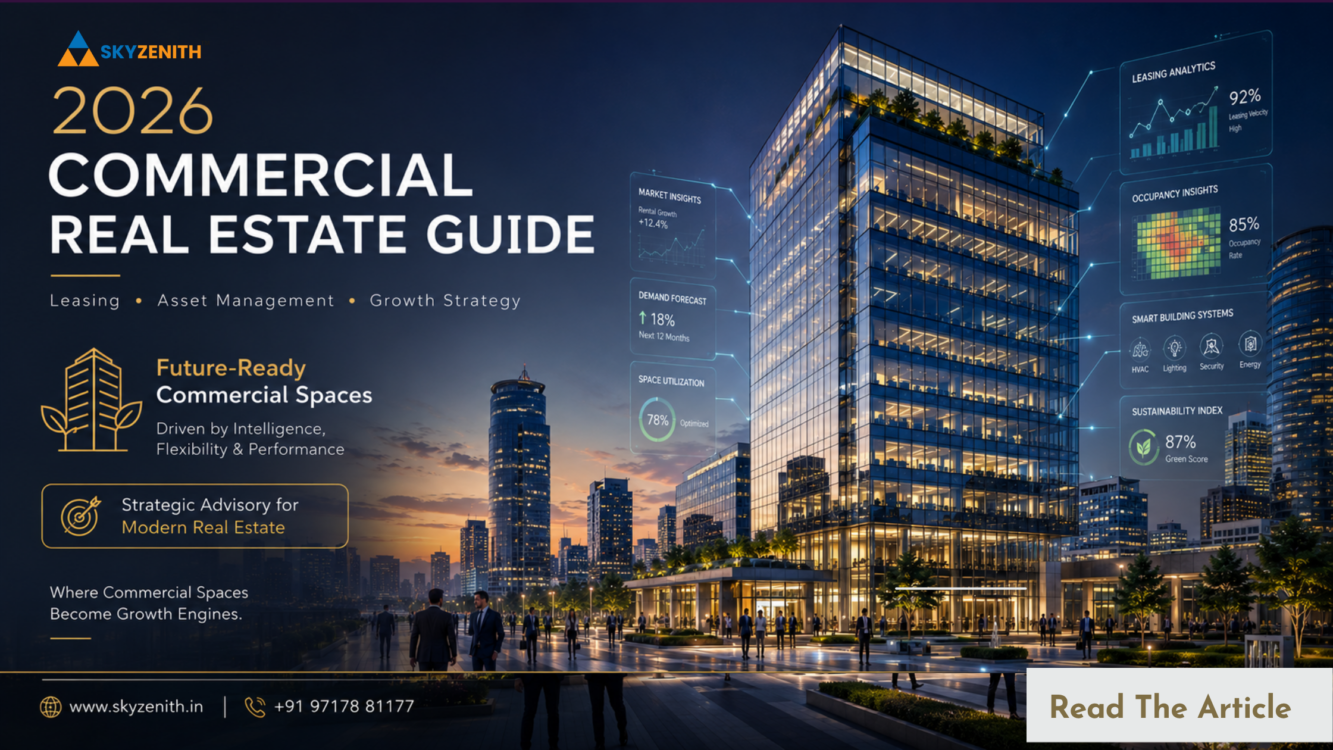
2026 Guide to Commercial Real Estate: Leasing, Management, and Growth Strategies
The landscape of commercial real estate is never static, but the year 2026 presents a watershed moment. Gone are the days when a simple lease agreement and a basic maintenance schedule sufficed. Today’s environment demands foresight, agility, and a deep understanding of how technology, hybrid work models, and economic shifts are rewriting the rules. For stakeholders across India’s bustling commercial corridors from Gurgaon’s Sohna Road to Bengaluru’s tech parks this guide serves as a compass. Whether you are a landlord seeking to maximize asset value, a tenant negotiating a commercial real estate leasing agreement, or a facility manager implementing commercial property management best practices, the strategies outlined here will define success in 2026 and beyond.
The Evolving Landscape of Commercial Real Estate Leasing
Leasing has historically been a transactional affair: square footage, term length, and rent. In 2026, it is a strategic partnership. The post-pandemic world has permanently altered workplace expectations, compelling both lessors and lessees to rethink value. Tenants now seek flexibility, wellness certifications, and technologically integrated spaces. Landlords, in turn, must offer more than four walls and a parking lot they must provide ecosystems that enhance productivity and well-being.
Hybrid Work Demands Hybrid Lease Structures
The rigid five-year, full-floor lease is no longer the default. Companies are increasingly adopting hub-and-spoke models, maintaining a central headquarters while operating smaller satellite offices. This shift has given rise to growth strategies in commercial real estate that prioritize short-term, renewable leases and co-working integrations. In 2026, astute landlords are offering “scale-up clauses” contractual provisions that allow tenants to expand or contract their footprint without punitive penalties. For businesses, this means aligning real estate costs directly with revenue performance, a prudent move in an unpredictable economy.
Location Intelligence Over Location Intuition
While “location, location, location” remains a mantra, the definition of a prime site has evolved. Proximity to public transit is now non-negotiable, but equally important is access to gig-speed internet, renewable energy grids, and green spaces. Data-driven platforms now allow investors to analyze foot traffic, local amenity scores, and even micro-climate patterns before signing a lease. In markets like Gurgaon, where commercial hubs such as DLF Corporate Greens on Sohna Road have become benchmarks, success hinges on choosing properties that blend connectivity with future-ready infrastructure.
Mastering Commercial Property Management in a High-Stakes Era
Once considered a back-office function, commercial property management has risen to a core competency. A poorly managed building bleeds value through vacancies, high turnover, and mounting operational costs. Conversely, exceptional management transforms a property into a destination.
Technology as the Silent Operator
The year 2026 is defined by the Internet of Things (IoT) and artificial intelligence. Smart sensors now monitor HVAC efficiency, air quality, and occupancy patterns in real time. Predictive maintenance algorithms alert managers to a failing chiller before it disrupts a tenant’s workday. For commercial spaces, these technologies are no longer luxuries they are baseline expectations. Tenants increasingly audit a building’s “smart readiness” before signing a lease, recognizing that operational excellence directly impacts their bottom line.
Sustainability Drives Financial Performance
Regulatory bodies and institutional investors are demanding measurable environmental, social, and governance (ESG) metrics. Energy-efficient lighting, water recycling systems, and waste reduction programs reduce utility expenses while attracting premium tenants. In 2026, commercial properties with credible green certifications command rental premiums and enjoy lower vacancy rates. Property managers who integrate sustainability into daily operations from janitorial protocols to landscaping turn compliance into a competitive advantage.
The Human-Centric Approach
Beyond technology and sustainability, successful property management acknowledges the human element. Tenants remember how quickly a maintenance request was resolved, how courteous the security staff were, and how clean the common areas remained. In high-density commercial towers, creating a sense of community through curated events, shared lounges, or even rooftop gardens—fosters loyalty. Low turnover is the ultimate metric of management excellence.
Growth Strategies for Commercial Real Estate Portfolios
Growth in this sector no longer means simply acquiring more square footage. It means optimizing, diversifying, and future-proofing. Whether you are a family office with a single asset or a fund managing a pan-India portfolio, the following growth strategies in commercial real estate will separate leaders from followers.
Adaptive Reuse and Mixed-Use Developments
Vacant retail spaces and aging office buildings are being reimagined. Adaptive reuse converting a struggling mall into a logistics hub or an old office block into a life sciences lab unlocks hidden value. Mixed-use developments that combine office, retail, residential, and hospitality components create self-sustaining ecosystems. In 2026, investors are targeting properties that can pivot across uses, hedging against sector-specific downturns.
Data-Driven Portfolio Optimization
Relying on intuition to buy or sell assets is a recipe for underperformance. Advanced analytics platforms now provide real-time valuations, lease expiration risk scores, and market absorption rates. Successful investors conduct quarterly portfolio reviews, shedding underperforming assets and doubling down on those with upward mobility. The key is to treat real estate as a dynamic investment, not a static holding.
Strategic Partnerships with Specialist Firms
No single entity can master every facet of commercial real estate. Growth increasingly comes through partnerships with specialized service providers. For instance, a property owner might collaborate with a firm that offers integrated commercial real estate leasing advisory, facility management, and energy auditing. By outsourcing non-core functions, owners free capital and attention for strategic initiatives. In India’s competitive markets, such collaborations are the difference between a building that merely exists and one that thrives.
Navigating 2026’s Unique Challenges
This guide would be incomplete without addressing the headwinds. Interest rate volatility, construction material inflation, and evolving building codes require constant vigilance. However, challenges also create opportunities. Well-capitalized investors can acquire distressed assets at favorable valuations. Proactive managers who invest in resilient infrastructure backup power, flood prevention, and seismic upgrades protect their tenants and their reputations.
Moreover, the regulatory environment in India is becoming more transparent with initiatives like the Real Estate (Regulation and Development) Act (RERA) and the introduction of model tenancy laws. In 2026, compliance is a baseline; excellence is found in exceeding standards. Properties that maintain impeccable documentation, transparent accounting, and proactive tenant communication will weather any economic storm.
The Road Ahead: Integrating Vision with Execution
The most successful players in 2026 will be those who view commercial real estate not as inert concrete and glass, but as a living asset that responds to innovation. Leasing must be collaborative, management must be intelligent, and growth must be strategic. Whether you are a tenant negotiating your next lease or an investor balancing a portfolio, the principles remain constant: prioritize flexibility, embrace technology, and never underestimate the value of a trusted partner.
For businesses seeking to navigate this complex terrain, having a knowledgeable ally can transform uncertainty into opportunity. Firms that combine deep local market intelligence with global best practices are uniquely positioned to deliver results. One such firm, operating from a strategic hub at Sector 74A on Sohna Road in Gurgaon, exemplifies the integrated approach required for 2026. By offering end-to-end solutions from initial site selection and lease negotiation to ongoing facility management and asset optimization they help clients turn commercial real estate into a genuine growth engine.
SkyZenith
Unit No. 908, 9th Floor, Tower 1, DLF Corporate Greens, Sector 74A, Sohna Road, Gurgaon, Haryana 122004
📧 Email: Hemraj.dabur@skyzenith.in
📞 Phone: +91 97178 81177
SkyZenith is a distinguished advisory and management firm specializing in commercial real estate solutions across India. The company provides comprehensive services including strategic leasing consultancy, end-to-end property management, asset optimization, and growth planning for investors, developers, and corporate tenants. Their unique selling proposition lies in combining data-driven market intelligence with on-ground execution capabilities, ensuring clients benefit from reduced vacancy periods, enhanced asset valuations, and seamless operational oversight. With a focus on transparency, regulatory compliance, and long-term partnerships, SkyZenith empowers businesses to navigate the complexities of the 2026 commercial real estate landscape with confidence and clarity.