-
Skyzenith
- May 25, 2026
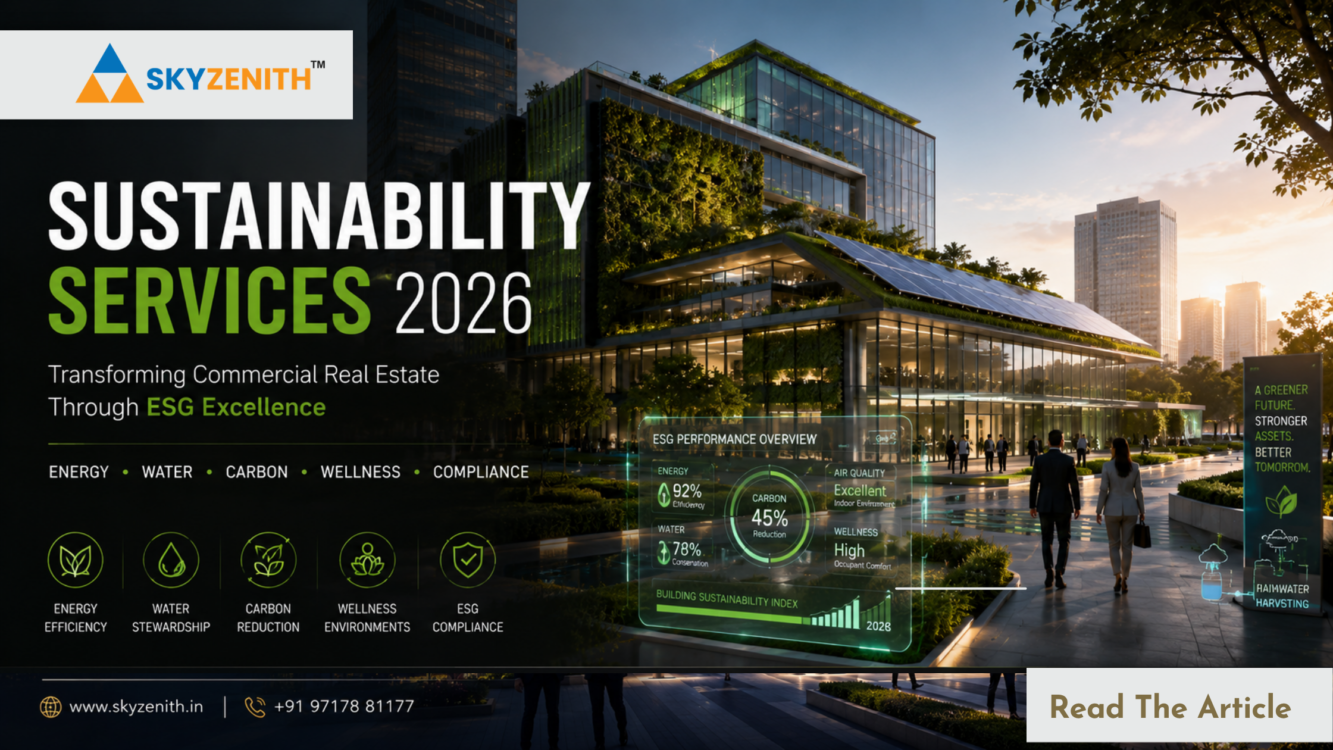
Sustainability Services in 2026: Meeting ESG Goals in Commercial Real Estate
The skyline of Gurgaon tells a story of ambition. Towering glass facades, bustling corporate parks, and endless rows of commercial spaces, each consuming energy, water, and resources at a staggering rate. But a quiet transformation is underway. As we move through 2026, the question is no longer whether commercial real estate should embrace sustainability. The question is how fast. For property owners, facility managers, and ESG officers, the pressure is real: regulatory mandates are tightening, tenant expectations are rising, and investors are demanding verifiable environmental, social, and governance (ESG) performance. This article explores how sustainability services have evolved to meet these challenges, turning green intentions into measurable outcomes.
The Silent Wake-Up Call: Why ESG Is No Longer Optional
Imagine a premium office tower in Sector 74A, Sohna Road. For years, its energy bills climbed, water leaks went unnoticed, and waste bins overflowed without segregation. Then came a multinational tenant with a simple demand: show us your ESG scorecard, or we lease elsewhere. That moment, repeated across Delhi NCR, Mumbai, and Bengaluru—changed everything. By 2025, commercial real estate in India accounted for nearly 30% of urban electricity consumption and 20% of water use in metro cities. The government’s updated Energy Conservation (Amendment) Act and the mandatory ESG disclosure framework for listed real estate investment trusts (REITs) have turned sustainability from a voluntary badge into a compliance necessity. In 2026, buildings without a clear ESG roadmap face higher vacancy rates, steeper insurance premiums, and potential penalties.
The Three Pillars: Environment, Social, and Governance in Real Estate
Understanding ESG in commercial real estate means breaking it down. The Environmental pillar covers energy efficiency, water conservation, waste management, carbon emissions, and indoor air quality. The Social pillar focuses on occupant health, safety, accessibility, and community impact. The Governance pillar ensures transparent reporting, ethical sourcing, and compliance with environmental regulations. A 2026-ready sustainability service addresses all three simultaneously, not as isolated checklists, but as an integrated strategy.
Key Sustainability Services Transforming Commercial Properties in 2026
What does effective sustainability support look like on the ground? It goes far beyond installing LED bulbs or placing recycling bins. Here are the core services that define the current landscape.
Energy Audits and Net-Zero Roadmaps
The first step is knowing where energy escapes. Professional energy audits use thermal imaging, sub-metering, and real-time monitoring to identify inefficiencies in HVAC, lighting, and plug loads. In 2026, the gold standard is an ISO 50002-compliant audit followed by a net-zero roadmap. This document outlines phased investments, from retro-commissioning of chillers to on-site solar installation, with payback calculations. For a typical Gurgaon office building of 500,000 square feet, a well-executed audit can uncover 15-20% energy savings annually, directly improving the bottom line and earning carbon credits under India’s Carbon Credit Trading Scheme.
Water Footprint Reduction and Recycling
Commercial real estate is water-intensive. Cooling towers, landscaping, restrooms, and kitchen facilities consume millions of litres. Sustainability services in 2026 emphasize zero liquid discharge models. Greywater recycling systems treat wastewater from sinks and AC condensate for reuse in flushing and gardening. Rainwater harvesting, mandated by Haryana’s groundwater regulations, is now being combined with sensor-based fixtures that reduce consumption by 40%. For properties near Sohna Road, where water tables are under stress, these measures are not just ethical; they are survival strategies.
Waste Segregation and Circular Economy Integration
The social and environmental aspects converge in waste management. A 2026 commercial building cannot simply send mixed waste to landfills. Sustainability services now deploy centralized waste segregation stations with colour-coded bins, organic waste converters, and partnerships with authorized recyclers for e-waste, plastic, and hazardous materials. The goal is to achieve 80% diversion from landfills. Moreover, the circular economy principle asks: can waste from one tenant become raw material for another? Some Gurgaon business parks now exchange shredded paper for packaging materials, reducing procurement costs.
Indoor Environmental Quality (IEQ) for Occupant Well-Being
The social pillar of ESG demands healthy workplaces. Post-pandemic, tenants prioritize indoor air quality (IAQ) monitoring for CO2, PM2.5, and volatile organic compounds. Sustainability services include installing demand-controlled ventilation, MERV-13 filters, and real-time IAQ dashboards visible to occupants. Natural lighting, thermal comfort, and acoustic design are also assessed. Buildings that achieve WELL Certification or IGBC Green Interior ratings command premium rents of 10-15% higher than non-certified peers.
Carbon Accounting and Reporting
Governance requires transparency. Sustainability service providers now offer carbon accounting aligned with the Greenhouse Gas Protocol. Scope 1 emissions come from on-site fuel combustion (generators, boilers). Scope 2 covers purchased electricity. Scope 3 includes tenant activities, employee commuting, and supply chain. With SEBI’s Business Responsibility and Sustainability Reporting (BRSR) mandatory for top 1000 listed companies, commercial real estate owners must provide verified emissions data. Professional services help collect utility bills, calculate conversion factors, and generate audit-ready reports.
Why 2026 Is the Turning Point for Indian Commercial Real Estate
Several forces have converged to make this year critical. First, the Bureau of Energy Efficiency has expanded the Energy Conservation Building Code (ECBC) to all commercial spaces with a connected load above 100 kW. Second, global investors, from BlackRock to local pension funds, have committed to net-zero portfolios by 2050, and they actively divest from non-compliant assets. Third, technology has matured: IoT sensors, AI-driven building management systems, and blockchain-based carbon tracking are now affordable and scalable. A building without a sustainability partner in 2026 is like a factory without electricity, technically possible, but commercially unviable.
Overcoming Common Barriers: Cost, Expertise, and Legacy Systems
The most frequent objection is upfront cost. However, the business case is compelling. Energy savings typically repay audit and retrofitting costs within 18 to 36 months. Water recycling systems have similar paybacks. Moreover, green building certification (LEED, IGBC, GRIHA) unlocks government incentives, including faster approvals and property tax rebates in some states. The real barrier is often expertise, knowing which interventions yield the highest return. That is where specialized sustainability service providers bridge the gap, offering turnkey solutions from assessment to implementation to reporting.
A Day in the Life of an ESG-Optimized Commercial Property
Let us walk through a typical morning at a transformed building. The sun rises over Sector 74A. Rooftop solar panels begin feeding DC power to the battery storage. The building management system, having forecasted occupancy from calendar data, pre-cools the lobby using a high-efficiency chiller. Water from yesterday’s condensate drips into a storage tank, ready for flushing. At 9 AM, sensors detect 200 people entering; ventilation ramps up silently. By noon, waste from the cafeteria is fed into an organic converter, producing compost for the surrounding landscape. At 5 PM, the system generates a real-time emissions report, automatically uploaded to the owner’s BRSR dashboard. This is not a futuristic fantasy. In 2026, this is the new normal for commercial properties that embraced sustainability services early.
SkyZenith
SkyZenith provides integrated sustainability services tailored for commercial real estate across Gurgaon, Delhi NCR, and beyond. Their offerings include comprehensive energy audits, water footprint reduction strategies, waste management systems, indoor environmental quality assessments, and end-to-end ESG reporting aligned with BRSR, GRI, and GHG Protocol standards. The company’s unique value proposition lies in its technology-driven approach, combining IoT-enabled monitoring, predictive analytics, and on-ground engineering expertise to deliver measurable reductions in carbon emissions and operational costs. SkyZenith also assists properties in achieving IGBC, LEED, and WELL certifications, ensuring that every intervention is audit-ready and compliant with 2026 regulatory frameworks. With a focus on transparency and long-term partnership, SkyZenith helps commercial real estate owners turn sustainability from a compliance burden into a competitive advantage.
Address
Unit No. 908, 9th Floor, Tower 1 DLF Corporate Greens, Sector 74A Sohna Road, Gurgaon, Haryana 122004
Email
Hemraj.dabur@skyzenith.in
Phone
+91 97178 81177