-
Skyzenith
- August 13, 2026
Mall Asset Management in India: Complete Guide to Mall Management, Leasing & Retail Growth
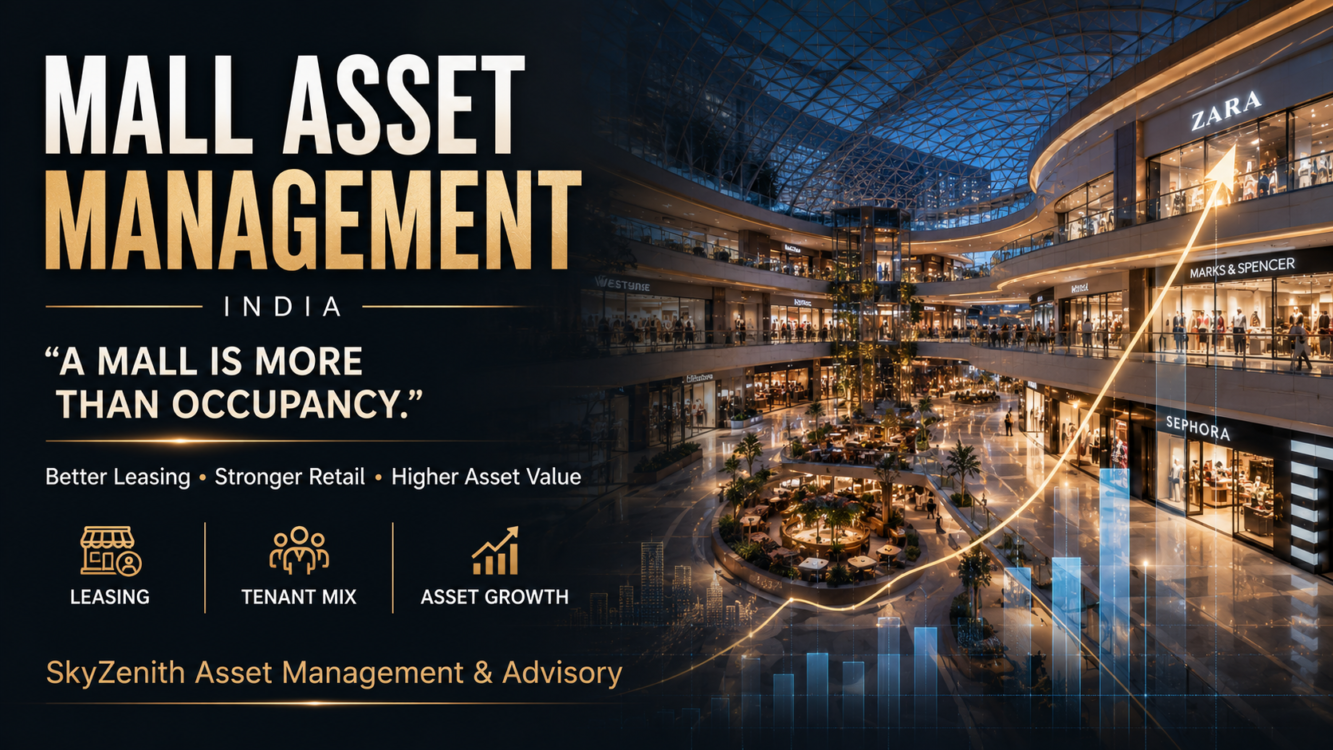
India’s shopping mall industry is entering a more sophisticated phase. A mall is no longer simply a large building filled with retail stores. Today, successful malls function as carefully curated commercial ecosystems where retail leasing, tenant mix, customer experience, asset performance, marketing, operations and financial management must work together.
This shift is visible in the current market. India’s retail sector recorded approximately 2.4 million sq. ft. of leasing across the top eight cities in Q2 2026, with malls accounting for 51.3% of the total leasing volume. Grade A mall vacancy also declined to 5.0%, highlighting strong demand for quality, professionally managed retail assets.
For mall owners and investors, the question is no longer simply, “How do we fill vacant shops?” The more important question is: How do we make every part of the asset perform better over the long term?
That is where professional mall asset management in India becomes increasingly important.
What Is Mall Asset Management?
Mall asset management is the strategic management of a shopping mall with the objective of improving its financial performance, operational efficiency, tenant relationships, customer experience and long-term asset value.
It goes beyond routine facility management.
A professional asset management strategy examines the entire commercial ecosystem, including occupancy, leasing revenue, tenant productivity, rental structures, tenant mix, operating costs, footfall, customer behaviour, marketing performance and future development opportunities.
The objective is to create sustainable value rather than focusing only on short-term occupancy.
A mall with 95% occupancy is not necessarily a high-performing mall if its tenant mix is weak, retailers are underperforming or customers have little reason to return.
Why Mall Management in India Is Becoming More Strategic
Indian consumers are changing the way they use shopping malls. Shopping is increasingly combined with dining, entertainment, leisure, social experiences and community activities.
This is influencing how developers approach mall management and leasing. CBRE reported that India’s retail leasing reached approximately 8.9 million sq. ft. in 2025, with demand supported by experiential flagship stores, kiosks and Gen Z-oriented formats.
The implication for mall owners is significant. A successful mall needs to understand not only how much space is occupied but also who occupies that space, how those tenants perform and whether the overall tenant ecosystem matches the target customer.
This makes strategic mall management a core component of commercial real estate performance.
Mall Leasing Strategy: Filling Space Is Not Enough
Leasing remains one of the most important components of mall asset management, but modern mall leasing strategy is about quality as much as quantity.
A vacant unit represents lost revenue, but leasing the wrong tenant simply to improve occupancy can create a different problem. The tenant may fail to attract customers, overlap with another retailer or weaken the overall positioning of the mall.
An effective leasing strategy considers location, category, brand positioning, rental potential, customer demographics and the performance of surrounding stores.
Fashion and F&B remain major drivers of retail demand. In Q2 2026, fashion accounted for 28.2% of leasing activity and F&B contributed 17.2%, while entertainment accounted for 10.8%.
This demonstrates why tenant mix optimization is essential. A mall needs complementary businesses rather than simply a large number of businesses.
Tenant Mix Optimization for Shopping Malls
Imagine a mall where every floor contains similar fashion retailers. Even if occupancy appears excellent, the customer journey may become repetitive.
A well-designed tenant mix creates a balance between fashion, lifestyle, beauty, electronics, home, F&B, entertainment, services and experiential concepts.
The right mix can encourage customers to spend more time inside the property and visit different zones.
Tenant placement also matters. Anchor tenants can influence movement patterns, while cafés, entertainment concepts and high-demand retailers can help activate areas that receive less natural footfall.
Therefore, tenant mix optimization in malls should be treated as an ongoing process rather than a one-time leasing exercise.
Mall Performance Management and Revenue Growth
Mall asset management should connect operational activity with measurable financial outcomes.
Important performance indicators can include occupancy, rental income, sales productivity, footfall, tenant sales, lease expiry schedules, common-area maintenance recovery, operating expenditure and marketing effectiveness.
Regular performance reviews can reveal opportunities that may otherwise remain hidden.
For example, a mall may have strong overall footfall but poor performance on a particular floor. Instead of treating the entire property as one market, management can investigate circulation patterns, tenant categories, signage, accessibility and customer behaviour within that specific zone.
This creates the foundation for data-driven mall management and retail growth.
Customer Experience Is Now a Commercial Asset
- Modern mall management increasingly focuses on what happens between the store entrances.
- Parking convenience, navigation, cleanliness, lighting, seating, washrooms, entertainment, food options, digital engagement and event programming can influence how customers perceive the property.
- Experience-led retail is becoming particularly important as consumers have more alternatives for purchasing products online.
- A successful mall therefore needs to offer something beyond transactions.
- This can include dining destinations, entertainment, family activities, seasonal events, pop-up concepts and community-oriented experiences.
- The objective is to increase footfall, dwell time, repeat visits and customer engagement while creating stronger commercial opportunities for tenants.
Mall Asset Optimization and Repositioning
Not every mall needs to be completely redeveloped to improve performance.
Sometimes relatively focused interventions can create meaningful change. These may include improving tenant mix, repositioning vacant areas, redesigning common spaces, introducing new F&B or entertainment concepts, upgrading signage, improving customer circulation or refreshing the property’s visual identity.
This is where mall asset optimization becomes valuable.
An asset manager should first understand the property’s existing strengths and weaknesses before recommending capital-intensive changes.
The right strategy could involve leasing changes, operational improvements, targeted refurbishment or a broader repositioning exercise.
The Role of Data in Mall Asset Management
Technology is changing the way shopping malls are managed.
Modern mall management can use data relating to footfall, customer movement, tenant performance, parking utilization, campaign engagement and leasing activity to support better decisions.
Instead of relying entirely on assumptions, owners can compare performance across zones, categories and time periods.
Data can also support more informed leasing discussions. Understanding customer demographics and movement patterns can help determine which categories may be suitable for particular spaces.
The result is a more measurable approach to commercial property management and retail asset performance.
Mall Management in Delhi NCR and India’s Growth Markets
Delhi NCR remains one of India’s most important retail markets. In Q2 2026, the region accounted for 28% of retail leasing across the top eight cities, while Delhi NCR, Mumbai and Hyderabad together contributed 64% of leasing activity.
Gurugram is particularly significant within the Delhi NCR ecosystem because of its corporate population, residential expansion, premium retail destinations and evolving consumer base.
However, successful mall asset management cannot simply copy a strategy from one city to another. Consumer profiles, competition, catchment areas, infrastructure and retailer demand differ significantly between markets.
A professional strategy therefore begins with market research, catchment analysis and asset-specific evaluation.
Why Professional Mall Asset Management Matters
A shopping mall represents a significant long-term investment. Poor leasing decisions, weak tenant relationships, inefficient operations or declining customer relevance can gradually reduce asset performance.
Professional mall asset management services in India provide a structured framework for addressing these challenges.
The focus should be on understanding the asset as a complete commercial ecosystem: attract the right retailers, create an effective tenant mix, improve customer experience, control operating performance and continuously identify opportunities for revenue and value creation.
The strongest mall strategies are not based on one department working independently. Leasing, marketing, operations, finance and asset planning need to work towards common commercial objectives.
The Future of Mall Asset Management in India
The next generation of Indian malls is likely to be increasingly experience-driven, data-led and strategically curated.
Current leasing data already points towards strong retailer demand for organized, high-quality retail environments. In Q2 2026, malls captured more than half of total leasing activity across the top eight cities, while limited premium supply contributed to tighter vacancy levels.
For owners, this creates an opportunity but also raises expectations.
Simply owning a well-located mall is no longer enough. The asset must continuously evolve with consumers, retailers and the surrounding market.
Mall asset management in India will therefore increasingly move from reactive property management towards proactive commercial strategy.
Conclusion
A successful shopping mall is the result of hundreds of interconnected decisions. From the retailer occupying a particular unit to the location of an anchor store, from customer circulation to F&B planning, every element can influence the property’s overall performance.
Effective mall management, retail leasing, tenant mix optimization and asset management bring these elements together into one strategic framework.
For mall owners, developers and investors, the objective should not simply be higher occupancy. It should be better occupancy, stronger tenant performance, improved customer experience, sustainable revenue and long-term asset value.
As India’s organized retail market continues to evolve, professionally managed and strategically positioned malls will be better placed to capture changing consumer demand and create durable commercial value.
About SkyZenith Asset Management & Advisory
SkyZenith Asset Management & Advisory is a professional real estate advisory firm focused on helping property owners, developers and investors improve the performance and long-term value of commercial assets. Its services include mall asset management, mall management, retail leasing, tenant mix optimization, asset management, location strategy, market research, commercial advisory, workplace and space planning, and retail growth strategy. The firm’s approach combines market intelligence, strategic planning and practical execution to help clients identify opportunities, address performance gaps and make informed commercial decisions. Its key strength is an integrated approach that connects leasing, asset performance, tenant strategy and operational considerations rather than treating each requirement as an isolated service. This enables property stakeholders to develop practical strategies focused on occupancy, tenant performance, customer experience, revenue improvement and sustainable asset growth.
SkyZenith Asset Management & Advisory
Unit No. 908, 9th Floor, Tower 1, DLF Corporate Greens, Sector 74A, Sohna Road, Gurgaon, Haryana 122004
Phone: +91 97178 81177
Email: Hemraj.dabur@skyzenith.in
Website: skyzenith.in