-
Skyzenith
- October 8, 2026
Hotel Leasing in India: How to Evaluate Location, Property and Business Potential
A hotel property can have an excellent building, attractive interiors and a promising location, yet still struggle to achieve its full commercial potential. In hospitality, the success of a property depends on much more than the physical asset. Location, demand, operator capability, property positioning, lease structure and long-term operating potential all influence whether a hotel becomes a successful business.
This makes hotel leasing in India a strategic real estate decision rather than a simple property transaction. For property owners, developers and hospitality brands, the right leasing strategy can help create a stronger partnership, improve asset utilisation and support long-term property value.
What Is Hotel Leasing?
Hotel leasing involves an arrangement in which a property owner provides a hotel property or hospitality space to an operator or brand under agreed commercial and operational terms.
Unlike conventional commercial leasing, hotel leasing has a strong connection between the physical property and the business operating from it. The property’s location, room inventory, facilities, positioning, brand compatibility and operating model can all influence its commercial performance.
For this reason, hotel leasing requires careful evaluation from both the property owner’s and operator’s perspective.
Why Does Location Matter in Hotel Leasing?
Location is one of the most important factors in evaluating a hotel property.
A business hotel may perform better near major commercial districts, corporate hubs, airports or transportation networks. A leisure property may depend more heavily on tourism demand, destination appeal and accessibility. Hotels serving weddings, events or extended stays may have different location requirements.
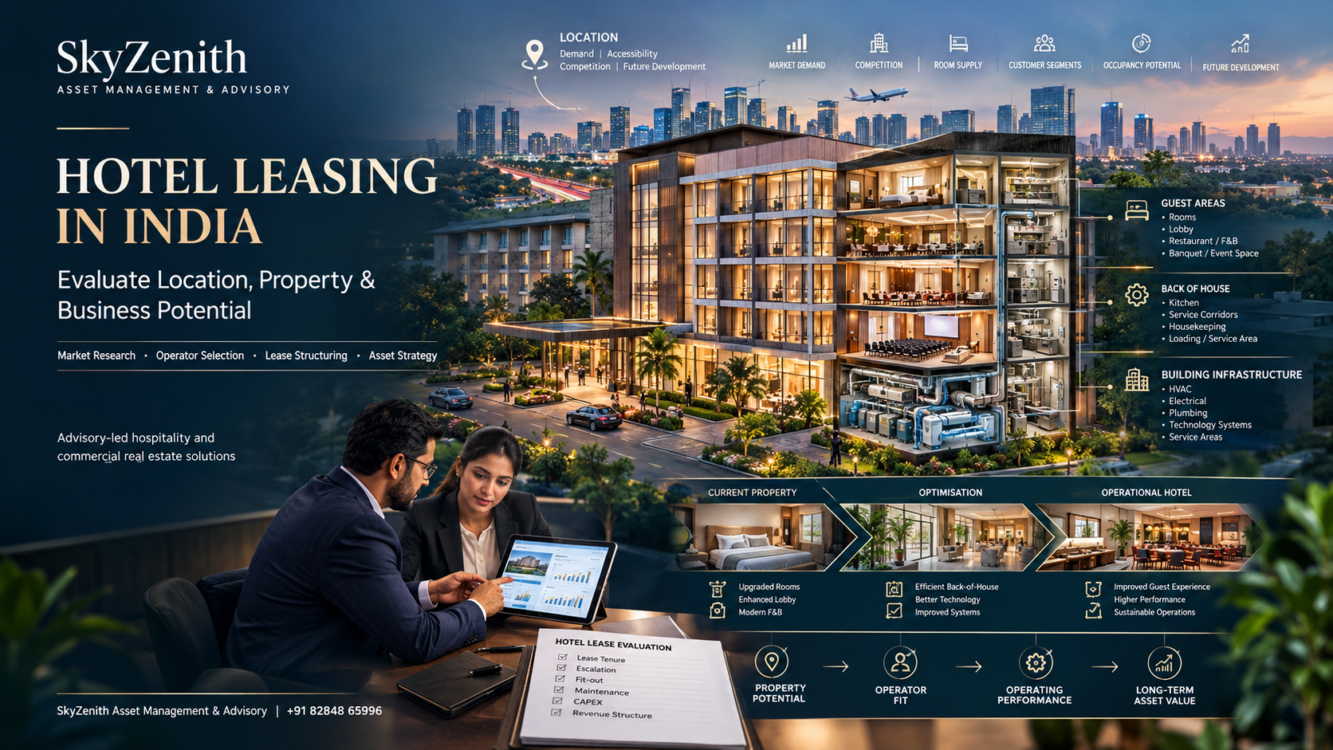
The right location should therefore be evaluated through | demand drivers | accessibility | competition | surrounding development | customer profile | connectivity | future growth.
A strong location does not automatically guarantee success, but an unsuitable location can make even a well-designed hotel difficult to operate profitably.
Evaluating the Hotel Property
Before entering a hotel lease, the physical property needs to be assessed carefully.
Important considerations may include room configuration, common areas, restaurants, banquet facilities, parking, back-of-house infrastructure, building condition, service areas, HVAC systems, technology infrastructure and opportunities for future upgrades.
The property’s current condition can influence the investment required before operations begin. A detailed assessment can help identify potential renovation, fit-out, maintenance and operational requirements before commercial terms are finalised.
Choosing the Right Hotel Operator
The operator can have a major influence on the performance and positioning of a hotel.
Property owners should consider the operator’s brand positioning, target customer, operating experience, distribution capabilities, management approach and understanding of the relevant market.
The right operator should complement the property rather than simply bring a recognised name. A luxury operator may not be appropriate for a property designed for value-conscious business travellers, while a limited-service model may not maximise the potential of a destination resort.
Operator selection should therefore be treated as a strategic decision.
Hotel Lease Structure and Commercial Terms
Hotel lease agreements can involve different commercial structures depending on the property, operator and investment objectives.
These may include fixed rental arrangements, revenue-linked structures or hybrid models. The appropriate structure depends on factors such as property investment, expected operating performance, market conditions, risk allocation and the objectives of both parties.
Other terms can also influence the long-term economics of the arrangement | lease tenure | escalation | fit-out responsibilities | maintenance obligations | renewal options | capital expenditure | operating standards.
A professionally structured agreement should create clarity around responsibilities while allowing the hotel business to operate sustainably.
Market Research and Hotel Feasibility
Hotel leasing decisions should be supported by market research rather than assumptions.
A feasibility assessment can examine the local hospitality market, competing properties, demand segments, room supply, customer profiles, business activity, tourism potential and future developments.
Understanding the competitive landscape can help property owners determine which type of hotel concept may have the strongest potential.
This is particularly important when a property is being converted into a hotel or when an existing hotel is being repositioned.
Hotel Property Optimisation
Leasing a hotel is only one part of the asset strategy. The property may require improvements to its layout, facilities, design, technology or operational systems to remain competitive.
Property optimisation can involve evaluating guest areas, room configuration, F&B spaces, event facilities, back-of-house operations, energy performance and other components that influence the guest experience and operating efficiency.
A well-planned approach can help align the physical property with the selected operator and target market.
Hotel Leasing for Long-Term Asset Value
For property owners, the objective should not be limited to finding an operator quickly.
The stronger objective is to establish a sustainable hospitality model that supports occupancy, operating performance, tenant or operator stability and long-term property value.
This requires consideration of the property’s future positioning, market demand, capital requirements and relationship between the lease structure and business performance.
Strategic hotel leasing therefore connects hospitality operations with broader real estate asset management.
How to Choose a Hotel Leasing Advisory Company in India
A suitable hotel leasing advisory company in India should understand both commercial real estate and hospitality.
The advisory process should ideally include market research, property assessment, operator identification, commercial evaluation, lease structuring, negotiation support and post-leasing coordination.
Most importantly, the advisor should understand that every hotel property has a different commercial story. The right operator, lease structure and positioning must be developed around the specific characteristics of the asset.
SkyZenith: Hotel Leasing and Hospitality Advisory
SkyZenith Asset Management & Advisory provides hotel leasing services designed to connect property owners with suitable hospitality operators and brands. Its approach includes market research and analysis, operator selection, lease structuring and negotiation, property optimisation and post-leasing support.
The company’s wider capabilities across commercial leasing, retail leasing, asset management, location strategy, fit-out management, smart buildings, sustainability, building audits and project management provide an integrated perspective on hospitality assets.
SkyZenith’s key USP is its advisory-led approach. Hotel leasing is considered not simply as filling a property with an operator, but as a broader asset strategy involving location, property potential, commercial structure, operational requirements and long-term value.
Contact SkyZenith
SkyZenith Asset Management & Advisory
Unit No. 908, 9th Floor, Tower 1, DLF Corporate Greens, Sector 74A, Sohna Road, Gurgaon, Haryana 122004
Email: Hemraj.dabur@skyzenith.in
Phone: +91 82848 65996
Website: skyzenith.in
Conclusion
Successful hotel leasing in India begins long before a lease agreement is signed. The location needs to be understood, the property evaluated, the market analysed and the right operator identified. Commercial terms must then be structured around the long-term potential of the asset.
For property owners and developers, the objective is not simply to lease hotel space. It is to create a hospitality partnership that can support operational performance, customer experience and sustainable property value.
When hotel leasing is approached as a strategic real estate decision rather than a conventional transaction, the property can be positioned for stronger and more sustainable long-term performance.