-
Skyzenith
- September 21, 2026
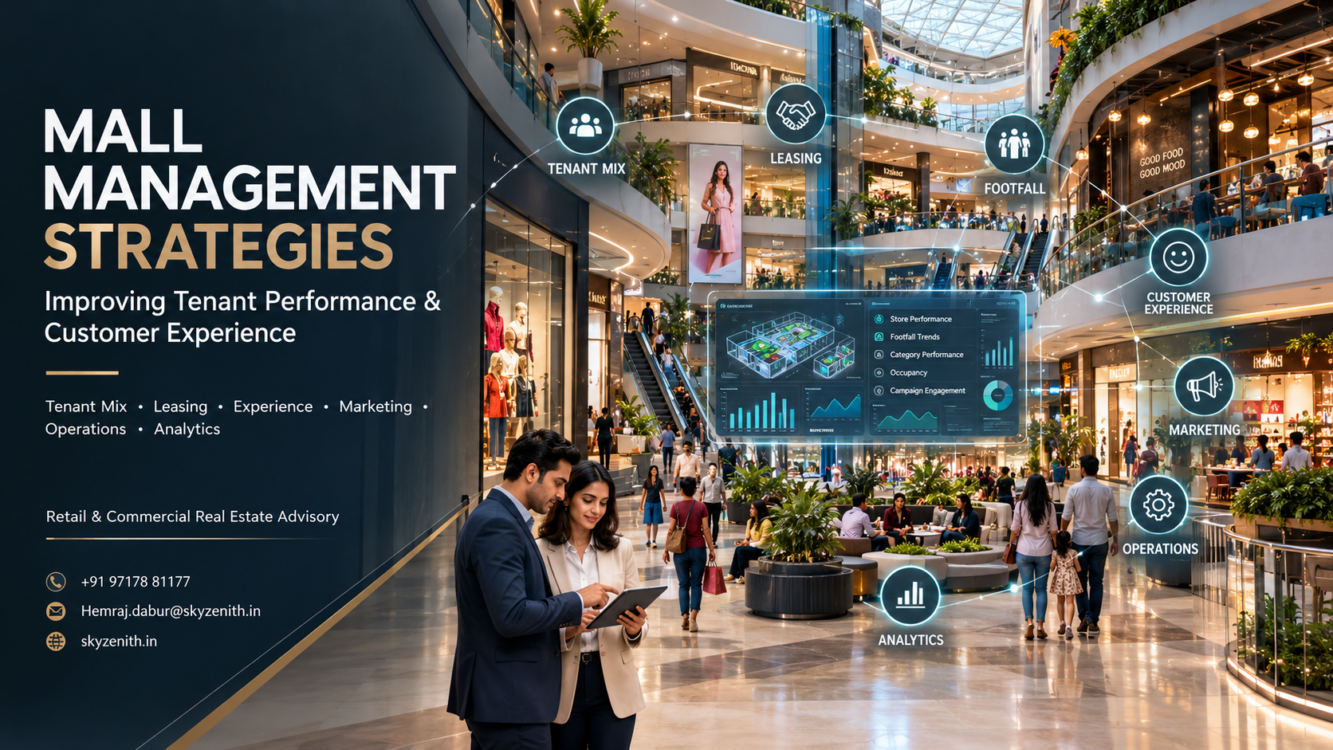
Mall Management Strategies for Improving Tenant Performance and Customer Experience
A successful shopping mall is more than a collection of retail stores under one roof. It is a carefully managed ecosystem where retailers, customers, property owners, food and beverage operators, entertainment brands and service providers must work together to create a consistent commercial experience.
A customer may enter a mall because of one particular brand, stay because of the dining and entertainment options, discover another retailer and eventually return because the overall experience was convenient and enjoyable. Behind that journey is a detailed mall management strategy that influences everything from tenant mix and leasing to marketing, maintenance, events and customer engagement.
India’s organised retail market continues to evolve toward experience-led formats. CBRE reported around 3.9 million sq. ft. of retail space absorption during H1 2026, with retailers continuing to focus on experiential formats and consumer-centric offerings. This changing environment makes effective mall management services increasingly important for both tenant performance and long-term asset value.
Mall Management Strategy: Creating a Strong Retail Ecosystem
The first responsibility of effective mall management is to understand that every tenant contributes to the identity of the property.
A fashion brand, premium restaurant, supermarket, entertainment centre and beauty retailer may serve different customer needs, but their combined presence determines how shoppers perceive the mall.
A strong mall management strategy therefore begins with understanding the catchment, customer demographics, competing properties and evolving consumption patterns.
The objective is to create a tenant ecosystem where categories complement rather than unnecessarily compete with one another.
Tenant Mix Optimization for Better Mall Performance
Tenant mix optimization is one of the most important elements of mall management.
A mall with too many similar brands may create intense internal competition without increasing overall customer attraction. Conversely, a property lacking strong anchors, dining options or entertainment may struggle to encourage customers to spend more time on-site.
An effective tenant mix can include complementary categories such as fashion, beauty, lifestyle, jewellery, electronics, food and beverage, entertainment and family experiences.
The right combination depends on the property’s location and target audience. CBRE’s 2026 retail data shows that fashion and apparel accounted for about 40% of H1 retail leasing, while F&B and entertainment also remained significant demand drivers.
This illustrates why tenant planning needs to look beyond individual leases and consider the performance of the entire destination.
Improving Retail Tenant Performance Through Data
Once tenants are operating, mall management should move beyond simply collecting rent and maintaining common areas.
Retail tenant performance management requires continuous evaluation of occupancy, sales trends where available, customer traffic, campaign participation, store visibility and category performance.
Data can help identify questions that may otherwise remain unnoticed.
For example, if customer movement is strong in one part of the mall but weak in another, management may investigate whether signage, tenant positioning, accessibility or category composition is influencing the difference.
Similarly, a retailer experiencing weaker performance may benefit from a review of its visibility, marketing activity, store format or customer engagement rather than immediately assuming that the location itself is responsible.
Customer Experience Management in Shopping Malls
Modern shoppers increasingly expect a mall to provide more than convenient access to products.
They may expect comfortable common areas, intuitive navigation, attractive food and beverage spaces, entertainment, events, digital convenience and a sense of discovery.
Customer experience management in malls therefore begins from the moment a visitor approaches the property.
Parking, entrances, security, elevators, washrooms, signage, cleanliness, lighting and wayfinding all influence the customer’s perception.
Small operational issues can have a surprisingly large impact. A confusing parking route or poorly placed directional sign can create frustration before the shopper has even entered a store.
Good mall management treats these details as part of the retail experience rather than separate facility concerns.
Mall Marketing Strategy to Increase Footfall
Generating footfall is important, but attracting the right audience is equally important.
A modern mall marketing strategy can combine seasonal campaigns, brand activations, social media, events, loyalty programmes, influencer collaborations and targeted digital communication.
Marketing should also support individual tenants rather than functioning independently from the leasing strategy.
For example, a fashion-led campaign can be connected with relevant restaurants, beauty retailers and entertainment offerings to encourage visitors to explore multiple parts of the property.
This creates a more integrated destination experience and gives tenants opportunities to participate in campaigns that extend beyond their individual storefronts.
Experiential Retail and Placemaking
The role of a mall is changing from simply providing retail space to creating places where people want to spend time.
CBRE’s recent retail research highlights the importance of experiential formats, flagship stores and consumer-centric offerings in India’s evolving retail market.
Experiential retail management can include live events, entertainment, interactive installations, seasonal experiences, community activities and food-led programming.
The purpose is not to fill the calendar with events. Each activation should have a clear connection with the mall’s audience and tenant ecosystem.
A well-designed experience can create reasons for customers to visit even when they are not shopping for a specific product.
Retail Leasing and Tenant Relationship Management
Successful malls also depend on strong relationships with their tenants.
Retail leasing management should not end once a lease agreement is signed. Tenant requirements evolve as brands change their formats, product categories, customer profiles and expansion strategies.
Regular communication between mall management and tenants can help identify operational issues, marketing opportunities and upcoming business requirements.
Tenant relationship management can also support better lease renewals, store relocations and strategic category planning.
The long-term objective is to build a relationship in which the mall and its retailers have a shared interest in improving the destination’s performance.
Mall Operations and Facility Management
Behind the customer-facing experience is a complex operational system.
Cleaning, security, HVAC, lighting, parking, escalators, elevators, fire safety, energy management and preventive maintenance all influence how customers experience a mall.
Mall facility management should therefore be proactive rather than reactive.
Regular inspections and preventive maintenance can reduce avoidable disruptions and help maintain consistent standards throughout the property.
Technology can further support this process through building-management systems, energy monitoring, occupancy analytics and digital maintenance tracking.
Using Technology to Improve Mall Customer Experience
Technology is increasingly becoming part of modern mall management.
Digital directories, mobile applications, loyalty platforms, customer feedback systems, smart parking and data analytics can make the shopping journey more convenient while helping management understand customer behaviour.
The value of technology, however, depends on how effectively it solves real customer and operational problems.
A sophisticated system is not useful simply because it is technologically advanced. It should provide measurable improvements in convenience, engagement, operational efficiency or decision-making.
Building a Long-Term Mall Management Strategy
A successful mall cannot depend on one strong tenant, one marketing campaign or one busy season.
It needs a coordinated strategy covering tenant mix, leasing, customer experience, marketing, operations, facility management, asset positioning and performance analysis.
This is particularly important as Indian retail becomes more experience-oriented and brands increasingly evaluate physical stores based on customer engagement and long-term viability.
For mall owners and developers, the opportunity is to treat the property as an evolving retail ecosystem rather than a static collection of leased units.
From Mall Operations to Asset Performance
The strongest mall management strategies connect daily operations with the long-term value of the property.
Every decision from selecting a new tenant to redesigning a common area—can influence customer perception, tenant productivity and asset positioning.
SkyZenith approaches mall management and retail real estate from this broader advisory perspective, connecting leasing, tenant strategy, customer experience, asset planning and operational considerations.
For property owners, developers and brands, this integrated approach can create a clearer framework for managing retail environments in a market where customer expectations continue to evolve.
About SkyZenith
SkyZenith provides retail and commercial real estate advisory services for mall owners, developers, brands, investors and businesses seeking strategic growth. Its services include mall management and advisory, retail asset and leasing advisory, commercial leasing and sales, hotel leasing, location strategy, fit-out and design advisory, smart building solutions, sustainability and building audits, workplace and occupancy planning, and experience and club management. Its USP is an integrated advisory approach that connects real estate strategy with retail performance, tenant requirements, customer experience and operational planning. Rather than viewing leasing, asset management and customer experience as separate functions, SkyZenith works across these areas to help stakeholders create better-positioned, commercially effective and experience-led retail environments.
Contact SkyZenith
Unit No. 908, 9th Floor, Tower 1, DLF Corporate Greens, Sector 74A, Sohna Road, Gurgaon, Haryana 122004
Email: Hemraj.dabur@skyzenith.in
Phone: +91 97178 81177
Website: skyzenith.in