-
Skyzenith
- August 16, 2026
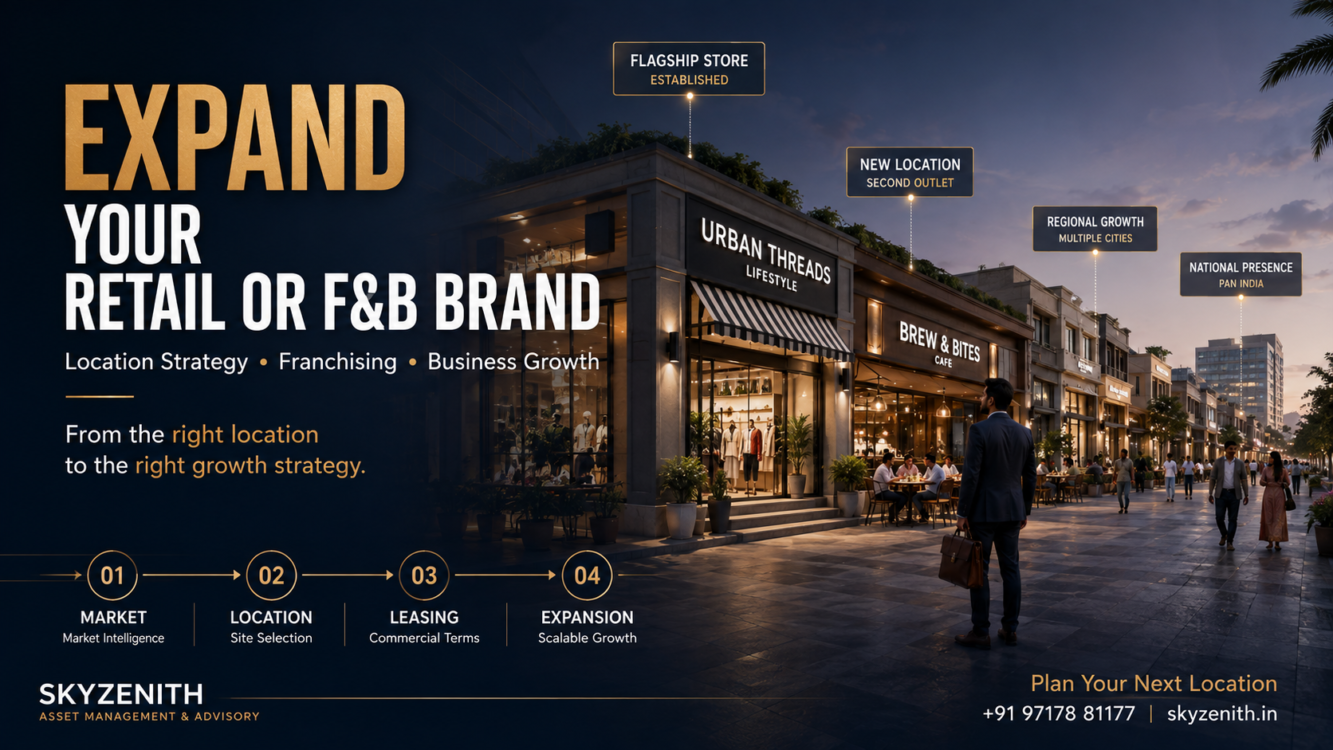
How to Expand a Retail or F&B Brand in India: Location Strategy, Franchising & Business Growth
India’s retail and food & beverage sector is entering a new phase of expansion. Brands are no longer looking only at the largest metropolitan markets. Established businesses, emerging D2C brands, restaurant chains and franchise-led concepts are increasingly exploring new neighbourhoods, high streets, shopping malls, mixed-use developments and emerging cities.
The opportunity is significant, but expansion is not simply a matter of opening more outlets. A successful growth strategy requires the right location, commercially viable leasing terms, a scalable operating model and a clear understanding of the customer.
India’s organised retail market continues to demonstrate strong momentum. Retail real estate leasing reached approximately 3.9 million sq. ft. in the first half of 2026, representing 20% year-on-year growth according to CBRE. Fashion and apparel remained the largest leasing category, while F&B accounted for around 14% of take-up.
For ambitious brands, the question is therefore not simply where can we open our next store? It is which location, format and expansion model can create sustainable business growth?
Retail and F&B Expansion in India Requires a Strategic Approach
A successful expansion strategy begins with understanding the brand’s existing business model. A premium fashion retailer, neighbourhood café, QSR, salon, electronics brand and luxury lifestyle concept will all have different location requirements.
The first step is to define the target customer, expected sales potential, preferred store size, investment capacity and desired market positioning. These factors provide a framework for identifying suitable locations.
A strong expansion plan brings together market research, location strategy, retail leasing, commercial space planning, financial evaluation and operational planning. When these elements work together, the chances of establishing a profitable outlet increase significantly.
How Location Strategy Supports Retail Expansion in India
Location remains one of the most important factors influencing retail performance. Even a strong brand can struggle if its outlet is positioned in an area with insufficient customer demand, poor accessibility or an unsuitable competitive environment.
A professional retail location strategy in India should examine the surrounding catchment, customer demographics, purchasing power, existing footfall, accessibility, visibility, parking, nearby residential and commercial developments, competing brands and future infrastructure.
For an F&B business, the analysis should also consider delivery demand, kitchen requirements, exhaust infrastructure, loading access, operating hours and the availability of sufficient frontage.
The objective is not to find the cheapest property. It is to identify a property where the expected customer demand justifies the occupancy cost and supports sustainable unit economics.
Choosing Between High Street and Shopping Mall Locations
One of the most important decisions for an expanding brand is whether to establish an outlet on a high street or within a shopping mall.
High streets can provide strong visibility, direct access and proximity to established neighbourhood markets. They can be particularly effective for brands that depend on local catchments, convenience and frequent customer visits.
Shopping malls provide a different environment. They can offer organised footfall, parking, entertainment, complementary brands and an experience-led environment. This can be valuable for fashion, lifestyle, premium retail and F&B brands.
The Indian market is currently supporting both formats. Cushman & Wakefield reported that malls accounted for 51.3% of retail leasing in Q2 2026, while main streets retained a strong 48.7% share.
Therefore, there is no universal answer. The correct choice depends on the brand’s customer profile, positioning, store format and financial model.
Tier-II and Emerging Cities Are Creating New Expansion Opportunities
India’s retail growth is gradually spreading beyond traditional metropolitan centres. Emerging cities are becoming increasingly attractive as consumer spending, organised retail infrastructure and brand awareness develop.
Markets such as Jaipur, Chandigarh, Indore, Lucknow, Surat, Kochi, Nagpur, Coimbatore and other growing urban centres can provide opportunities for brands seeking their next phase of expansion.
However, entering a new city should not be based solely on population size. Brands need to understand local consumption behaviour, competition, catchment quality, rental levels and the availability of suitable commercial properties.
A successful retail expansion strategy for Tier-II cities therefore combines national brand positioning with local market intelligence.
Build a Cluster-Based Expansion Strategy
Expanding across India one isolated outlet at a time can create unnecessary operational complexity. A cluster-based approach can provide a more structured alternative.
A brand could initially establish multiple outlets within a specific region or group of nearby cities. Once the operational infrastructure becomes established, the business can move into the next market.
This approach can improve supply-chain efficiency, staff deployment, marketing effectiveness and management oversight. It can also help the brand build stronger local awareness instead of maintaining scattered outlets with limited regional presence.
For F&B businesses, clustering can be particularly useful because procurement, kitchen supplies, logistics, training and operational supervision can become easier when outlets are located within manageable geographic areas.
Franchising: A Powerful Model for Brand Expansion in India
Once a brand has developed a proven business model, franchising can provide an effective route to expansion.
A franchise model allows independent business partners to invest in and operate outlets under the established brand system. This can help a company expand into multiple markets without funding every location entirely through its own capital.
However, successful franchise expansion in India requires much more than a recognisable brand name.
The business should have clearly documented operating procedures, store standards, employee training systems, procurement processes, marketing guidelines, technology systems and quality-control mechanisms.
A franchisee should know what the investment involves, how the outlet operates, what support the brand provides and how performance will be measured.
When Is a Brand Ready for Franchising?
Franchising should ideally begin after the business has demonstrated that its concept can be replicated successfully.
A brand should understand its store-level economics, including approximate investment, operating expenses, staffing requirements, expected sales, occupancy costs and potential breakeven period.
It should also have a reliable supply chain and a clear customer proposition.
If the business model works only because of the founder’s personal involvement, franchising may be premature. A scalable franchise system requires processes that can be transferred to another operator without compromising the customer experience.
Retail Leasing Strategy Can Influence Long-Term Profitability
Finding the right property is only half of the expansion process. Negotiating the right commercial terms is equally important.
A brand should evaluate the complete lease structure, including rent, security deposit, escalation, lock-in period, lease tenure, fit-out period, CAM charges, revenue-sharing arrangements, signage rights, permitted use, maintenance responsibilities, renewal conditions and exit provisions.
A property with attractive footfall can still become financially challenging if the occupancy cost is disproportionate to expected sales.
This makes retail leasing services in India an important part of expansion planning. Professional leasing support can help brands compare properties, evaluate commercial structures and negotiate terms that are better aligned with the business model.
Use Data Before Finalising a Commercial Property
Expansion decisions should combine market intelligence with financial analysis.
Before signing a lease, a brand should understand the property’s catchment, customer profile, visibility, accessibility, competition, estimated footfall, rental structure and potential sales.
The business can then compare different properties through a structured location evaluation process.
A good location assessment should answer several important questions: Who lives or works nearby? Who is likely to visit the outlet? What competing brands already operate in the area? Is the property easy to access? Is there sufficient visibility? Can the rent be supported by realistic sales projections? What developments are planned around the location?
These questions can help reduce the risk of making expansion decisions based purely on appearance or assumptions.
Commercial Space Planning and Store Design Matter
A successful location brings customers to the property, but the store environment influences how customers interact with the brand.
Professional commercial space planning should consider customer movement, product displays, seating, billing areas, storage, staff circulation, lighting, signage and operational requirements.
For F&B brands, kitchen workflow and service efficiency become particularly important. For retail brands, product visibility and customer movement can directly influence the shopping experience.
The objective is to create a space that represents the brand while remaining commercially efficient.
Omnichannel Growth Is Changing Physical Retail
Physical stores are no longer separate from digital business. Many modern brands use stores as customer-experience centres, fulfilment points, brand-building environments and extensions of their online presence.
D2C businesses are increasingly moving from online-only models toward physical retail. CBRE reported that D2C players accounted for around 28% of retail absorption in H1 2026, demonstrating the growing importance of physical stores in digital-native brand expansion.
This creates a new opportunity for brands to design stores around both physical and digital customer journeys.
A strategically positioned outlet can strengthen brand recognition while also supporting online customer acquisition and fulfilment.
Maintain Brand Consistency During Rapid Expansion
One of the biggest challenges of rapid expansion is maintaining consistency.
Customers should experience the same brand identity, product quality and service standards regardless of whether they visit an outlet in Delhi, Mumbai, Bengaluru, Jaipur or Indore.
This requires documented SOPs, employee training, store-design guidelines, centralised marketing standards, technology integration and regular operational reviews.
For franchise businesses, these systems become even more important because the brand must maintain quality across locations operated by different partners.
The Future of Retail and F&B Expansion in India
India’s retail market is expected to continue evolving through a combination of organised retail development, experiential formats, D2C expansion and growth in emerging locations.
CBRE expects continued investment-grade retail supply, stronger high-street development and increasing integration between retail, mixed-use developments and transit-oriented locations.
At the same time, current leasing activity demonstrates strong demand from both fashion and F&B brands. Cushman & Wakefield reported that fashion and F&B together contributed 46% of retail leasing activity in Q1 2026, while Q2 data showed F&B accounting for 17.2% of leasing across the top eight cities.
For brands, this means competition for quality locations is likely to remain strong. Strategic planning before entering a market can therefore provide a significant advantage.
Conclusion
Successful retail and F&B expansion in India is not about opening the greatest number of outlets in the shortest possible period. Sustainable growth comes from selecting the right markets, understanding local customers, securing commercially viable properties and creating an operating model that can be replicated.
Location strategy provides the foundation. Retail leasing determines the commercial structure. Space planning shapes the customer experience. Franchising provides a scalable route to geographical growth. Strong operating systems ensure that expansion does not compromise the brand.
For businesses planning to enter new cities or strengthen their existing presence, a carefully planned expansion strategy can turn individual store openings into a long-term national growth programme.
About SkyZenith
SkyZenith provides integrated commercial real estate and asset management solutions for brands, businesses, investors and property owners across India. Its services include retail leasing, hotel leasing, commercial leasing, occupancy and space planning, design solutions, fit-out management and building audits. The company’s key USP is its integrated approach, combining property strategy, leasing expertise, occupancy planning and design thinking to help clients make commercially informed real estate decisions. Rather than treating leasing and space planning as separate activities, SkyZenith focuses on connecting location, property utilisation and business objectives to support stronger occupancy, improved asset performance and sustainable expansion.
Contact SkyZenith
Address: Unit No. 908, 9th Floor, Tower 1, DLF Corporate Greens, Sector 74A, Sohna Road, Gurgaon, Haryana 122004
Email: Hemraj.dabur@skyzenith.in
Phone: +91 97178 81177
Website: skyzenith.in