-
Skyzenith
- October 31, 2026
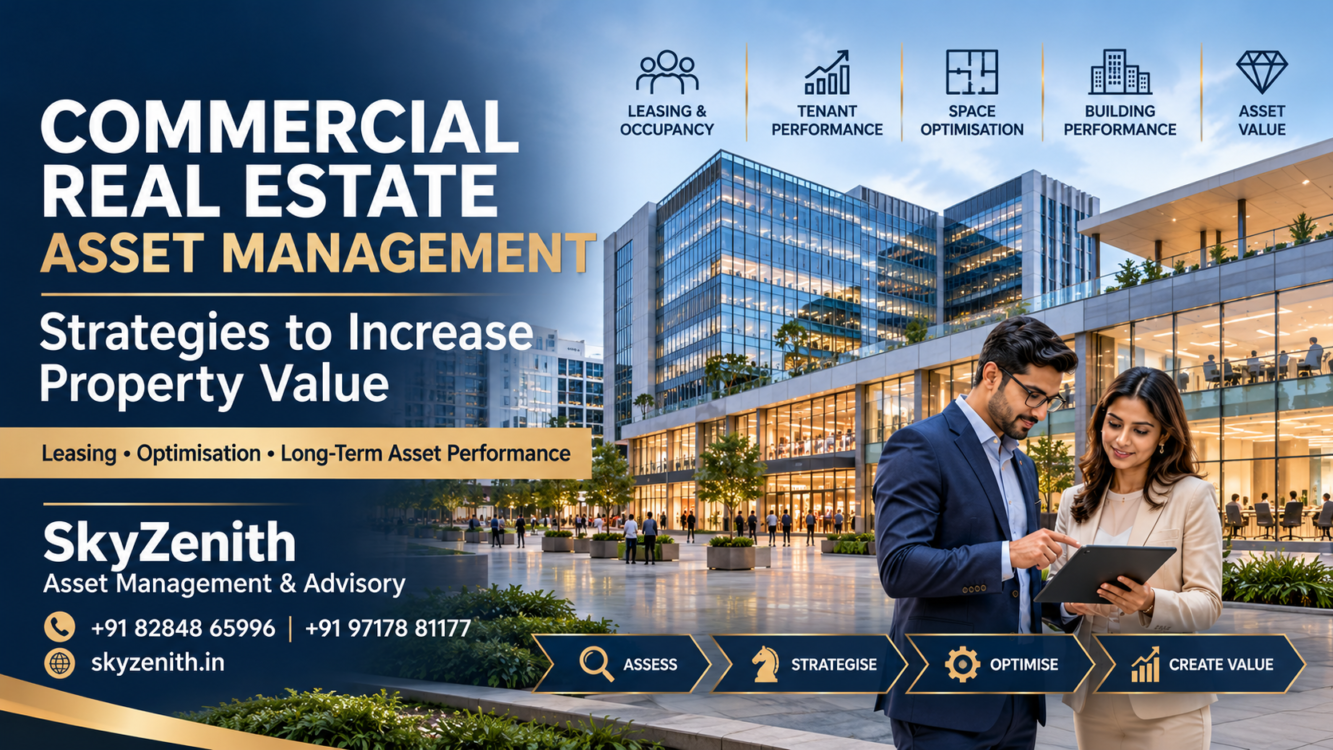
Commercial Real Estate Asset Management: Strategies to Increase Property Value
A commercial property is not valuable simply because it has a good location or a strong tenant.
Its real value depends on how effectively the asset is positioned, leased, operated, maintained and improved over time. This is the role of commercial real estate asset management.
For property owners, developers and investors, asset management provides a strategic framework for improving income, controlling risks, strengthening occupancy and protecting long-term property value.
India’s commercial real estate market continues to attract strong investment and occupier demand. In the first half of 2026, India’s real estate sector recorded USD 8.5 billion in equity capital inflows, the highest half-yearly figure recorded at that point, reflecting continued investor confidence in the sector.
In this environment, simply owning a commercial property is not enough. The quality of asset management can make a significant difference to long-term performance.
What Is Commercial Real Estate Asset Management?
Commercial real estate asset management is the strategic management of a property or portfolio with the objective of improving financial performance, operational efficiency, tenant relationships and long-term asset value.
It sits between ownership and day-to-day property operations.
While property management focuses heavily on the operational side of a building, asset management takes a broader view | leasing | revenue | tenant performance | market positioning | capital improvements | risk | customer experience | long-term investment value.
The objective is to understand how different decisions affect the asset as a whole.
Why Is Commercial Real Estate Asset Management Important?
Commercial properties operate in changing markets.
Rental expectations change, tenants expand or relocate, competing developments enter the market, customer behaviour evolves and infrastructure can transform the attractiveness of a location.
A property that performs strongly today cannot simply be left unchanged for the next five or ten years.
Professional commercial property asset management creates a continuous process of evaluating the asset and identifying opportunities for improvement.
This may involve reviewing leasing performance, analysing tenant requirements, assessing operating costs, improving space utilisation, planning capital expenditure and considering repositioning opportunities.
Leasing Strategy and Occupancy
Leasing is one of the strongest drivers of commercial property performance.
A vacant property can create a direct loss of income, but filling space with the wrong tenant may also create long-term problems.
An effective leasing strategy considers | tenant quality | lease duration | rental potential | tenant requirements | property positioning | market demand | future asset objectives.
India’s office market demonstrates how important active leasing strategy has become. CBRE reported record office absorption of approximately 66.4 million sq. ft. during the first nine months of 2026, while occupiers continued expanding their portfolios and prioritising high-quality locations.
For asset owners, this creates opportunities, but capturing them requires understanding what occupiers are looking for and how the property compares with competing assets.
Tenant Management and Long-Term Relationships
Strong tenant relationships are central to asset performance.
Commercial tenants are not simply sources of rental income. Their business performance can influence the attractiveness and reputation of the property.
For retail assets, tenant mix can influence customer traffic and overall destination positioning. For offices, the quality and stability of occupiers can contribute to the property’s market profile.
Asset management therefore considers tenant requirements, lease renewals, expansion opportunities, space changes and long-term relationships as part of the wider property strategy.
Improving Commercial Property Value
Increasing property value is not limited to increasing rent.
Value can also be created by improving occupancy, attracting stronger tenants, reducing inefficient costs, upgrading facilities, repositioning underperforming areas and improving the overall quality of the asset.
In some situations, relatively targeted improvements can make a property more competitive | better common areas | improved building systems | upgraded amenities | more efficient space planning | stronger sustainability performance.
The right investment depends on the asset’s market position and long-term objectives.
Market Research and Asset Performance Analysis
Successful asset management depends on information.
Owners need to understand what is happening within their property as well as outside it.
Market analysis can examine rental trends, competing developments, tenant demand, vacancy, customer behaviour, infrastructure changes and emerging commercial opportunities.
Performance analysis can then connect this market information with the property’s own results.
For example, if occupancy is declining, the issue may not simply be pricing. It could be outdated facilities, inefficient space, weak positioning, changing tenant requirements or increasing competition.
Identifying the underlying reason is essential before deciding on a solution.
Space Planning and Asset Optimisation
Commercial space should be evaluated according to how effectively it supports the property’s objectives.
Commercial space planning can help identify inefficient layouts, underutilised areas and opportunities for better space allocation.
For offices, this may involve workplace strategy, occupancy planning and flexible space requirements.
For retail assets, it may involve tenant zoning, customer movement and store configuration.
For mixed-use properties, different uses may need to be coordinated to create a stronger overall experience.
This makes space planning an important part of asset optimisation rather than simply an interior design exercise.
Sustainability and Building Performance
Sustainability is increasingly connected with commercial property strategy.
Energy efficiency, building performance, water management, indoor environmental quality and green certifications can influence operating costs as well as occupier preferences.
CBRE’s 2026 India office data indicates that green-certified buildings represented a substantial share of both new office supply and leasing activity, demonstrating the increasing importance of sustainability and quality in occupier decisions.
For asset owners, sustainability should therefore be considered alongside financial and operational planning.
Asset Management for Different Commercial Properties
The strategy can differ significantly depending on the asset.
For office properties, the focus may include leasing, workplace requirements, occupancy planning, amenities, connectivity and building quality.
For retail assets, tenant mix, customer experience, leasing, footfall and destination positioning become particularly important.
For mixed-use developments, the challenge is to coordinate different uses while creating a commercially coherent environment.
For hospitality assets, location, leasing structure, customer experience and operational considerations can influence long-term performance.
A professional asset management strategy should therefore be customised rather than based on a single formula.
How to Choose a Commercial Real Estate Asset Management Company
Choosing an asset management partner requires looking beyond routine property operations.
A strong commercial real estate asset management company should understand the relationship between market conditions and property performance.
Important capabilities include market research, asset strategy, leasing, retail asset management, location strategy, space planning, fit-out management, building audits, sustainability, tenant strategy and project management.
The most effective approach connects these capabilities rather than treating them as independent services.
SkyZenith: Integrated Commercial Real Estate Asset Management
SkyZenith Asset Management & Advisory works with developers, property owners, investors, brands and businesses across India.
Its capabilities include asset management, retail asset management, mall advisory, mall management, retail leasing, commercial leasing, hotel leasing, location strategy, fit-out management, occupancy and space planning, workplace strategy, design solutions, project management, smart buildings, building audits and sustainability services.
Its integrated advisory approach connects property strategy with leasing, market intelligence, space utilisation, operational considerations and long-term asset performance. This allows commercial properties to be evaluated not only according to their present condition but also according to their future potential.
The focus is on helping stakeholders make informed decisions around occupancy, tenant performance, property positioning, customer experience, operational efficiency and long-term value creation.
Contact SkyZenith
SkyZenith Asset Management & Advisory
Unit No. 908, 9th Floor, Tower 1, DLF Corporate Greens, Sector 74A, Sohna Road, Gurgaon, Haryana 122004
Email: Hemraj.dabur@skyzenith.in
Phone: +91 97178 81177
Website: skyzenith.in
Conclusion
Commercial real estate is a long-term asset, and its value can change significantly depending on how effectively it is managed.
Commercial real estate asset management in India brings together leasing, market intelligence, tenant strategy, space planning, building performance and investment thinking to create a more structured approach to property performance.
For owners and investors, the objective is not simply to maintain an asset. It is to continuously understand where value can be protected, improved and created.
In a competitive commercial real estate market, active and integrated asset management can become one of the most important tools for building stronger, more resilient and higher-performing properties.