-
Skyzenith
- April 11, 2026
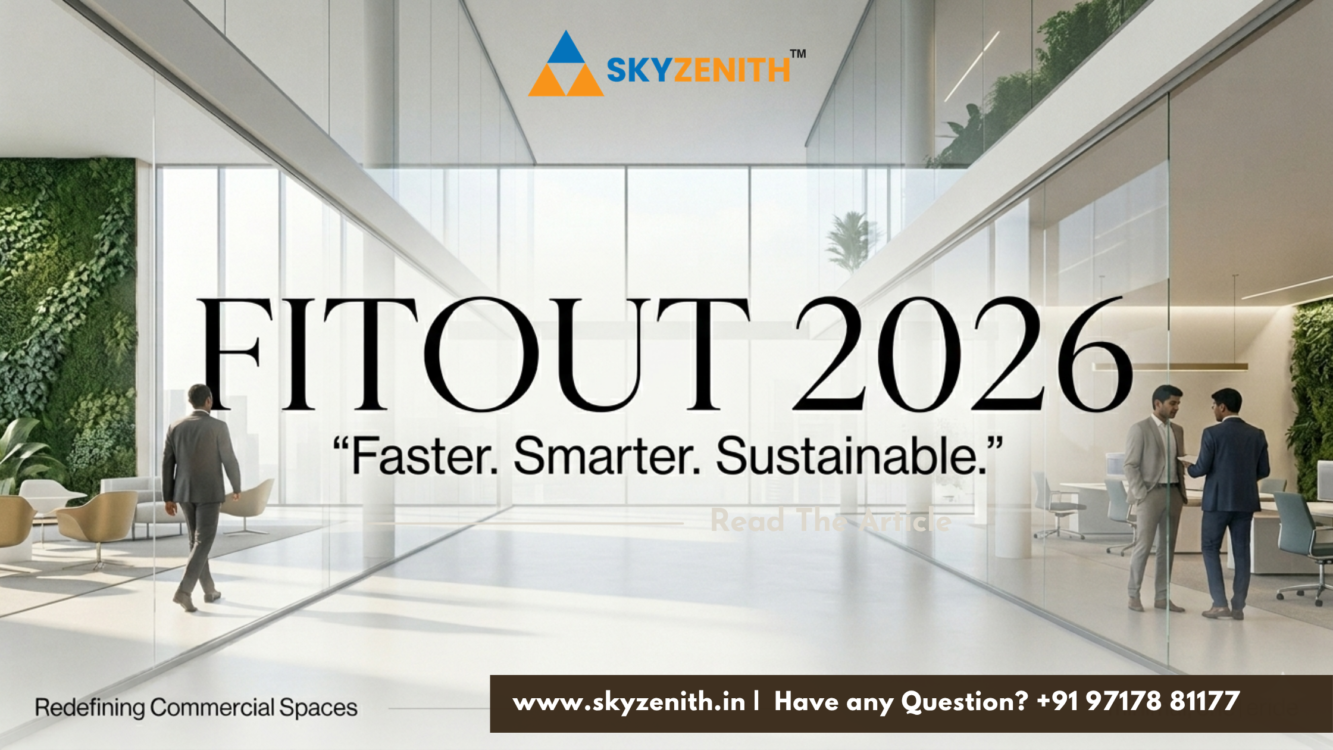
Fitout Management Trends for 2026: Faster, Smarter, and More Sustainable Transformations
The world of commercial interior fitouts is undergoing a quiet revolution. Gone are the days when transforming an empty shell into a functional workspace meant months of disruption, unpredictable budgets, and environmental indifference. As we look toward 2026, fitout management has evolved into a disciplined fusion of technology, psychology, and ecological responsibility. For businesses planning to renovate, expand, or relocate, understanding these emerging trends is no longer optional, it is the difference between a fitout that merely occupies space and one that actively drives performance.
The Acceleration Imperative: Why Speed Defines Fitout Success in 2026
Time has always been money, but in the post-pandemic commercial landscape, time has become something more: a competitive weapon. Organisations emerging from hybrid work models need agile spaces that adapt before market conditions shift again. The trend toward accelerated fitout timelines is not about cutting corners; it is about reimagining the entire delivery chain. Modular construction techniques, prefabricated building components manufactured off‑site and assembled on‑location, have reduced typical project schedules by thirty to forty percent.
Project managers now employ integrated digital platforms where architects, engineers, contractors, and clients collaborate in real time, eliminating the sequential bottlenecks that traditionally delayed decisions. Simultaneous engineering, designing structural, mechanical, electrical, and plumbing systems in parallel rather than in series, has become standard practice. What once took six months can now be achieved in twelve weeks without compromising quality. This acceleration, however, demands a fitout manager who understands not just construction but logistics, procurement, and risk mitigation at an orchestral level.
Smart Fitouts: Integrating Intelligent Building Ecosystems
The term “smart building” has moved beyond novelty into necessity. By 2026, a fitout that does not incorporate intelligent infrastructure will be considered functionally obsolete before the paint dries. Smart fitouts begin with the physical layer: sensor‑embedded flooring, adaptive lighting that responds to occupancy and natural daylight, and HVAC systems that learn usage patterns and self‑adjust for comfort and efficiency. But intelligence extends further into the digital realm.
Building Information Modeling, or BIM, has evolved from a design tool into a live operational dashboard. Post‑construction, the same BIM model used during fitout becomes a digital twin of the facility, allowing facility managers to monitor energy consumption, predict maintenance needs, and simulate reconfiguration scenarios without physical disruption. Workplace analytics platforms, integrated during the fitout phase, now provide granular data on space utilisation, which meeting rooms remain empty, which collaboration zones thrive, and where employees naturally gravitate. These insights inform future fitouts and allow businesses to right‑size their real estate footprint, eliminating wasted square footage and the associated operational costs.
Sustainable Transformations: Beyond Greenwashing to Regenerative Fitouts
Sustainability in fitout management has matured from a marketing afterthought to a core design principle. The 2026 approach is no longer merely about reducing harm, it is about creating positive environmental value. Regenerative fitouts prioritise materials with verified low embodied carbon, such as cross‑laminated timber, recycled steel, and bio‑based insulation. Circular economy principles guide every procurement decision: can this ceiling tile be reclaimed? Will this carpet tile manufacturer take back worn material for recycling? Is this workstation designed for disassembly and reconfiguration rather than landfill?
Waste diversion rates during fitout have become key performance indicators, with leading projects achieving over ninety percent diversion through meticulous sorting and partnerships with material recovery facilities. Low‑volatile organic compound paints, adhesives, and sealants protect indoor air quality, directly impacting occupant health and cognitive function. Perhaps most significantly, fitouts now routinely incorporate biophilic design elements living green walls, maximised daylight penetration, and natural ventilation strategies, not as aesthetic flourishes but as evidence‑based interventions proven to reduce stress and enhance productivity.
The Human‑Centric Fitout: Designing for Psychological Wellbeing
Technology and sustainability serve little purpose if the finished space does not support the people who inhabit it. The most profound trend in fitout management for 2026 is the deliberate shift toward human‑centric design. Acoustics, often overlooked, have taken centre stage. Fitouts now specify sound‑absorbing panels, acoustic ceiling clouds, and strategic zoning to create quiet focus areas separate from collaborative zones. Thermal comfort is personalised through zoned HVAC controls and adjustable personal diffusers.
Ergonomics has expanded from chairs and desks to include circadian lighting systems that shift colour temperature throughout the day, supporting natural sleep‑wake cycles and reducing eye strain. Neurodiversity‑inclusive design, providing quiet retreat rooms, non‑fluorescent lighting options, and wayfinding systems that reduce cognitive load, reflects a growing recognition that one design does not fit all. Fitout managers now conduct post‑occupancy evaluations using standardised wellbeing surveys, closing the feedback loop and continuously refining design standards.
The Financial Case for Advanced Fitout Management
For finance directors and business owners, the question is never just about trends, it is about return on investment. Accelerated fitouts reduce holding costs and allow revenue‑generating activities to commence earlier. Smart building integrations lower utility bills by twenty to thirty percent annually while predictive maintenance prevents costly emergency repairs. Sustainable materials, though sometimes carrying higher upfront costs, command higher asset valuations and attract environmentally conscious tenants or clients.
Human‑centric design reduces absenteeism and turnover while improving recruitment appeal in competitive talent markets. When these benefits are quantified over a typical five‑year lease cycle, the premium for professional, trend‑aligned fitout management yields a compelling internal rate of return that far exceeds conventional approaches.
Navigating the Complexities: The Role of Specialised Fitout Managers
Executing a fitout that simultaneously achieves speed, intelligence, sustainability, and human comfort is not a do‑it‑yourself endeavour. The complexity of coordinating modular manufacturing schedules, integrating IoT sensors into building management systems, sourcing certified low‑carbon materials, and applying evidence‑based design principles requires specialised expertise. Fitout managers have evolved from general contractors into strategic partners who translate business objectives into physical environments. They maintain curated supplier networks, stay current with evolving building codes and sustainability certifications, and assume contractual responsibility for timeline and budget adherence.
As we move through 2026, the organisations that thrive will be those that view their physical workspace not as a static expense but as a dynamic asset, continuously improved, data‑informed, and human‑validated. The fitout is no longer a one‑time project; it is the beginning of an ongoing relationship between people, place, and performance.
Address: Unit No. 908, 9th Floor, Tower 1 DLF Corporate Greens, Sector 74A Sohna Road, Gurgaon, Haryana 122004
Email: Hemraj.dabur@skyzenith.in
Phone: +91 97178 81177
SkyZenith delivers comprehensive fitout management services across commercial, retail, and hospitality sectors, specialising in accelerated project delivery, smart building integration, and sustainable transformation strategies. The company’s unique selling proposition lies in its integrated approach that combines construction expertise with workplace analytics and wellbeing design principles, ensuring every fitout achieves measurable improvements in operational efficiency, occupant satisfaction, and environmental performance. From initial space planning and material selection through to post‑occupancy evaluation, SkyZenith provides end‑to‑end project governance with transparent budgeting and fixed timelines, making advanced fitout management accessible to businesses seeking competitive advantage through their physical environments.