-
Skyzenith
- April 20, 2026
Mall Management in 2026: Trends, Technology, and Tenant Mix Strategies
The Quiet Revolution of the Indian Shopping Mall
Once upon a time, not very long ago, the Indian shopping mall was a temple of window shopping and weekend indulgence. Families would dress up, drive across the city, and spend hours wandering through fluorescent corridors, stopping for fast food and perhaps a movie. The mall was an experience in itself.
Then came the pandemic, and for nearly two years, those corridors fell silent. When the doors reopened, something had changed. The customer who returned was not the same as the one who had left. More demanding, more digital, more conscious of time and value. The mall as a mere collection of shops was no longer enough.
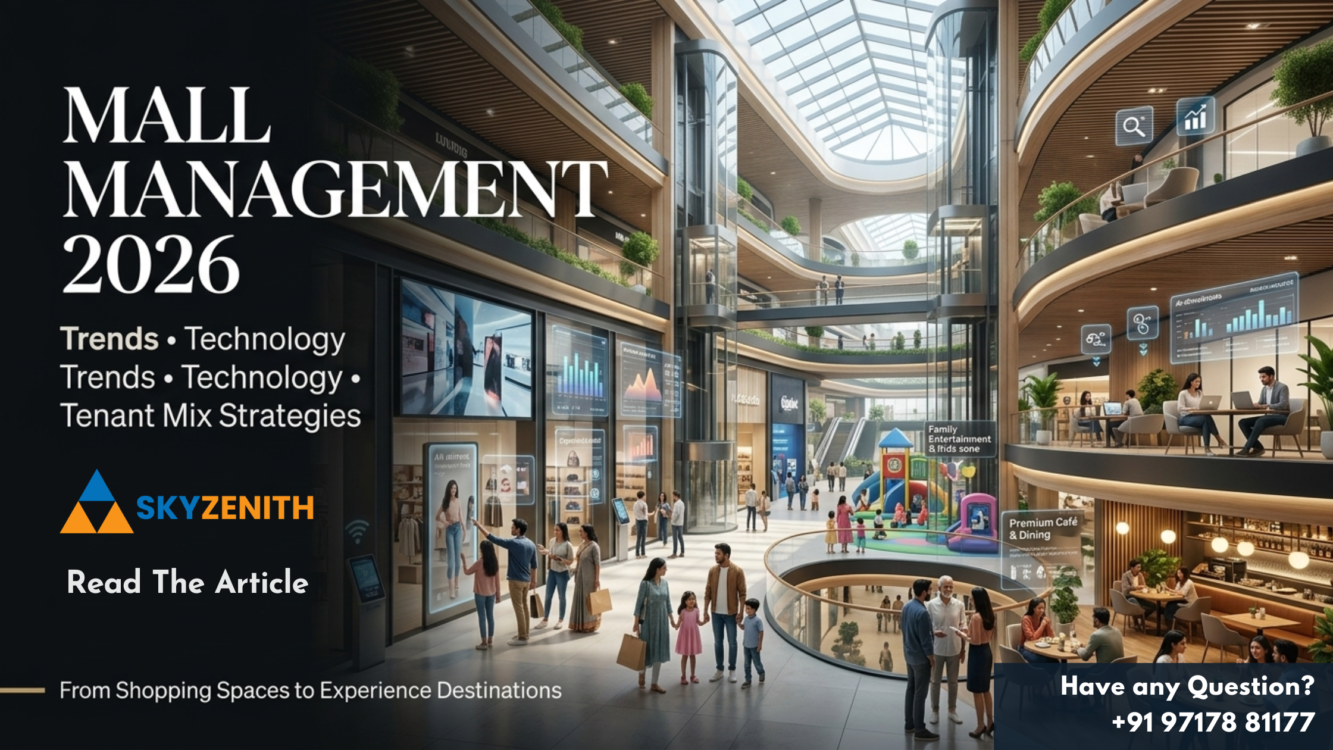
Today, as we navigate 2026, mall management has transformed from an operational back‑office function into a strategic discipline that blends retail science, experiential design, data analytics, and community building. The mall owners and managers who understand this shift are thriving. Those who do not are watching their footfall dwindle. This article explores the three pillars of modern mall management in 2026: emerging trends, transformative technology, and the art of tenant mix.
Trends Reshaping Mall Management in 2026
The Experience Economy Takes Centre Stage
The most significant trend driving mall management today is the primacy of experience over transaction. Online retail has captured convenience, speed, and price comparison. Physical retail can never win that battle. What it can offer is something the screen cannot: sensory immersion, human connection, and spontaneous joy.
Forward‑thinking mall managers are reimagining their properties as lifestyle destinations rather than shopping centres. This means dedicating substantial square footage to entertainment, dining, wellness, and cultural spaces. Indoor adventure parks, immersive art installations, live performance stages, cooking studios, and even co‑working lounges are becoming standard features. The goal is simple: give visitors a reason to come that cannot be fulfilled by a delivery app.
The Rise of the Hybrid Mall
Another powerful trend is the blurring of boundaries between retail, office, hospitality, and residential uses. The hybrid mall model integrates co‑working spaces, medical clinics, fitness centres, and even short‑stay apartments within the same complex. A visitor might drop off their child for a tuition class, attend a yoga session, have a business meeting in a shared office, shop for groceries, and then enjoy dinner with family all without moving their car.
This model creates multiple traffic drivers throughout the day and evening, smoothing out the traditional peaks and troughs of mall visitation. It also makes the mall a genuine community hub, not just a weekend destination.
Sustainability as a Non‑Negotiable
Indian consumers in 2026 are far more environmentally conscious than even five years ago. Mall management must now demonstrate genuine commitment to energy efficiency, water conservation, waste reduction, and sustainable sourcing. Solar panels, rainwater harvesting, EV charging stations, and zero‑waste initiatives are no longer optional add‑ons. They are expectations.
Moreover, sustainability has become a branding advantage. Malls that achieve green certifications and transparently communicate their environmental performance attract both premium tenants and discerning shoppers.
Technology Transforming Mall Operations
Data‑Driven Decision Making
The most revolutionary change in mall management over the past three years has been the mainstream adoption of data analytics. Sensors, Wi‑Fi tracking, camera analytics, and point‑of‑sale integration now provide real‑time visibility into every aspect of mall operations.
Managers can see exactly how many people enter, how long they stay, which zones attract the most traffic, and how movement patterns shift throughout the day and week. This data informs everything from cleaning schedules and security deployment to promotional planning and rent negotiations. A mall that knows its traffic patterns can charge premium rents for high‑visibility locations and justify those rents with hard numbers.
Smart Building Management Systems
Behind the scenes, Internet of Things (IoT) technology has transformed facility management. Smart HVAC systems adjust temperature and fresh air delivery based on real‑time occupancy. Predictive maintenance algorithms alert engineering teams before an elevator fails or a chiller trips. Lighting systems dim automatically in low‑traffic areas, saving substantial energy costs.
These systems not only reduce operational expenses but also enhance the visitor experience. No one notices when everything works perfectly, but everyone notices when the air conditioning is inadequate or the escalator is broken.
Contactless and Frictionless Experiences
The pandemic accelerated the adoption of contactless technology, and 2026 has seen its full maturation. Visitors expect to enter parking lots via automatic number plate recognition, navigate via digital directories on their phones, order food from food court kiosks, and pay without ever handing over a card or cash.
Mall management must ensure that these digital touchpoints are seamless, reliable, and secure. A broken payment gateway or a slow Wi‑Fi connection is no longer a minor annoyance; it is a reason for a customer not to return.
Tenant Mix Strategies for 2026
Beyond the Anchor Store Model
The traditional mall model relied on one or two large anchor department stores to draw traffic, surrounded by smaller specialty retailers. That model is crumbling. Department stores have struggled globally, and Indian consumers no longer see them as essential destinations.
Modern tenant mix strategy replaces the anchor concept with a portfolio of destination tenants, each drawing its own distinct audience. A premium gym, a gourmet supermarket, a multiplex cinema, a family entertainment centre, and a cluster of popular fast‑casual restaurants can collectively generate more footfall than any single anchor ever did.
Curated, Not Full
Another critical shift is the move from maximising occupancy to curating relevance. Empty space is expensive, but poorly chosen tenants are even more expensive. A vacant unit can be filled later with the right brand. A bad tenant one that does not align with the mall’s positioning, fails to generate traffic, or damages the overall ambiance can take years to remove and leave a lasting negative impression.
Successful mall managers in 2026 are ruthless curators. They reject tenants that do not fit the vision, even if it means temporarily higher vacancy. They actively recruit emerging direct‑to‑consumer brands that are expanding offline, pop‑up concepts that generate buzz, and local artisans that add authenticity.
Dynamic Leasing and Revenue Sharing
The leasing model itself is evolving. Fixed monthly rent remains common, but increasingly malls are adopting hybrid structures that include a percentage of sales or minimum guarantee with revenue sharing. This aligns the interests of mall and tenant: both succeed only when the customer buys.
Short‑term leases and pop‑up agreements have also become more prevalent, allowing malls to refresh their tenant mix frequently, test new concepts, and capitalise on seasonal trends. A Christmas market in December, a wedding exhibition in May, a back‑to‑school zone in June these temporary installations keep the mall feeling dynamic and new.
The Human Element: Why Great Management Still Matters
For all the technology and data, mall management remains fundamentally a people business. The best sensors and smart systems cannot replace a well‑trained security guard who greets every visitor with a smile, a cleaning staff that responds instantly to a spill, or a customer service desk that resolves complaints with genuine empathy.
In 2026, the malls that win are those that combine technological sophistication with operational excellence and authentic hospitality. They feel safe, clean, welcoming, and effortless. Visitors do not think about the management. They simply feel good being there.
Looking Ahead: The Mall of 2030
What comes next? The trends visible today point toward even greater integration of digital and physical retail. Augmented reality wayfinding, personalised offers pushed to shoppers’ phones based on their real‑time location, and seamless integration of online ordering with in‑mall pickup are already emerging.
We may also see the rise of the fully modular mall, where walls and fixtures can be reconfigured overnight to accommodate changing tenant needs. Sustainability will move from best practice to regulatory requirement, with strict penalties for energy waste.
For mall owners and managers, the message is clear. Adapt or become irrelevant. The consumer has moved on. It is time for the industry to catch up.
Conclusion
Mall management in 2026 is no longer about maintaining a building and collecting rent. It is about curating an ecosystem that delivers value to visitors, tenants, and investors simultaneously. It requires fluency in data analytics, skill in tenant curation, investment in smart technology, and a genuine commitment to sustainability and hospitality.
The Indian retail landscape is vast and growing. Organised retail penetration remains relatively low compared to mature markets, which means enormous opportunity lies ahead. But opportunity belongs to the prepared. Mall owners who embrace the trends, deploy the technology, and perfect their tenant mix strategies will write the success stories of the next decade. Those who do not will become case studies in decline.
SkyZenith
SkyZenith is a specialised facility and asset management firm dedicated to optimising the performance of commercial real estate, with particular expertise in mall management, retail environment operations, and mixed‑use property solutions. The company provides end‑to‑end services including integrated facility management, HVAC and electrical maintenance, security and housekeeping operations, tenant relationship management, energy efficiency audits, and sustainability consulting. SkyZenith distinguishes itself through a data‑driven approach that combines predictive maintenance technologies, real‑time performance monitoring, and customised operational strategies tailored to each property’s unique tenant mix and customer profile. With a proven track record of reducing operational costs while enhancing visitor satisfaction and tenant retention, SkyZenith serves as a trusted partner for mall owners seeking to navigate the complex demands of the 2026 retail environment. The company’s commitment to transparency, proactive communication, and continuous improvement ensures that every property under its management operates at peak efficiency and remains competitive in an increasingly experience‑driven marketplace.
Address: Unit No. 908, 9th Floor, Tower 1 DLF Corporate Greens, Sector 74A Sohna Road, Gurgaon, Haryana 122004
Email: Hemraj.dabur@skyzenith.in
Phone: +91 97178 81177