-
Skyzenith
- November 12, 2026
Mall Advisory Services in India: How to Improve Mall Performance
A shopping mall can have impressive architecture, strong brands and steady customer traffic, yet still fail to achieve its full commercial potential.
The problem is often not the property itself. It is the strategy behind the property.
Tenant mix, leasing, customer experience, catchment potential, space utilisation, operational efficiency and market positioning all influence how a mall performs as a commercial asset. When these elements are managed independently, opportunities can be missed and underperformance can continue unnoticed.
This is where mall advisory services in India play an important role.
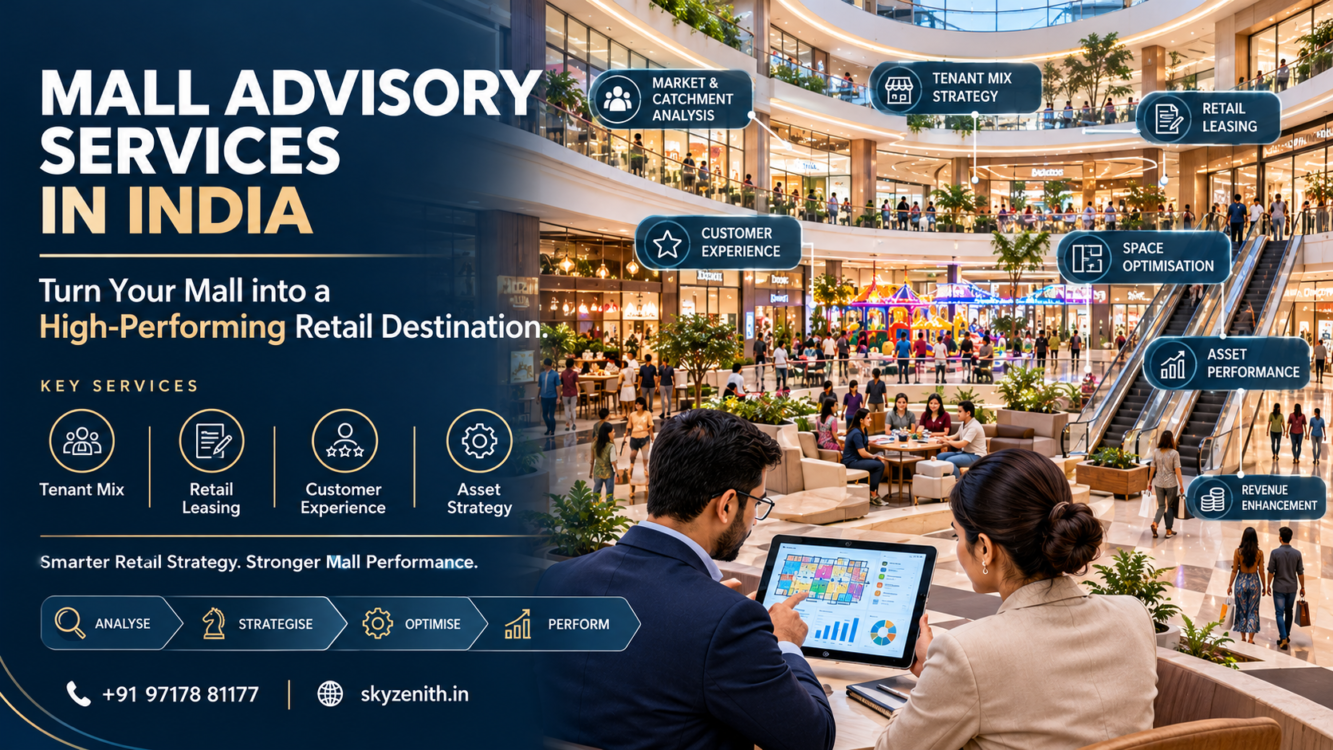
Mall advisory brings together market intelligence, retail strategy, leasing, tenant planning, customer experience and asset management to help developers, investors and property owners make better decisions throughout the lifecycle of a retail property.
As India’s retail market becomes increasingly experience-led and destination-focused, professional advisory is becoming an important part of building and repositioning successful malls.
What Are Mall Advisory Services?
Mall advisory services provide strategic guidance for the development, positioning, leasing, management, repositioning and performance improvement of shopping malls.
Unlike routine property management, advisory focuses on the bigger commercial questions:
- Is the mall positioned correctly for its market?
- Does the tenant mix match the catchment?
- Are the available spaces being used effectively?
- Is the leasing strategy attracting the right brands?
- Are customers spending enough time within the property?
- Which areas of the mall are underperforming?
- What changes can improve long-term asset value?
A good advisory strategy connects these questions rather than addressing each one separately.
Why Mall Advisory Is Important in India
India’s organized retail market is changing rapidly. Retailers are becoming more selective about location quality, customer profile, visibility, store economics and the overall experience offered by a retail destination.
Recent market activity also shows continued occupier demand for organized retail, while high-quality mall space remains relatively constrained in major markets.
For mall owners, this creates an important opportunity.
A well-positioned property can attract stronger brands and build a more valuable retail ecosystem. But achieving this requires more than simply filling vacant units.
It requires understanding the market before making commercial decisions.
Mall Market Research and Feasibility Analysis
The first question for any retail asset should be simple:
Who is the customer?
Mall advisory typically begins with a detailed understanding of the catchment area and competitive environment.
This may include analysis of:
- Population and demographics
- Household income
- Consumer spending patterns
- Existing retail destinations
- Competing malls and high streets
- Accessibility and connectivity
- Traffic and customer movement
- Brand demand
- Future development
- Category opportunities
This information helps determine whether the existing mall positioning is appropriate or whether the property requires a strategic shift.
For a new development, it can support decisions around product positioning, size, tenant categories and commercial feasibility.
For an existing mall, it can reveal gaps that may be limiting performance.
Tenant Mix Strategy for Shopping Malls
A mall can be fully occupied and still commercially underperform.
The reason is that occupancy is not the same as a successful tenant mix.
A strong tenant mix should create complementary customer journeys. Fashion, food and beverage, entertainment, lifestyle, beauty, electronics, services and anchor tenants can serve different customer requirements while contributing to overall footfall and dwell time.
Tenant mix planning should consider:
Catchment demand: What categories are customers actively looking for?
Brand positioning: Which brands fit the mall’s target audience?
Category balance: Are there too many similar retailers?
Store placement: Which brands should occupy high-visibility zones?
Customer movement: Does the tenant arrangement encourage exploration across the property?
Commercial performance: Can the proposed mix support sustainable rental and revenue potential?
This makes tenant mix optimization one of the most important components of professional mall advisory.
Mall Leasing Strategy and Occupancy Improvement
Leasing is at the heart of mall performance.
However, effective mall leasing is not simply about reducing vacancy as quickly as possible.
A strategic mall leasing strategy considers the long-term role of every retail unit.
Advisors can evaluate vacant and upcoming spaces based on category demand, brand expansion plans, rental potential, unit size, location and the existing tenant ecosystem.
The objective is to create a leasing plan that supports the mall’s positioning.
A fashion anchor, for example, may influence customer movement differently from a restaurant or entertainment operator. Similarly, placing complementary categories together can create stronger commercial zones.
Therefore, leasing strategy should be connected to tenant mix and overall mall positioning.
Mall Repositioning for Underperforming Assets
Not every mall needs to be rebuilt to improve performance.
Sometimes the opportunity lies in repositioning the existing asset.
A mall that was originally designed around traditional shopping may need stronger food, entertainment, lifestyle or experience-led offerings. Another property may need better zoning, improved circulation, refreshed common areas or a different brand strategy.
Mall repositioning may involve:
- Reviewing the existing tenant mix
- Identifying underperforming zones
- Reworking category distribution
- Attracting new anchor tenants
- Improving customer experience
- Revising leasing strategy
- Enhancing common areas
- Introducing experience-led destinations
- Improving marketing and activation
- Reviewing space utilisation
The right strategy depends on the reasons behind the property’s underperformance.
Customer Experience and Mall Performance
Modern customers are not visiting malls only to purchase products.
They are increasingly looking for convenience, entertainment, dining, social interaction and memorable experiences.
This means customer experience in shopping malls has become closely connected to commercial performance.
Advisory can examine the complete customer journey, including:
- Arrival and parking
- Entrance experience
- Wayfinding
- Vertical circulation
- Common areas
- Food and beverage zones
- Entertainment
- Events and activations
- Store visibility
- Cleanliness and ambience
- Digital engagement
A mall should make it easy for customers to discover, navigate and enjoy the destination.
Space Planning and Mall Zoning
Even a strong tenant mix can underperform if the physical arrangement is poorly planned.
Mall zoning determines how customers move through the property and how different categories interact.
Strategic space planning can help address issues such as:
- Dead zones
- Poor visibility
- Uneven footfall
- Underutilized areas
- Weak vertical movement
- Inefficient unit configurations
- Poor category adjacency
The goal is to align physical space with commercial strategy.
This is particularly important when repositioning an existing mall, where changes may need to be made within an established building rather than through complete redevelopment.
Mall Asset Performance and Revenue Enhancement
A mall is ultimately a commercial asset, so advisory must connect strategy with financial performance.
Performance analysis may consider:
- Occupancy
- Rental income
- Leasing velocity
- Tenant productivity
- Vacancy
- Operating costs
- Space utilisation
- Customer traffic
- Revenue opportunities
- Capital improvement requirements
This allows owners and investors to identify where value is being created and where it may be leaking.
Revenue enhancement does not necessarily mean increasing rents immediately. It may involve better tenant selection, stronger occupancy, improved category performance, additional monetisation opportunities or repositioning underutilized areas.
Mall Advisory for New Developments
Mall advisory is also valuable before construction begins.
For a new retail development, early strategic decisions can influence performance for many years.
Advisory may support:
- Market feasibility
- Catchment analysis
- Retail positioning
- Development planning
- Tenant mix strategy
- Anchor planning
- Zoning
- Space planning
- Leasing strategy
- Customer experience
- Design coordination
- Commercial viability
Making the right decisions at the planning stage can reduce the need for expensive corrections after the mall becomes operational.
How to Choose a Mall Advisory Company in India
Choosing a mall advisory company in India requires looking beyond a single service.
A capable advisory partner should understand the relationship between:
Market → Location → Customer → Tenant Mix → Leasing → Operations → Experience → Asset Value
The strongest approach combines commercial real estate knowledge with practical retail understanding.
Important capabilities include market research, tenant mix planning, retail leasing, asset management, space planning, customer experience, fit-out coordination, building audits, sustainability and long-term property strategy.
An advisory partner should also be able to adapt its approach to the specific market, asset type and commercial objectives of the client.
SkyZenith: Mall Advisory and Retail Asset Strategy
SkyZenith Asset Management & Advisory works with developers, property owners, investors, brands and businesses across retail and commercial real estate.
Its capabilities include mall advisory, mall management, retail asset management, retail leasing, commercial leasing, hotel leasing, location strategy, fit-out management, smart buildings, building audits, sustainability services, workplace strategy, occupancy and space planning, design solutions, project management and experience and club management.
The firm’s approach connects market understanding, commercial strategy and practical execution. This can help clients evaluate tenant mix, leasing opportunities, asset positioning, customer experience, operational considerations and long-term property value as interconnected parts of the same strategy.
Its key USP is an integrated advisory approach rather than treating leasing, asset management, fit-out, experience and property strategy as isolated activities. This allows retail and commercial assets to be evaluated from a broader perspective, with the objective of improving performance, positioning and long-term value.
Contact SkyZenith
SkyZenith Asset Management & Advisory
Unit No. 908, 9th Floor, Tower 1, DLF Corporate Greens, Sector 74A, Sohna Road, Gurgaon, Haryana 122004
Email: Hemraj.dabur@skyzenith.in
Phone: +91 97178 81177
Website: skyzenith.in
Conclusion
A successful mall is not created simply by filling retail space.
It is created by understanding the market, selecting the right tenants, designing a commercially effective customer journey and continuously adapting the asset to changing consumer and retailer requirements.
Mall advisory services in India provide the strategic framework to make those decisions with greater clarity.
For developers, owners and investors, the objective is ultimately the same: build or reposition retail assets that remain relevant to customers, attractive to brands and capable of generating sustainable long-term value.