-
Skyzenith
- November 14, 2026
Retail Asset Management in India: How to Maximize Property Value
Retail real estate can look successful from the outside while quietly losing value on the inside.
A shopping mall may have attractive architecture, high occupancy and well-known brands, yet its long-term performance can still suffer if tenants are poorly matched, leasing decisions are reactive, operating costs are uncontrolled or customer experience is declining.
This is where retail asset management in India becomes important.
Retail asset management is not simply about maintaining a commercial property. It is about understanding how every part of a retail asset contributes to revenue, occupancy, tenant performance, customer engagement and long-term property value.
As India’s organized retail sector becomes increasingly experience-led and strategically managed, property owners and investors need a more integrated approach to asset performance.
What Is Retail Asset Management?
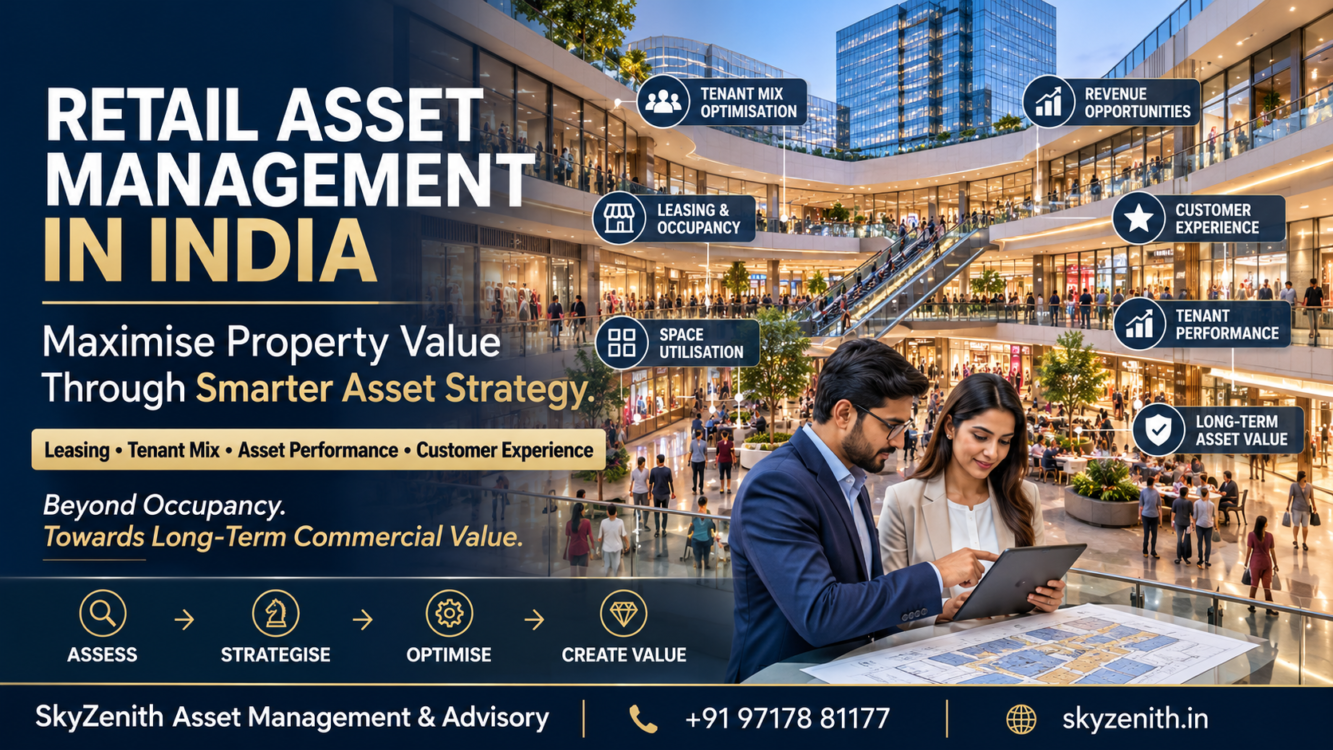
Retail asset management is the strategic management of a retail property with the objective of improving its financial performance, operational efficiency, tenant productivity and long-term market value.
It connects multiple areas of commercial real estate, including:
- Retail leasing
- Tenant mix planning
- Occupancy management
- Rental strategy
- Customer experience
- Marketing and promotions
- Property operations
- Market research
- Space planning
- Asset positioning
- Capital improvement planning
The objective is not simply to keep a property occupied.
The objective is to make the asset commercially stronger over time.
A property with high occupancy but weak tenant performance may not be as valuable as an asset with a carefully selected tenant mix, strong customer demand and sustainable rental potential.
Why Retail Asset Management Matters in India
India’s retail market is becoming more sophisticated. Retailers are increasingly evaluating locations based on visibility, catchment potential, customer demographics, footfall quality and the overall environment in which their stores operate.
Recent market data shows continued demand for organized retail environments, while fashion, food and beverage and entertainment remain important categories within retail leasing.
For property owners, this creates both opportunity and competition.
A retail asset must continuously answer important questions:
Is the tenant mix relevant to the target customer?
Are vacant spaces being leased strategically?
Are existing tenants performing well?
Is the property generating sufficient customer engagement?
Are operating costs aligned with asset performance?
Can the property create additional revenue opportunities?
These questions form the foundation of effective retail asset management.
Retail Leasing Strategy: More Than Occupancy
One of the biggest mistakes in retail property management is treating occupancy as the only measure of success.
Filling every available unit may improve occupancy statistics, but the wrong tenant can negatively affect the overall asset.
For example, placing several businesses from the same category next to each other may create unnecessary internal competition. Similarly, a tenant that does not match the property’s customer profile may generate limited footfall and reduce the commercial potential of its location.
A strong retail leasing strategy considers:
- Brand positioning
- Customer demographics
- Store category
- Catchment characteristics
- Rental potential
- Unit size and location
- Adjacency to other tenants
- Customer movement
- Expected tenant productivity
- Long-term asset positioning
The goal is to create a tenant ecosystem in which individual businesses support the wider performance of the property.
Tenant Mix Optimization and Property Value
Tenant mix is one of the most important components of retail asset management.
A successful retail destination generally needs a combination of categories that encourage customers to visit, stay longer and return regularly.
Fashion may attract one customer segment. Food and beverage can increase dwell time. Entertainment can create family visits. Lifestyle, beauty, electronics and essential categories can provide additional reasons to visit.
The right combination depends on the asset.
A premium urban mall may require a very different tenant mix from a neighborhood retail centre or a mixed-use commercial development.
This is why tenant mix optimization should be based on market research rather than assumptions.
How Customer Experience Influences Retail Asset Performance
Retail property value is closely connected to customer behaviour.
Customers do not experience a mall or retail asset as a collection of individual leased units. They experience the entire environment arrival, parking, navigation, store discovery, food options, entertainment, cleanliness, ambience and convenience.
A property that delivers a consistent customer experience can become more attractive to both shoppers and retailers.
This makes customer experience an important part of modern retail asset management services.
Retail owners may therefore need to evaluate:
- Customer movement patterns
- Wayfinding
- Common areas
- Food and entertainment zones
- Parking experience
- Events and promotions
- Digital engagement
- Dwell time
- Customer feedback
- Overall destination positioning
Improving these areas can support stronger tenant relationships and help differentiate the property from competing retail destinations.
Data and Market Research in Retail Asset Management
Modern retail decisions should not rely only on intuition.
Market intelligence can help property owners understand changing consumer preferences, competitor developments, retailer expansion plans and local demand patterns.
A professional retail asset management approach can evaluate data related to:
Catchment: Who lives, works and shops around the property?
Competition: What competing retail destinations are nearby?
Tenant performance: Which categories and stores are generating stronger engagement?
Vacancy: Which spaces remain vacant and why?
Customer behaviour: Where do visitors spend time and how do they move through the property?
Market demand: Which brands and categories are actively looking for space?
The purpose of this analysis is to convert information into better commercial decisions.
Improving Revenue Through Retail Asset Management
Maximizing property value does not always mean simply increasing rent.
Revenue improvement can involve multiple strategies, including better leasing structures, stronger tenant mix, improved occupancy, monetization of underutilized spaces, promotional opportunities and improved performance of existing tenants.
Other opportunities may include:
- Repositioning underperforming retail zones
- Improving visibility of selected units
- Introducing new categories
- Reconfiguring spaces
- Improving common areas
- Creating experience-led destinations
- Reviewing lease structures
- Identifying additional commercial opportunities
The right strategy depends on the asset’s current position and its long-term objectives.
Retail Asset Management and Long-Term Property Value
A retail asset should be viewed as a long-term investment rather than a collection of individual shops.
Every leasing decision, capital improvement, tenant change and customer experience initiative can influence future asset performance.
This is why retail asset management in India increasingly requires coordination between leasing, operations, market intelligence, customer experience and property strategy.
A short-term decision may improve today’s revenue but create challenges later. Conversely, a strategic investment in the right tenant category, experience zone or asset improvement may strengthen the property’s competitive position for years.
The strongest approach balances immediate commercial requirements with long-term value creation.
What Should Property Owners Look for in a Retail Asset Management Company?
Choosing a retail asset management company requires looking beyond basic property management capabilities.
A strong advisory partner should understand both the property and the market around it.
Important capabilities include:
- Retail market research
- Tenant mix strategy
- Retail leasing
- Asset performance analysis
- Location strategy
- Customer experience planning
- Space planning
- Fit-out management
- Operational understanding
- Sustainability and building audits
- Long-term commercial strategy
Most importantly, these functions should work together.
Retail asset management becomes more effective when leasing decisions are connected with location, customer behaviour, property operations and the wider commercial strategy.
SkyZenith: Integrated Retail Asset Management and Advisory
SkyZenith Asset Management & Advisory works with developers, property owners, investors, brands and businesses across retail and commercial real estate.
Its capabilities include retail asset management, mall management and advisory, retail leasing, commercial leasing, hotel leasing, location strategy, fit-out management, smart buildings, building audits, sustainability services, workplace strategy, occupancy and space planning, design solutions, project management and experience and club management.
The firm’s approach focuses on connecting strategic advisory with practical execution. Instead of treating leasing, asset performance, customer experience, fit-out and property strategy as separate activities, the objective is to evaluate the asset as a complete commercial ecosystem.
This integrated approach can help stakeholders identify opportunities to improve occupancy, tenant performance, customer engagement, operational efficiency and long-term property value.
Contact SkyZenith
SkyZenith Asset Management & Advisory
Unit No. 908, 9th Floor, Tower 1, DLF Corporate Greens, Sector 74A, Sohna Road, Gurgaon, Haryana 122004
Email: Hemraj.dabur@skyzenith.in
Phone: +91 97178 81177
Website: skyzenith.in
Conclusion
The future of retail real estate in India will not be determined simply by how much space a property owns.
It will increasingly depend on how effectively that space is positioned, leased, operated and continuously improved.
Retail asset management in India provides the framework for making those decisions strategically. By combining tenant mix, leasing, market intelligence, customer experience, operational planning and long-term asset strategy, property owners can move beyond occupancy and focus on sustainable commercial value.
A well-managed retail asset is not just a property that is occupied. It is an asset that remains relevant, productive and competitive as the market evolves.